
Share:

AI marketing & automation


AI Overviews sit on top of millions of Google search results and answer complex questions before users scroll. Google now monetizes that placement by inserting ads around and inside the AI box, yet offers advertisers limited visibility.
You do not get a new toggle called AI Overview placement. You get a different layout, new query patterns, and a reporting gap. This article explains how Google runs ads in AI Overviews, which campaigns qualify, how to measure performance, and how to connect this with your GEO and SEO strategy.
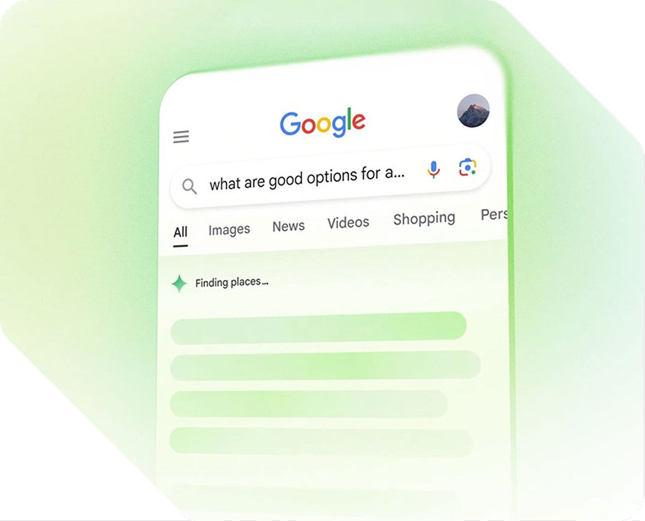
Ads in AI Overviews ride on the standard Google Ads auction. AI Overviews appear on complex, answer-seeking queries, and ads can show above, below, or inside the AI box when commercial intent and quality thresholds are met. You cannot force these placements, but you can design campaigns that are eligible when the surface appears.
AI Overviews now appear on a meaningful slice of searches. Munro Agency reports that in 2025 they showed on more than 30 percent of searches in English-speaking markets such as the US and UK. Google also announced plans to reach more than one billion users by the end of 2024.
Google documentation shows that AI Overviews trigger on questions where users compare options or solve multi-step problems. They appear less on short “buy now” terms and more on questions like “best CRM for startups using Google Workspace.”
Google Ads Help states that when AI Overviews appear, search and Performance Max campaigns can show ads above, inside, or below the AI box. The same auction logic applies, with ad rank driven by bid, relevance, and quality.
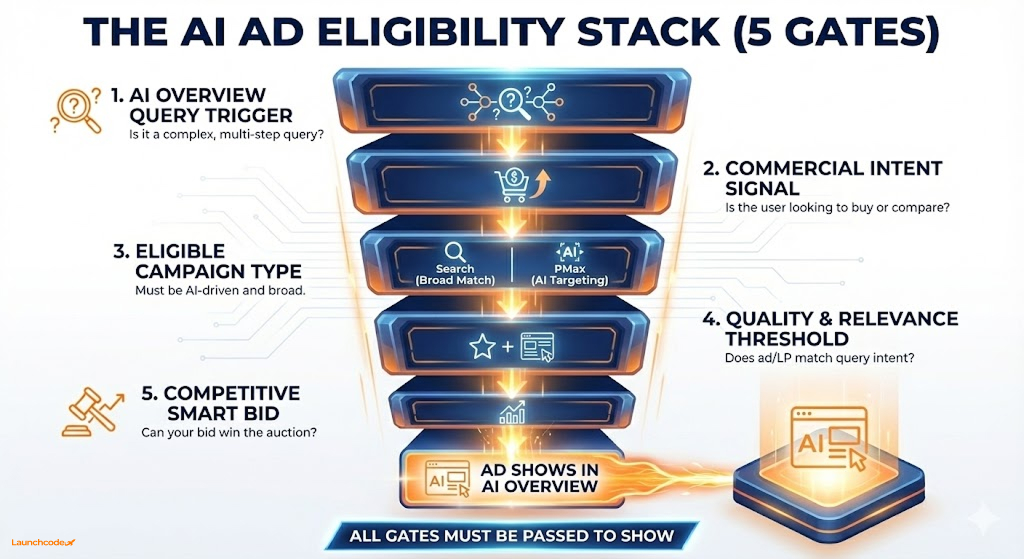
Think about eligibility as a stacked set of conditions:
Google VP Vidhya Srinivasan explains that Google can read informational queries and identify when connecting a user to a product is the logical next step. That is why ads appear even when the query starts as research, not purchase.
For advertisers, treat AI Overview impressions as upper and mid funnel traffic that still needs nurturing, clean targeting, and measurement beyond last click metrics.
Google can place ads above the AI Overview, inside the AI box, or below it next to organic listings. Most impressions show below the AI box, though a consistent share still appears above it, which preserves top-of-page visibility.
GrowByData tracked retail categories and found AI Overviews increased from 5.2 percent of SERPs in January 2025 to 13.5 percent in June 2025. In the same data, most ads appeared below the AI box, while 18 to 20 percent appeared above it.
Google documents three core placements:
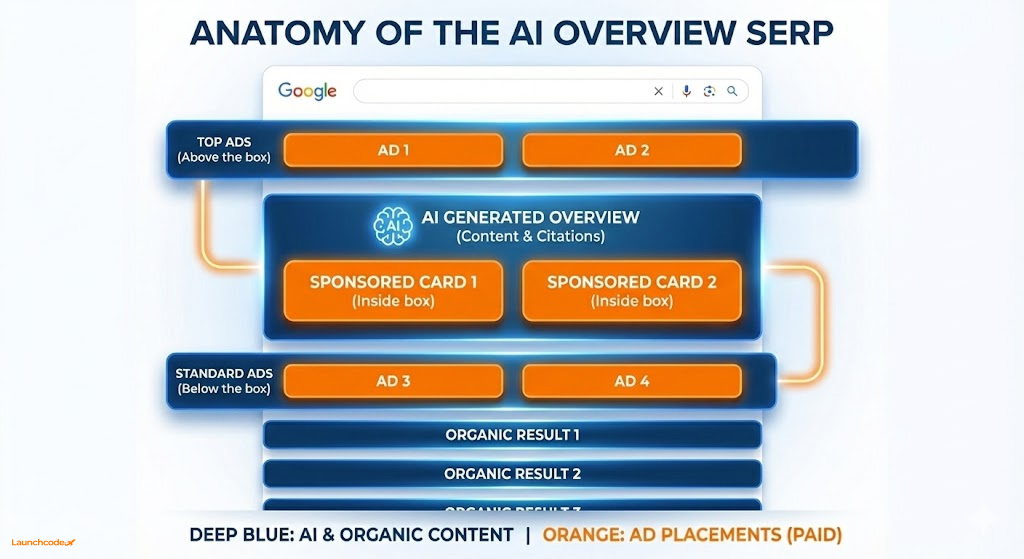
Several patterns show up across studies:
Users often read the AI answer first, skim cited sources, and only then scan ads and organic listings. Above box ads still get attention, but they compete with the AI response itself.
Practical implications for teams:
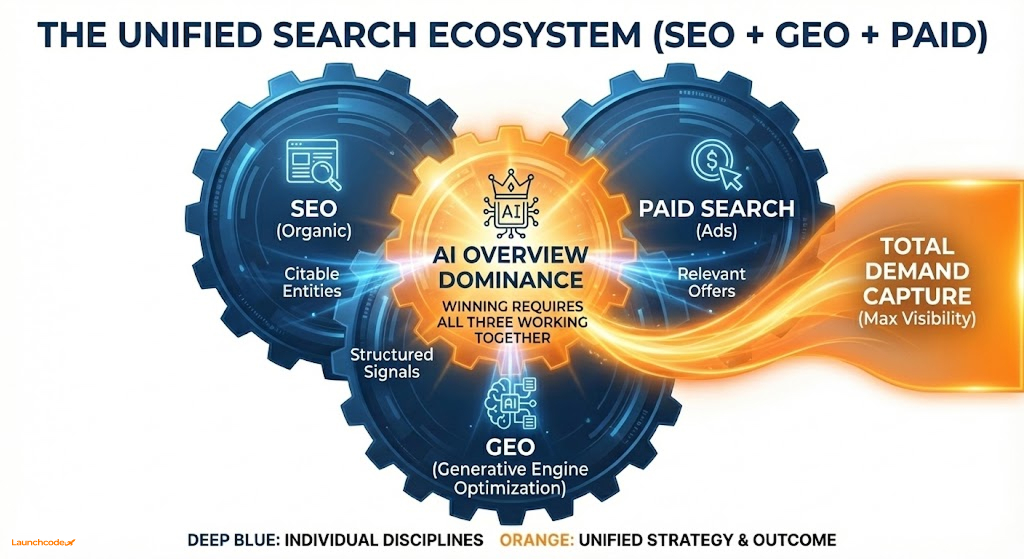
Tie this directly to your GEO and SEO work. If you already invest in AI SEO and local AI SEO, design paid programs that reinforce the same entity footprint.
There is no AI Overview checkbox in Google Ads. Eligibility flows through search and Performance Max campaigns that use AI-powered targeting, broad match, quality creative, and smart bidding. Accounts locked into exact match only and manual bidding typically see less AI Overview inventory.
Google Ads Help and agency analyses agree on the pattern. Ads in AI Overviews come from existing campaigns. Google also recommends AI-driven targeting, broad match, and automated bidding.
Here is a simple view of which campaigns matter.
| Campaign type | Who it fits | Key strength for AI Overviews | Watch out for |
|---|---|---|---|
| Standard search | B2B, service, niche queries | Strong keyword and copy control | Reduced reach without broad match |
| Performance Max | Ecommerce and scalable lead gen | Access to AI surfaces and automated allocation | Limited placement transparency |
| AI Max or new AI first types | Data mature teams | Designed for AI surfaces including AI Mode and AI Overviews | Early-stage behavior and low control |
Search plus Performance Max remains the practical core. AI-first campaign types will mature, but most advertisers need stronger governance before scaling them.
To increase eligibility, focus on:
“As client programs evolve, eligibility improves fastest when campaigns are structured around real questions users ask, not only brand or product names.”
Brittany Charles, SVP, Client Services
Launchcodex often maps client campaigns to AI Overview style queries, then introduces one or two test campaigns using broad match and smart bidding to learn safely.
Google does not break out AI Overview placements in Google Ads or Search Console. You will not see AI Overview as a row in your reports. To understand performance, combine SERP tracking, controlled experiments, and analytics segments tied to pages and queries that often trigger AI Overviews.
GrowByData highlights this reporting gap clearly. Google provides no placement-level metrics for AI Overviews. Search Console rolls AI Overviews and AI Mode into the standard Web search type.
That makes internal measurement more important, not less.
A practical framework looks like this:
The goal is to answer whether AI Overview friendly campaigns improve pipeline and revenue for affected queries, not to isolate every single click.
Imperva research cited by Lunio suggests bots represent more than half of internet traffic. New AI surfaces can change click quality.
Reduce risk by:
“For tests like this, we pair campaign changes with warehouse views so teams can see assisted revenue and not overreact to short-term click swings.”
Derick Do, Co-Founder and Chief Product Officer
AI Overviews compress the SERP, reduce organic clicks, and blur the lines between organic and paid. Winning means treating SEO, GEO, and paid search as one system that protects total demand, not separate channels that argue over attribution.
Studies cited by Lunio and Ahrefs show that when AI Overviews appear, clicks can drop by more than one-third. Italian publisher groups reported much larger drops on certain categories and raised concerns with regulators.
From a brand perspective, three shifts matter:
GEO focuses on making your entities and pages easy for models to cite. AI Overviews use similar signals.
That means:
This connects directly with local and multi-location strategies, where clean profiles and structured data support both GEO and paid performance.
You do not need a full budget shift. Instead:
Brands in restricted YMYL categories may not see AI Overview ad inventory at all. Here, the priority is understanding how AI Overviews rewrite snippets and how to earn citations through content quality and clarity.
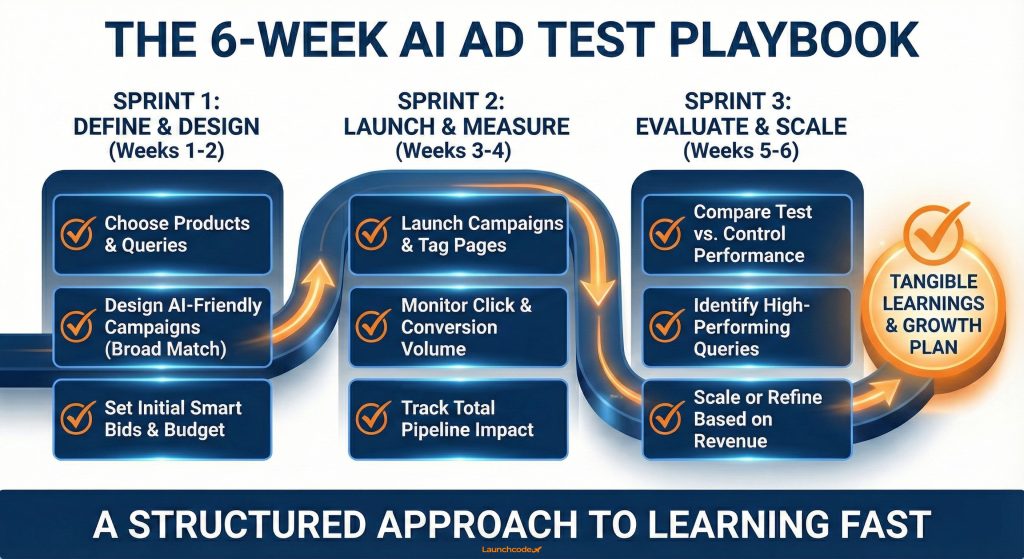
You can learn a lot with a focused six-week test. Target AI Overview queries, use smart bidding, and rely on controlled experiments. Define success before you launch and evaluate performance using total conversions and pipeline, not only clicks.
Here is a pragmatic test structure.
If Performance Max is already active, isolate one asset group for AI Overview themes.
If you have a data warehouse, push tags through to models so finance and analytics teams can review lift.
After four to six weeks:
This type of system first playbook helps teams learn fast while staying in control of spend and data.
AI Overviews will keep changing, and Google will keep experimenting with monetization. Durable advantage comes from systems that connect GEO, SEO, paid search, and data so you see how AI surfaces affect total demand and adjust with confidence.
Perfect visibility will not exist. Large advertisers will still work with incomplete data. The teams that succeed will build measurement models, experiment often, and align paid and organic decisions.
A sustainable approach includes:
If you already invest in AI SEO and GEO, AI Overview ads are not a separate program. They are another surface where your entities, offers, and proof must align with how users search and decide.
No. Ads in AI Overviews come from existing search and Performance Max campaigns. New formats such as AI Max are built for AI surfaces, but you can start by aligning current campaigns with AI Overview queries and using broad match with smart bidding.
Not today. Google does not provide separate placement metrics for AI Overviews. They count under standard search and Top Ads. To understand performance, rely on segments, experiments, and SERP tracking.
No. AI Overview ads are live in selected English-speaking markets. Sensitive YMYL categories, including some finance and healthcare topics, typically do not receive AI Overview ads.
Yes, in proportion to budget. Focus on identifying which queries in your market trigger AI Overviews, then ensure your search and Performance Max campaigns reach those users with clear content and strong tracking.



Real stories from the people we’ve partnered with to modernize and grow their marketing.