





UX and conversion design: How great design drives revenue
See how page speed, shorter forms, and trust signals lift conversion, with primary source data and a simple model to rank fi...





AI has changed how search engines assemble answers, but the foundations of SEO still decide whether you get found and trusted. The opportunity is not AI or SEO. It is AI plus SEO, used together in a way that speeds up research, sharpens information architecture, raises content quality, and improves measurement, while your team keeps judgment and accountability. This post shows where AI adds leverage, how to keep outputs safe, and a 90-day plan you can run with a small team.
Think of AI as an accelerator for the classic stack, not a replacement. It clusters queries into topics faster than a human, drafts briefs that follow your message architecture, spots technical patterns in large exports, and summarizes performance for leaders.
You still set the strategy, decide what to publish, validate claims, and measure outcomes. The goal is to build pages that rank and to become a source models cite inside AI overviews like the examples discussed in our guide on local AI SEO.
Ready to grow your organic traffic?
Get a free SEO audit from the Launchcodex team.
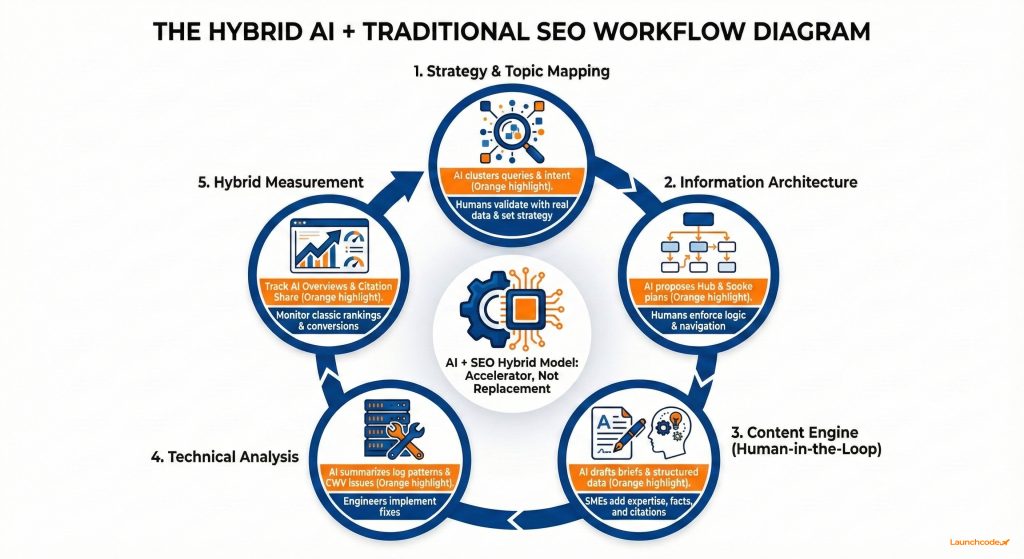
Use AI to sort large query lists into topics and intent in minutes. Then ground the clusters in your own data so you are not chasing noise. A good flow looks like this. Feed Search Console queries into an AI cluster, label with intent, map to entities buyers recognize, and validate with GA4 landing page performance.
You will end with a topical map that shows which clusters deserve a hub, which spokes are missing, and where internal links should flow.
“Cluster these queries into topics and subtopics. Label intent for each cluster. List common entities and three gaps we should cover. Return a table. Queries, {paste_list}.”
Traditional SEO wins when your site structure mirrors how buyers think. AI helps you propose a hub and spoke plan from your entity inventory, but the rules do not change. One hub per core entity. Spokes that answer specific questions, comparisons, and tasks. Navigation that reflects clusters.
Breadcrumbs that make hierarchy explicit. Cross-links that connect siblings naturally. When you ship this structure, click depth drops, clarity improves, and both rankings and AI citations trend up. This often works hand in hand with thoughtful web development practices.
Keep a single sheet with entity, hub URL, required spokes, related entities, and internal links in and out. Update it as new pages ship so the architecture stays intentional.
Crawl exports, Core Web Vitals reports, and server logs overwhelm teams. AI can summarize patterns quickly so you work on the right fixes first. Ask it to identify the templates that drive the biggest LCP or CLS issues, to group duplicate title clusters, and to highlight orphaned or redirecting URLs that break topical coverage. Engineers still implement changes, and you validate with Lighthouse, lab tests, and real user data.
“Review this CWV export. Identify templates with the largest LCP and CLS impact. Propose fixes, likely causes, and estimated effort. Data, {paste_rows_or_link}.”
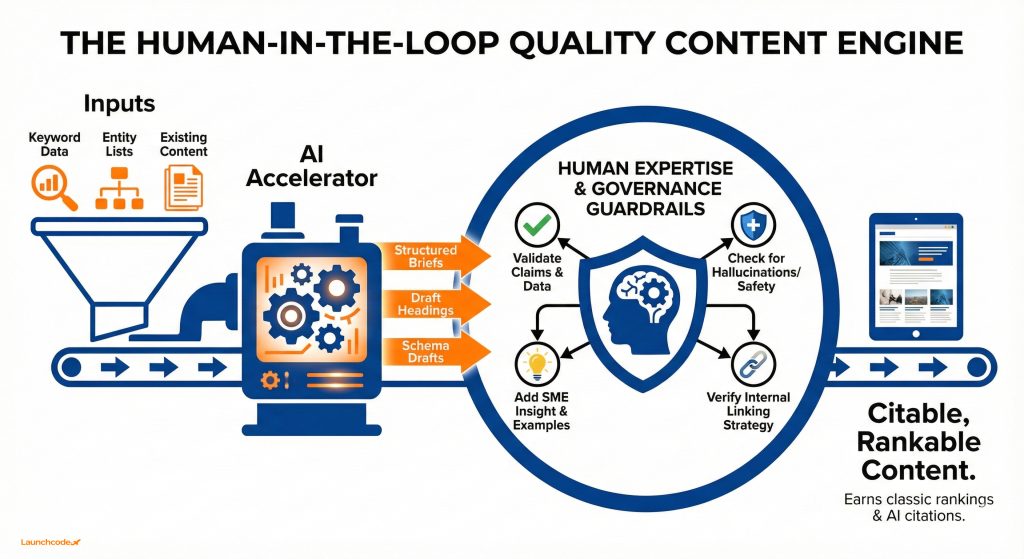
AI speeds research and first drafts. Expertise still carries the piece. The model can produce a structured brief with headings that mirror intent, a set of questions to answer, required citations, and internal link targets. A subject matter expert then fills the gaps, adds examples, and checks facts. The result is a citable article that earns rankings and citations.
Make citations mandatory for claims and numbers. Require a reviewer sign-off. Log sources and methods on evergreen pages. Keep schema consistent with what is on the page, not a wishlist.
“Create a content brief for the entity {entity}. Primary keyword {keyword}. Audience {persona}. Include headings, questions to answer, five reputable sources, internal link targets, and schema notes. Keep it factual and cite every claim.”
Internal links are not decoration. They are how you tell users and models what relates to what. Use AI to propose related reading blocks for each hub and spoke, then let an editor verify anchors and context. Add breadcrumb markup so hierarchy is machine readable. Protect hubs from stray links that dilute the topic. When links mirror meaning, session paths tighten and more visitors reach the right conversion page with fewer clicks.
“Given this hub and its spokes, propose related reading blocks and anchors that reduce click depth. Hub, {url}. Spokes, {list}. Return a table with from, to, anchor, reason.”
Schema makes your intent explicit. AI can draft JSON-LD for Organization, WebSite, WebPage, Article, Product or Service, and FAQ from a page outline. Keep humans in the loop to check fields against the on-page text, confirm IDs and URLs, and run validators. Consistency matters more than volume. Use the same names and canonicals across schema, titles, and H1s.
“Draft valid JSON-LD for Organization, WebSite, WebPage, and Article from this page outline. Use example.com for URLs and do not invent claims. Outline, {paste}.”
Link earning still matters. AI helps you find the angles that add something new. Ask it to summarize consensus and disagreements across trusted sources, then define a study, checklist, or guide that fills the gap. Publish methods and data, then pitch associations and vertical publishers. You will earn citations that help classic rankings and increase the odds your content is referenced in AI answers.
“Research {topic} using sources from {domains}. Summarize consensus in short paragraphs, list disagreements, propose three study or guide ideas that would add new value. Cite each claim.”
Leaders care about outcomes, not dashboards. Roll up metrics at the topic level and show what changed because of the work. Classic KPIs still apply, impressions, rankings distribution, CTR, qualified sessions, and conversions. Add AI era signals, monthly appearances in AI overviews for your target clusters, share of cited answers that reference your pages, and mentions of your brand or authors next to the entities you own. When you report both, investment decisions get easier.
Visibility from impressions and average position. Trust from AI appearances and citation share. Engagement from dwell time and return visits to hubs. Pipeline from assisted demos or orders linked to the cluster. Quality from schema validity and editorial error rate. Track all five monthly.
AI introduces new failure modes. Plan for them so trust holds.
A light QA sheet with checkboxes for citations present, schema valid, author review, and last updated date prevents most problems.
This plan assumes a small team and a normal publishing cadence. Adjust the scope to your capacity and stick to the rhythm.
Cluster Search Console queries with AI, validate with GA4, and select three topics to invest in. Create or confirm one hub per topic. Tighten navigation and breadcrumbs. Remove or redirect overlaps. Baseline topic metrics, both classic and AI era.
Publish or refresh one canonical guide per chosen topic. Add FAQ sections that answer real questions with citations. Implement schema for Organization, WebSite, WebPage, Article, BreadcrumbList, and FAQ where used. Plan and add related links between siblings.
Run an AI-assisted brief to outline two spokes per topic that target gaps. Experts draft and review. Publish weekly. Start a simple link earning program with one data or reference asset and three targeted outreach pitches to associations or trusted publishers.
Tune titles and intros on high impression, low CTR pages. Adjust internal links based on user paths. Add author pages with credentials and links to external profiles. Report AI overview appearances and citation share next to SEO KPIs. Kill tactics that do not move the numbers.
AI makes great SEO faster, but it does not replace the fundamentals. Strategy still starts with entities and buyers. Architecture still guides meaning. Content still earns trust when it is citable and reviewed.
What changes is your speed to insight, your consistency, and the quality of your measurement. Integrate AI into each layer of your SEO program with clear guardrails and you will win in classic SERPs and in AI answers.
Use AI to accelerate the classic SEO stack, not replace it. Let models cluster queries, draft briefs, spot technical patterns, and summarize results. Humans still set strategy, validate claims, write examples, and own outcomes.
Topical mapping from Search Console exports. Information architecture proposals from an entity list. First-pass content briefs and outlines. Technical triage from CWV and crawl data. Weekly reporting summaries with clear actions.
Strategy and prioritization. New messaging and claims with numbers. Expert review of drafts. Structured data validation. Executive summaries that shape decisions.
Require source retrieval from vetted domains or instruct the model to abstain. Make citations mandatory for all claims. Keep prompts and evaluation checks versioned. Sample outputs weekly with a QA checklist.
Report at the topic level. Pair classic KPIs, impressions, rankings, CTR, qualified sessions, conversions, with AI era signals, AI overview appearances and citation share by cluster, plus brand or author mentions next to target entities.
Feed the entity inventory to generate a hub and spoke proposal with URL patterns, breadcrumbs, and related links. Review anchors and hierarchy, then implement so click depth drops and context is clear.
Yes, keep a human in the loop. Use AI for briefs and first drafts. Experts add examples and methods, then cite sources. Do not publish model text without review. Add schema that matches on-page content.
It is when templates support a defined entity and link back to a hub with context. It fails when you flood the site with near-duplicate pages that compete with pillars. Quality controls and internal linking rules are non-negotiable.
AI can draft JSON-LD from an outline, but humans must verify fields, IDs, and URLs. Validate with official tools. Keep names and canonicals consistent across schema, titles, and H1s.
Days 1 to 14, cluster queries, pick three topics, fix navigation and duplicates. Days 15 to 30, publish or refresh one pillar per topic with FAQ and schema. Days 31 to 60, ship two spokes per topic with citations. Days 61 to 90, tune titles and links, complete author pages, and report AI overview and citation trends next to SEO KPIs.




See how page speed, shorter forms, and trust signals lift conversion, with primary source data and a simple model to rank fi...
Generative engine optimization (GEO), sometimes called AI SEO, works differently on each engine. Here's how retrieval works ...
OpenSEO is an open-source SEO platform built for AI agents. See how its MCP server works with Claude Code, what AI visibilit...