949.822.9583
support@launchcodex.com

ChatGPT ads and conversation targeting: What it means for privacy and brand safety

Last Date Updated:
January 19, 2026
Time to read clock
8 minute read
ChatGPT ads are planned to use conversation context to show relevant sponsored units while keeping chats private from advertisers. That changes how you target, measure, and protect trust. Treat this as contextual advertising, build sensitive topic and claim controls, and measure value through CRM quality since early reporting is expected to be aggregate.
ChatGPT ads and conversation targeting
Table of Contents
Primary Item (H2)
Build-operate-transferCo-buildJoint ventureVenture sprint
Ready for a free checkup?
Get a free business audit with actionable takeaways.
Start my free audit
Key takeaways (TL;DR)
Conversation targeting is contextual relevance based on what the user is discussing, not identity-level audience targeting.
Build a brand safety and disclosure workflow now, since sensitive topic exclusions and trust risk will shape what can run.
Assume aggregate reporting, then measure value in your CRM with qualified lead rules, pipeline tracking, and holdout tests.

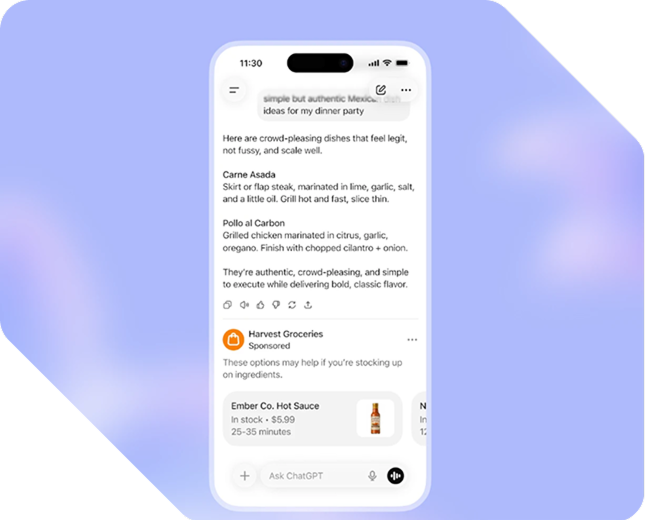
ChatGPT ads are moving from speculation to product testing. OpenAI says ads will be separate from answers, clearly labeled, and shown when there is a relevant sponsored product or service based on the current conversation.

If you run paid media, you need a plan that covers performance and trust. That means privacy safe measurement, clear creative rules, and brand safety gates that prevent sensitive adjacency and deceptive formatting.

What conversation targeting means in ChatGPT ads

Conversation targeting in ChatGPT is contextual matching, ads show when the current chat suggests a topic and intent, not because advertisers can read a user’s private conversation history or target them by identity. OpenAI says ads are labeled and separate from answers, and that conversations remain private from advertisers, which shifts the advantage to offer fit, landing page clarity, and measurement.

Ready to grow your organic traffic?

Get a free SEO audit from the Launchcodex team.

Book a Free Audit

Start with what OpenAI has committed to

OpenAI’s most direct statement is in its post on advertising and expanding access to ChatGPT. It states three practical constraints you should plan around:

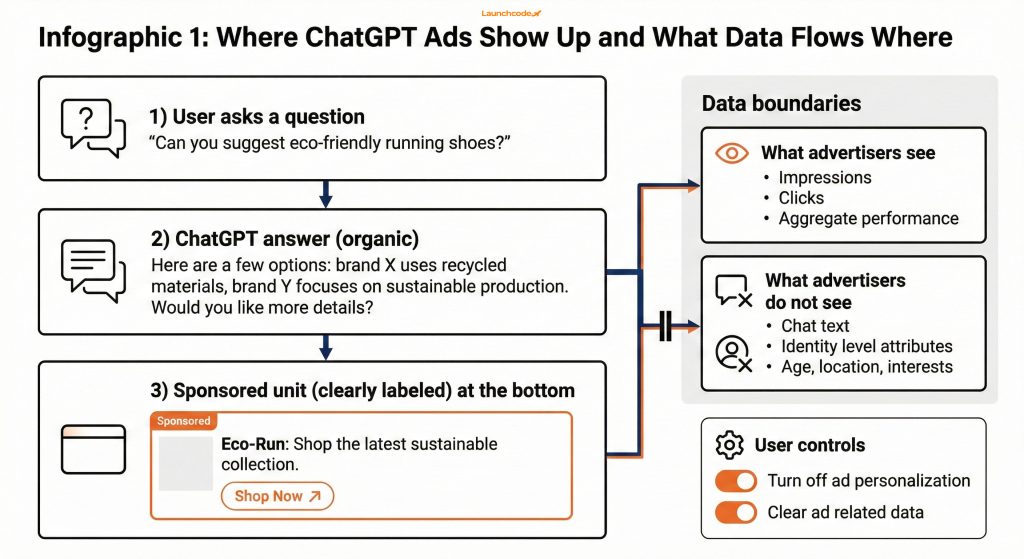
  • Ads stay separate from answers and are clearly labeled.
  • Advertisers do not get access to your conversations.
  • Users can control ad personalization and clear data used for ads.

Practical implication: you win by matching intent, not by targeting identity

In a contextual model, messaging and landing pages do more of the work than audience segments.

Use intent mapping to reduce mismatch:
  • Compare intent: lead with decision criteria and side by side options.
  • Validate intent: lead with proof, constraints, and implementation detail.
  • Act intent: lead with steps, pricing cues, and a low risk next step.
Where ChatGPT ads show up and what data flows where

What advertisers can and cannot measure

Expect measurement to look more like aggregate performance reporting than user level audience analytics, so you need to connect ad outcomes to CRM quality signals. Reporting coverage from WIRED says OpenAI indicated advertisers will not see user attributes like age, location, or interests, and will see aggregate metrics like impressions and clicks in early phases through WIRED’s reporting on how the ads will work.

Build a measurement plan that assumes limited user data

If you cannot rely on granular targeting, measurement becomes your control surface. Set up tracking so you can answer one question weekly: did this spend create qualified pipeline.

Minimum viable setup for early tests:

  1. Define one primary conversion per campaign
    • Demo request, purchase, quote request, consult booking
  2. Standardize UTMs across campaigns
    • Source, medium, campaign, and content
  3. Instrument clean events in GA4
    • Form submit, booking, key CTA click, purchase
  4. Push lead quality into the CRM
    • Qualified stage, meeting set, opportunity created, revenue
  5. Build a weekly view
    • Spend, clicks, conversion rate, qualified rate, pipeline created

Tools you will likely use: GA4, Google Tag Manager, server side tagging, and a CRM like HubSpot, Salesforce, or GoHighLevel.

“Treat aggregate reporting like a constraint, then design your instrumentation around outcomes you control, CRM stages, response time, and revenue events.”
Derick Do, Co-Founder and Chief Product Officer

Use simple holdouts to reduce false positives

Aggregate reporting can still support good decisions if you design your tests.

Use one of these checks:

  • Geo split
    • Run ads in one region, hold out a similar region
  • Time holdout
    • Two weeks on, one week off, compare quality adjusted leads
  • Matched list holdout
    • If supported, exclude a subset and compare lift

These methods will not answer every question. They will keep you from optimizing on noise.

How privacy and user controls change ad strategy

User controls reduce deterministic personalization, so your ad must be relevant on its own and your landing page must earn trust fast. If a user disables ad personalization, your results depend more on intent fit, proof, and a clear next step than on audience targeting.

Design creative that feels relevant without feeling invasive

Conversation targeting can feel helpful or creepy depending on tone.

Use these rules:

  • Speak to the problem, not the person.
    • “Reduce lead response time” beats “We noticed you need help.”
  • Avoid language that implies surveillance.
    • Do not reference prior chats or personal details.
  • Make the value obvious in the first line.
    • Outcome, timeline, cost, or risk reduction

Build trust at the top of the landing page

In a conversational product, users often arrive with high scrutiny.

Place these above the fold:

  • Clear offer and who it is for
  • Proof that matches the claim
    • Results, timelines, methodology, constraints
  • One low risk next step
    • Assessment, demo, trial, or quote

If you operate in regulated areas, document your internal rules and have counsel review.
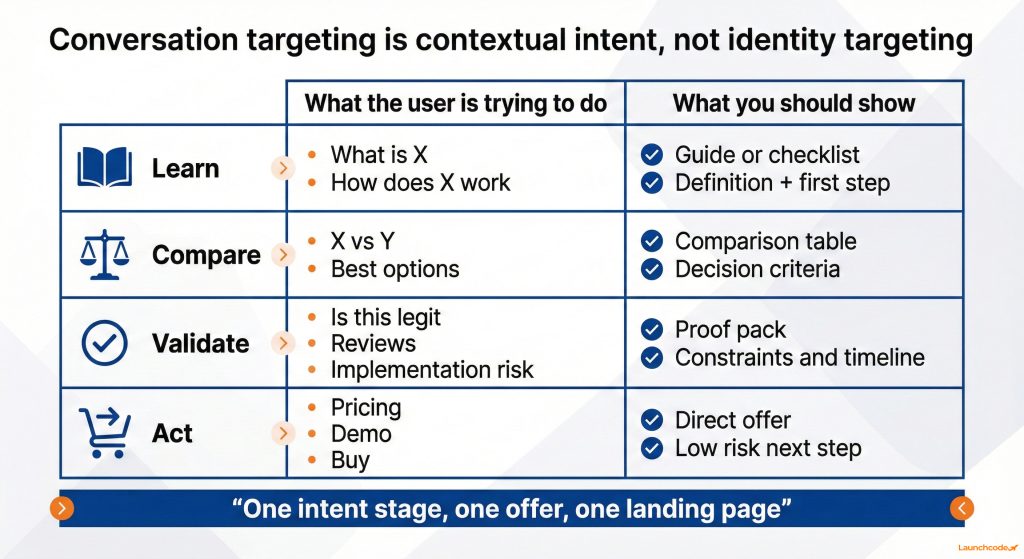
Conversation targeting equals intent mapping

Brand safety in conversational ads

Brand safety for ChatGPT ads starts with eligibility, sensitive topic exclusions, and claim standards, because trust risk is higher when ads appear alongside advice and decision making. Search Engine Land reports OpenAI plans to restrict ads for users under 18 and exclude sensitive or regulated topics like health, mental health, and politics in its coverage of OpenAI beginning to test ads inside ChatGPT.

Create a brand safety gate before you launch

Use a simple gate that marketing and legal can agree on.

  • Category eligibility
    • Confirm your category is not near restricted areas
  • Topic adjacency rules
    • Exclude prompts and themes that imply sensitive intent
  • Claim substantiation rules
    • Require proof for every quantitative claim
  • Landing page suitability review
    • Confirm tone, disclosures, and risk statements match your brand

If you already use brand suitability tools, map those policies to this surface. Your internal rules still matter in a new placement.

“Most delivery issues show up as lead quality problems first. If you do not define suitability, claims, and qualification up front, your reporting looks fine while pipeline gets worse.”
Brittany Charles, SVP, Client services

Risk and pitfall module: what breaks trust fast

  • Recommendation style language that looks like the assistant endorsed you
  • Over specific messaging that implies profiling
  • Claims without proof, especially on pricing, performance, or outcomes
  • Retargeting that feels aggressive after a single click

Disclosure and compliance basics for this surface

If an ad could be confused for a recommendation, disclosure needs to be clear and prominent, and your landing page must avoid deceptive formatting. The FTC’s native advertising guidance is a strong baseline for disclosure in Native Advertising: A Guide for Businesses.

A practical disclosure checklist for marketers

Use this checklist in creative and landing page review:

  • Confirm the ad is labeled as sponsored in the UI
  • Avoid copy that implies editorial endorsement
    • “Recommended” and “top pick” require proof and careful context
  • Place disclosures near the claim when the claim drives action
    • Pricing, testimonials, paid partnerships
  • Match claims to evidence on page
    • Show how results were achieved and what constraints apply

If you market to California residents, coordinate with your privacy team on opt out rights and signal handling using California CCPA guidance.

A practical operating model for privacy safe, brand safe testing

Treat ChatGPT ads like a high intent contextual channel, then standardize your workflow across targeting assumptions, measurement, and safety gates. Your goal is to learn fast without creating compliance risk or trust damage.

The readiness framework you can implement this month

  1. Define intent stages and map them to offers
    • Learn, compare, validate, act
  2. Build landing pages per intent
    • One primary CTA per page
  3. Instrument measurement end to end
    • GA4 events, CRM stages, pipeline outcomes
  4. Establish brand safety and disclosure gates
    • Eligibility, adjacency, claim proof, page review
  5. Run small tests with holdouts
    • Geo or time holdouts, weekly quality reporting

Example module: how a B2B team avoids creepy targeting

Scenario: A SaaS company wants to reach teams researching CRM automation.

Bad approach:

  • Ad copy implies surveillance, like “We saw you asking about your pipeline problems.”

Better approach:

  • Ad copy stays contextual, like “Automate lead routing and follow up, see a 14 day implementation plan.”
  • Landing page shows a process, timeline, and constraints.
  • CRM tracks qualified stage and opportunity creation, not only form fills.

Build trust while you build performance signals

Scale comes from trust plus clean measurement, not aggressive targeting. If you map intent to offers, instrument CRM quality, and enforce suitability and disclosure gates, you can test ChatGPT ads without creating avoidable risk. Use your AI ad learnings elsewhere as a comparison point, including how Google runs ads in AI Overviews, then apply the same rule here: relevance and transparency drive better outcomes than precision targeting claims.

FAQ

Are ChatGPT ads targeted using my personal data?

OpenAI says it keeps conversations private from advertisers and does not sell user data to advertisers. Early plans describe relevance based on the current conversation, plus user controls for ad personalization.

Can advertisers read my ChatGPT conversations?

OpenAI says conversations remain private from advertisers. Ads are selected based on relevance signals, but advertisers do not receive your chat content.

Where do ChatGPT ads show up?

OpenAI says ads will be separate from answers and clearly labeled, and it plans to test ads at the bottom of answers when there is a relevant sponsored product or service based on the current conversation.

What should marketers do first to stay brand safe?

Set eligibility rules, sensitive topic exclusions, and claim substantiation standards. Then review landing pages for disclosures, proof, and tone before running spend.

How should marketers measure performance if reporting is aggregate?

Use GA4 and CRM tracking to measure qualified lead rate, opportunity creation, and pipeline. Add holdout tests, such as geo splits or time holdouts, to estimate lift.

Launchcodex author image - Derick Do
— About the author
Derick Do
- Co-Founder & Chief Product Officer
Derick leads product and AI innovation at Launchcodex. He focuses on building scalable systems that automate workflows and turn strategy into measurable outcomes. He bridges technical thinking with real business impact.
Launchcodex blog spaceship

Join the Launchcodex newsletter

Practical, AI-first marketing tactics, playbooks, and case lessons in one short weekly email.

Weekly newsletter only. No spam, unsubscribe at any time.
Envelopes

Explore more insights

Real stories from the people we’ve partnered with to modernize and grow their marketing.
View all blogs

Move the numbers that matter

Bring your challenge, we will map quick wins for traffic, conversion, pipeline, and ROI.

Get your free audit today

Marketing
Dev
AI & data
Creative
Let's talk
Full Service Digital and AI Agency
We are a digital agency that blends strategy, digital marketing, creative, development, and AI to help brands grow smarter and faster.
Contact Us
Launchcodex
3857 Birch St #3384 Newport Beach, CA 92660
(949) 822 9583
support@launchcodex.com
Follow Us
© 2026 Launchcodex All Rights Reserved
crossmenuarrow-right linkedin facebook pinterest youtube rss twitter instagram facebook-blank rss-blank linkedin-blank pinterest youtube twitter instagram