


Share:

AI marketing & automation


Before a patient sends you a consultation request, they have already made a decision. They searched, read reviews, compared ratings, and formed an opinion about your practice based on what other people said. That process happens without you. What you control is the raw material: the volume, recency, and quality of your review profile across the platforms where patients look.
This guide builds a complete reputation management system for plastic surgery practices. It covers the revenue impact of your star rating, which platforms matter most for cosmetic surgery, how to generate reviews at scale without FTC exposure, how to respond without HIPAA risk, and how your review content now determines whether AI-powered search tools recommend your practice or a competitor’s.
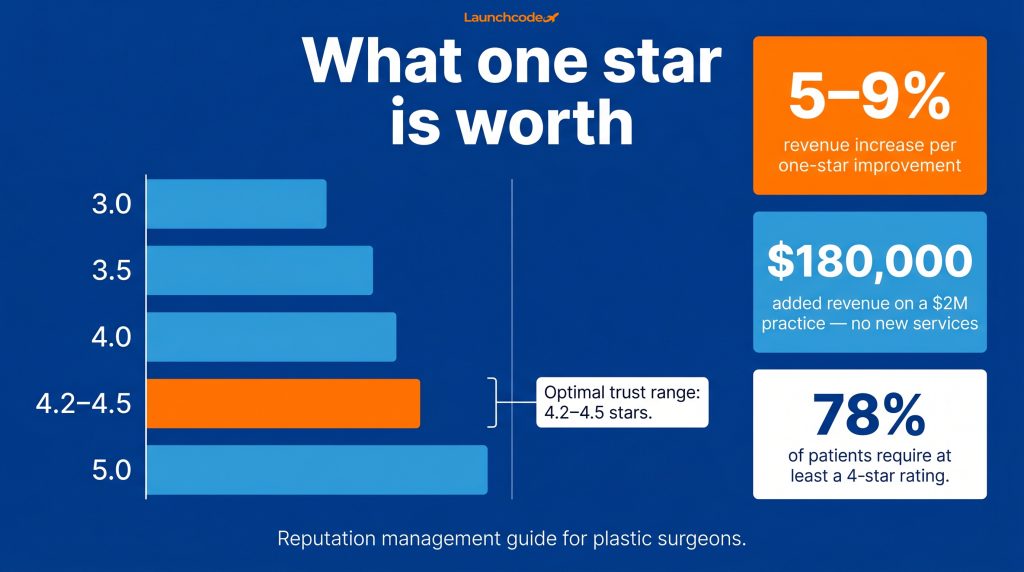
Your star rating has a direct dollar value. Harvard Business School research by Professor Michael Luca found that a one-star increase in rating produces a 5 to 9 percent increase in revenue for independent service businesses. For a plastic surgery practice generating $2 million annually, moving from 3.8 to 4.8 stars represents up to $180,000 in additional revenue without changing a single service, procedure, or staffing cost.
Most practices treat reputation management as a branding activity. The data frames it differently. Your rating is a revenue variable, and every point of improvement carries a measurable output.
Patient behavior confirms this. According to rater8’s How Patients Choose Their Doctors report, 84% of patients check online reviews before choosing a healthcare provider. 51% read at least six reviews before making a care decision. And 40% have canceled an appointment or changed providers entirely after reading negative reviews. That final figure is the clearest signal: a weak or thin review profile costs practices real revenue.
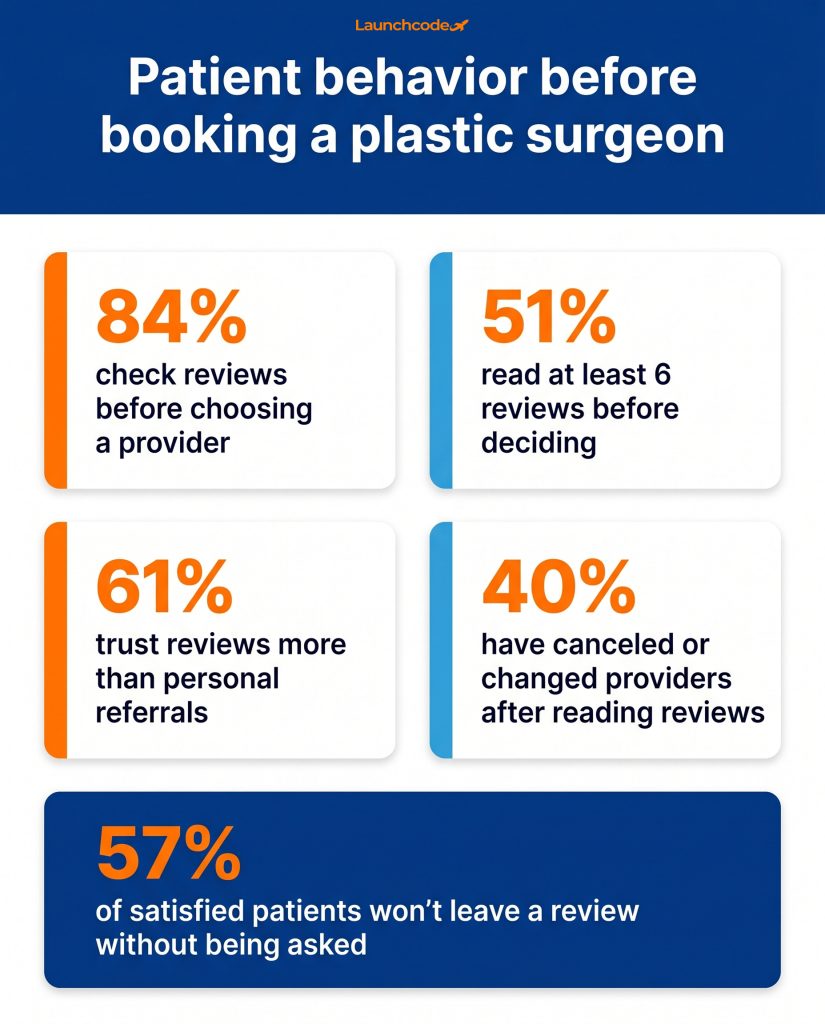
The assumption that plastic surgery practices grow primarily on personal referrals is outdated. The same rater8 survey found that 61% of patients trust online reviews more than personal referrals when choosing a healthcare provider. A patient who hears your name from a trusted friend will still search your reviews before calling. A 3.6-star average with no recent activity ends that referral before it converts.
Practices that build strong review profiles build an acquisition channel that compounds. More reviews drive better search visibility. Better visibility drives more consultations. More consultations generate more reviews.
Not all star ratings perform equally. Research from Northwestern University’s Spiegel Research Center shows the optimal trust range is 4.2 to 4.5 stars. A perfect 5.0 often signals too few reviews to feel credible. At the same time, RepuGen’s 2025 Patient Review Survey found that 78% of patients will only consider providers with at least a four-star rating. Falling below that threshold means the majority of your potential patients screen you out before reading a single word about your practice. The goal is a defensible rating in the 4.2 to 4.5 range, supported by consistent volume and recent activity.
Google Business Profile is the highest priority for discovery and search visibility. RealSelf is the highest priority for high-consideration procedure research. Healthgrades and secondary directories matter for AI crawling and directory coverage. Yelp has general reach but produces the lowest average ratings in the specialty. Focus where your target patients are actively researching, at the stage of the decision that matters most.
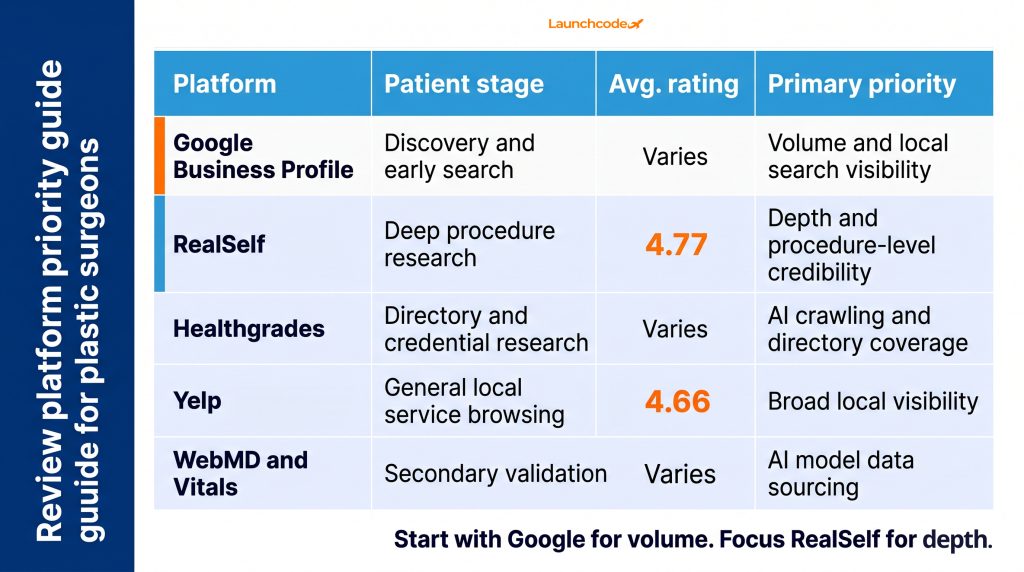
Each platform attracts a different patient at a different stage of the journey. Understanding that distinction drives better prioritization.
| Platform | Patient stage | Avg. rating in cosmetic surgery | Primary priority |
|---|---|---|---|
| Google Business Profile | Discovery and early search | Varies by practice | Volume and local search visibility |
| RealSelf | Deep procedure research | 4.77 (Oxford Academic) | Depth and procedure-level credibility |
| Healthgrades | Directory and credential research | Varies | AI crawling and directory coverage |
| Yelp | General local service browsing | 4.66 (Oxford Academic) | Broad local visibility |
| WebMD and Vitals | Secondary validation | Varies | AI model data sourcing |
When someone searches “rhinoplasty surgeon near me,” Google’s local results pull from review volume, rating, and recency on your Google Business Profile. That same profile data feeds directly into Google’s AI Overviews. A profile with consistent new reviews and complete procedure information outranks competitors in both traditional local results and AI-generated summaries. Google is where you build volume.
An Oxford Academic analysis of 11,078 plastic surgery reviews found RealSelf users write longer and more detailed reviews than users on general platforms, with a higher average rating (4.77) than any other platform in the study. A surgeon with 40 detailed RealSelf reviews discussing specific procedures and recovery outcomes will often outperform a competitor with 200 generic Google reviews when a patient is seriously evaluating a breast augmentation or facelift. RealSelf is where you build credibility depth.
The biggest obstacle to a strong review profile is not unhappy patients. It is the silence of satisfied ones. According to rater8’s 2025 survey, 57% of satisfied patients do not leave feedback without a direct request. Reviews do not accumulate passively. They require a structured ask, at the right moment, through the right channel. BrightLocal’s Local Consumer Review Survey 2026 found that 83% of people asked to leave a review went on to leave one. The ask works. Most practices do not make it systematically.
“The practices generating the most reviews aren’t asking more often. They’re asking at the right moment. The seven-to-fourteen-day post-procedure window is the sweet spot. Satisfaction is high, the experience is fresh, and patients are far more likely to write something detailed and specific.” – Brittany Charles, SVP Client Services
The FTC Consumer Review Rule, which took effect on October 21, 2024, prohibits offering any reward in exchange for a review that expresses a specific sentiment. Asking for an honest review is permitted. Tying a discount, free service, or gift to a five-star review is not. Civil penalties reach up to $53,088 per violation. The FTC issued its first enforcement sweep under this rule in December 2025, sending warning letters to ten companies with potential violations. Review incentive programs that blur the line between requesting and conditioning are a liability.
Every review, positive or negative, deserves a response. HIPAA creates a firm constraint: you cannot confirm or deny that a reviewer is your patient, and you cannot reference any clinical detail, even if the patient mentioned it first. A response that acknowledges the reviewer’s procedure, health status, or outcome creates protected health information (PHI) exposure in a public forum. The right response acknowledges the feedback without confirming the relationship.
A well-crafted, HIPAA-compliant response builds trust with every prospective patient who reads the exchange.
A non-compliant response to a negative review:
“We are sorry to hear about your rhinoplasty recovery experience. We take all post-operative concerns seriously and would love to schedule a follow-up.”
That response confirms the reviewer’s procedure and their patient status. It violates HIPAA.
A compliant response:
“We take all feedback seriously and genuinely care about everyone who considers or visits our practice. We would welcome the chance to learn more about your experience. Please reach out to our office directly so we can address your concerns.”
That response acknowledges the feedback, invites offline conversation, and reveals nothing about the reviewer’s clinical relationship with the practice. It reads as responsive and professional to every prospective patient who sees it.
“The most common HIPAA mistake we see in review responses is specificity. A practice tries to show it cares by acknowledging what went wrong, and in doing so, it confirms the patient relationship and references clinical details. Being warm and being specific are two different things.” – Brittany Charles, SVP Client Services
The American Medical Association advises physicians to treat review responses as formal communications. For practices with high review volume or complex complaints, a periodic compliance review with legal counsel protects against exposure that generic response templates can miss.
Document the review with a screenshot before taking any action. File a formal dispute through the platform’s removal process, not through a public reply. Do not respond publicly in a way that escalates or discloses any clinical information, even to disprove a false claim. The Consumer Review Fairness Act protects patients’ rights to leave honest reviews. Platforms including Google and RealSelf do remove reviews that violate their terms, particularly reviews from verified non-patients or reviews containing demonstrably false statements of fact.
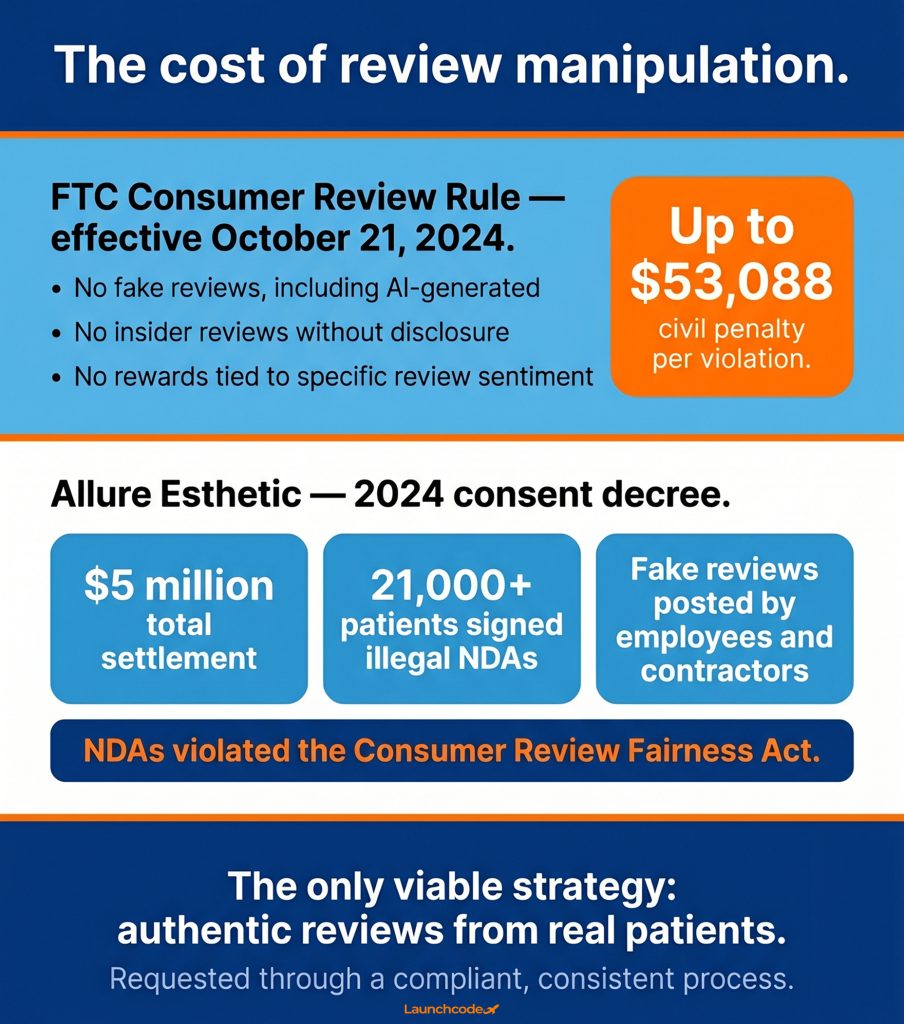
In 2024, the Washington Attorney General’s office concluded a lawsuit against Dr. Javad Sajan and Allure Esthetic in Seattle, resulting in a $5 million consent decree. The investigation found the practice had forced more than 21,000 patients to sign NDAs prohibiting negative reviews, posted fake positive reviews through employees and contractors, and paid patients to remove negative posts. A federal judge ruled the NDAs violated the Consumer Review Fairness Act. This case is the defining example of how review manipulation in healthcare creates legal exposure that far exceeds any reputational benefit.
The FTC Consumer Review Rule, effective October 21, 2024, applied this legal framework nationally. The Allure Esthetic case and the new rule together send a clear signal: review shortcuts carry financial and regulatory risk that no practice can absorb long-term.
Under the FTC Consumer Review Rule, practices cannot:
The only viable long-term strategy is authentic reviews from real patients, requested through a compliant and consistent process.
Google’s AI Overviews and AI-powered search tools are changing how patients find plastic surgeons. Instead of browsing a list of website links, patients increasingly receive a curated AI-generated summary directly in their search results, drawn from review content, directory listings, and structured profile data. Practices with high-volume, recent, and specific reviews appear in those summaries. Practices without them get skipped, regardless of clinical quality or website content.
Evan Steele, founder and CEO of rater8, described the shift in Plastic Surgery Practice magazine: “With the rollout of AI Overviews, Google is no longer just showing a list of links, it’s curating and summarizing content for prospective patients directly in the search results. If your practice doesn’t show up in these AI summaries, you risk being left out of the conversation entirely, even if you’re delivering excellent care.”
The scale of the shift is already significant. rater8’s Next Evolution of Patient Choice report found that 26% of patients now choose healthcare providers based on AI tools, nearly matching the 28% who rely on primary care physician referrals. The traditional referral pipeline is weakening. Practices without AI search visibility are losing patients to competitors with stronger review infrastructure.
Steele describes structured review content as reviews that are “tagged, formatted, and categorized in a way that search engines, and now AI models, can easily understand and parse through. Practices that consistently generate a high volume of structured review content have a better chance of being accurately and favorably represented in AI Overviews and other summary-style search results.”
In practice, this means reviews that mention the specific procedure, the surgeon by name, the office location, and the patient’s outcome. A single prompt makes the difference: when requesting a review, ask patients to mention what they had done, what stood out about their care, and how they feel about their results. That request shifts reviews from generic to structured without coaching sentiment.
Review velocity, recency, and content specificity directly determine how AI systems describe and recommend a practice in generative search results. For practices building a full visibility strategy, connecting reputation management to AI search is covered in our guide to GEO for healthcare and aesthetic practices.
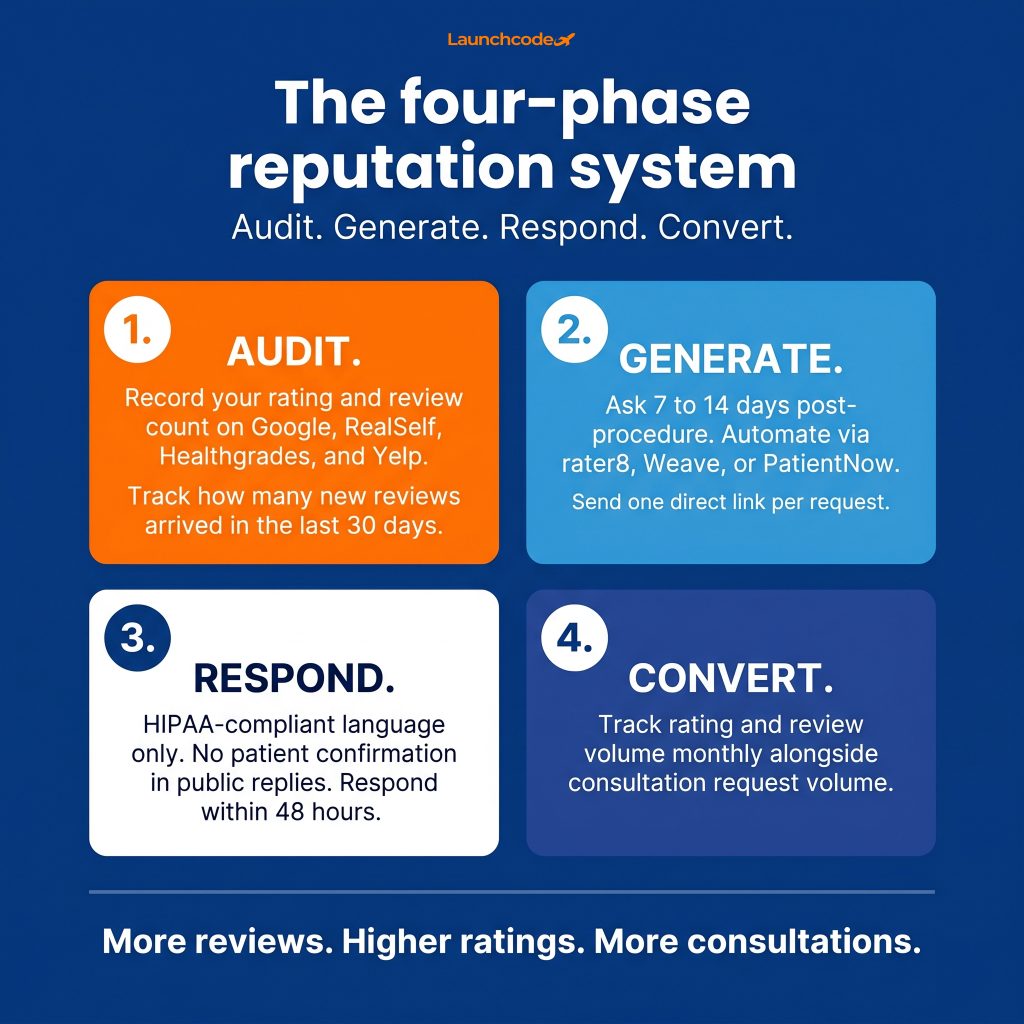
Reputation management works as a system, not a one-time project. Practices that treat it as reactive stay behind. Practices that build a repeatable process see compounding results: more reviews, higher ratings, stronger search visibility, and more consultation requests. The system runs in four phases: audit, generate, respond, and convert.
Before changing anything, measure where you stand.
Build a structured review request process into your patient journey. Connect it to your practice management system through a platform like rater8, Weave, or PatientNow. Target Google for volume and RealSelf for depth. Ask at high-satisfaction moments, not at checkout or billing.
“Once the review request is tied to the practice management system, it runs on its own. We’ve seen practices go from two or three reviews a month to over 20 without adding any staff time. The manual version of this same process takes a team member 30 to 40 minutes a day.” – Natalie Brooks, Executive Assistant
Respond to positive reviews with brief, genuine acknowledgment. Respond to negative reviews with HIPAA-compliant, offline-directing language within 48 hours. Use AI-assisted tools to draft responses at scale, then approve before posting. RepuGen’s ReplyWize and Weave’s Response Assistant both generate HIPAA-aware draft responses your team can edit before publishing.
Monitor your rating and review volume monthly alongside consultation request volume. If your rating improves but consultations stay flat, audit your website conversion path and intake speed. If consultations increase, attribute a measurable portion to the reputation work. rater8’s reporting dashboard and most practice management CRMs surface the link between review activity and patient volume over time.
The data points in one direction. Reviews are the most influential variable in how patients choose a plastic surgeon. 84% of patients read them before booking. 61% trust them more than referrals. A one-star improvement is worth 5 to 9 percent more revenue. And 26% of patients now choose providers through AI tools that draw directly from review content.
The practices that build this well do not chase a perfect score. They build a system: consistent, compliant review requests at the right moments, HIPAA-aware responses within 48 hours, and a review profile that gives AI tools the structured, specific content they need to surface the practice favorably in generated results.
Start with the audit. Find out exactly where your practice stands on Google, RealSelf, and Healthgrades right now. That rating is your current revenue baseline. Every point of improvement from there is measurable.
For practices ready to connect reputation management to a full patient acquisition strategy, our SEO and GEO services for healthcare practices cover how review signals, local search, and AI visibility work together.
Volume and recency matter more than reaching a specific number. rater8’s 2025 survey found that more than half of patients read at least six reviews before making a care decision. A practice with 50 or more reviews posted in the last 12 months consistently outperforms one with 200 old reviews and no new activity. The goal is consistent velocity.
Yes. You can ask patients by text, email, or in person to leave an honest review on Google or RealSelf. The FTC Consumer Review Rule permits review requests as long as no reward is tied to a specific sentiment. Ask for an honest review, not a positive one. That distinction is what keeps you compliant.
Document the review with a screenshot before taking any action. File a formal dispute through the platform’s removal process. Do not respond publicly in a way that escalates the situation or reveals any clinical information. Google and RealSelf remove reviews that violate their terms or originate from verified non-patients, though outcomes vary and timelines differ by platform.
Do not confirm or deny that the reviewer was your patient. Do not reference any clinical details, even if the patient disclosed them first. Acknowledge the feedback, express genuine care, and invite the person to contact your office offline. That approach satisfies HIPAA and demonstrates responsiveness to every prospective patient reading the exchange.
Yes, directly. Google’s AI Overviews and AI-powered search tools draw from review content and directory data to generate provider summaries. Practices with high-volume, recent, and procedure-specific reviews appear more often and more favorably in those summaries. Review velocity and content depth are now GEO signals that drive AI search visibility alongside patient trust.



Real stories from the people we’ve partnered with to modernize and grow their marketing.