
Share:

AI marketing & automation


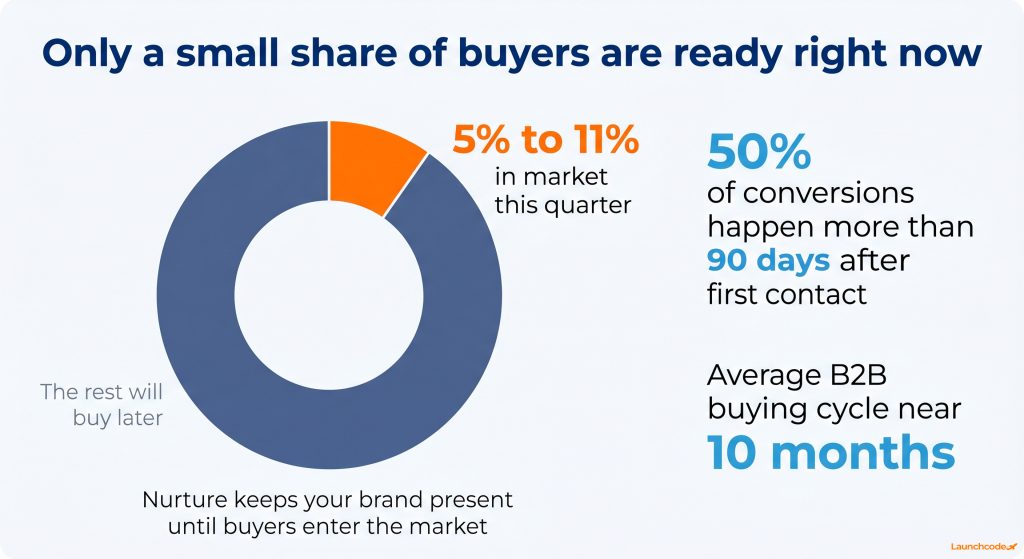
Most B2B email programs are built for speed. They run a short welcome series, push a demo, then go quiet when the lead does not convert. That model breaks when the average B2B buying cycle now runs close to 10 months and half of conversions happen more than 90 days after first contact. The deal you want is decided during the months your emails went silent.
This article gives you a working system for long cycles. You will learn how to nurture a full buying committee, set cadence by deal length, use behavior to time sends, score leads for a clean sales handoff, recover stalled deals, attribute email across quarters, and protect deliverability the whole way through.
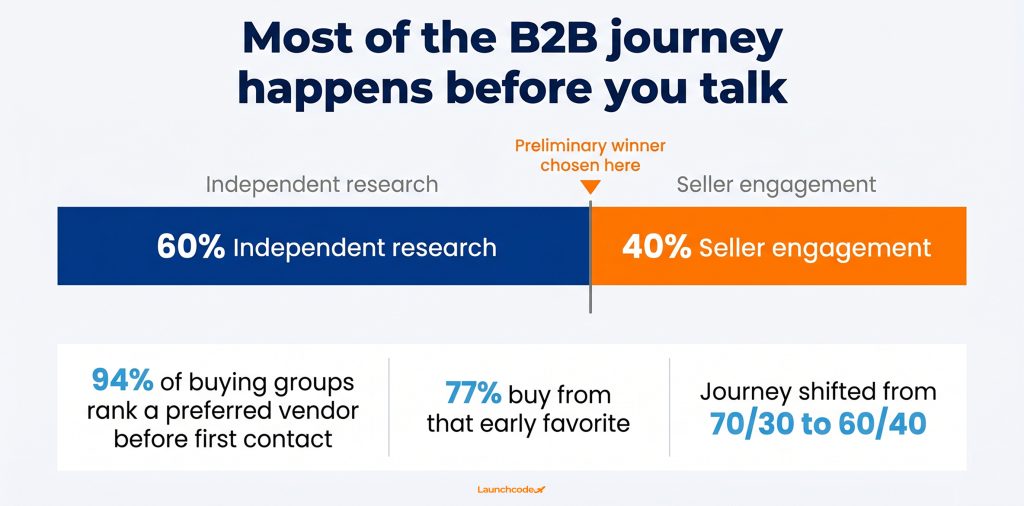
Long cycles change the job of email. The goal is not a fast close. It is to stay relevant and trusted for months while a committee researches on its own. Buyers spend roughly 60% of the journey on independent research before they engage a seller, and most pick a preliminary winner before that first conversation. Email is how you earn that early preference.
The data is direct. In the 2025 buyer research from 6sense, the journey shifted from a 70/30 to a 60/40 split between research and seller engagement, and 94% of buying groups ranked a preferred vendor before first contact. They then bought from that early favorite 77% of the time. The shortlist forms while you are invisible, so your content has to do the selling.
This is why patience works. Kerry Cunningham, head of research at 6sense and a former Forrester analyst, notes that buyers rarely go into market and buy in the same quarter. His point is that most providers need to influence target accounts two to four quarters in advance.
Teams treat nurture like a countdown to a demo. They send three educational emails, then a hard pitch, then nothing. When the buyer is six months out, that sequence ends long before the decision starts. The fix is to build for the timeline you actually sell into, not the one you wish you had.
Email keeps paying off because it reaches the inbox where research happens. The channel returns strong ROI versus other digital channels, and it scales across a long cycle without rising media costs. The catch is that volume no longer wins. Cold outreach reply rates slipped from 6.8% in 2023 to 5.8% in 2025, a clear sign that relevance beats frequency.
One person rarely decides a B2B purchase. Buying groups now average about 10 people, and by the time a single contact fills out a form, the group has often completed 70% of its journey. Effective nurturing reaches multiple roles with content built for each one, so the program speaks to the finance lead, the technical evaluator, and the executive sponsor at the same time.
The single form fill is a trap. It looks like one lead, but it represents a committee already deep in research. 6sense puts North American buying groups near 10.6 people, with similar sizes across EMEA and APAC buying groups. You are nurturing a room, not a person.
“We used to optimize for the one contact who filled out the form. Once we mapped the full committee and ran a track per role, the deals that converted were the ones where three or more people from the account engaged.” Tanner Medina, Co-Founder and Chief Growth Officer
Picture a SaaS deal with eight stakeholders and a nine-month cycle. Instead of one drip to the form filler, you run three role-based tracks. Over the cycle, finance gets two ROI breakdowns, evaluators get three product deep dives, and the sponsor gets two outcome-focused case studies. Coverage of the committee rises, and the deal moves because objections get answered before the sales call, not during it.
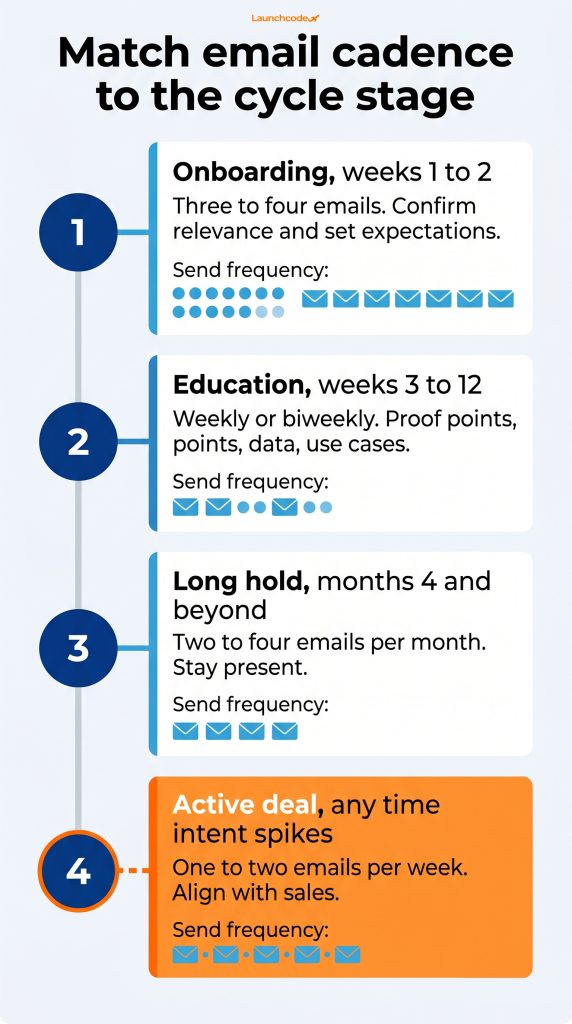
Match sequence length to cycle length. A 30-day drip cannot carry a ten-month deal. Run an active nurture of one to two emails per week for engaged contacts, then shift to a slower educational cadence of two to four emails per month for the long middle. Always pace by engagement, not by a fixed calendar.
The mistake is treating cadence as one setting. Long cycles have phases, and each phase needs a different rhythm. Active interest deserves a faster pace. A quiet research period deserves steady value without pressure.
Watch the signals. If opens and clicks fall across two or three sends, slow down or pause and trigger a re-engagement flow. Segmented sends help here, since segmentation lifts opens by about 30% and clicks by about 50% compared to one message for everyone. Fewer, more relevant emails protect the list across a long timeline.
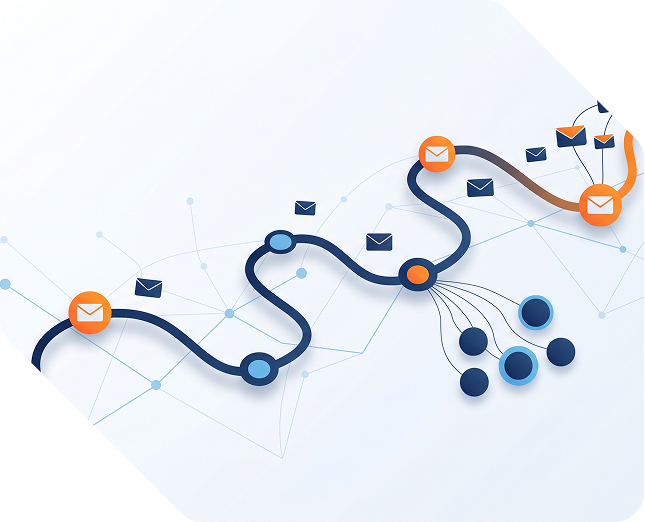
Behavior-triggered flows beat fixed drips for long cycles because they send the right message when intent is hot. A drip fires on a schedule no matter what the buyer does. A trigger fires when the buyer visits a pricing page or returns after weeks away. Automated, triggered emails generate far more revenue than scheduled batch sends.
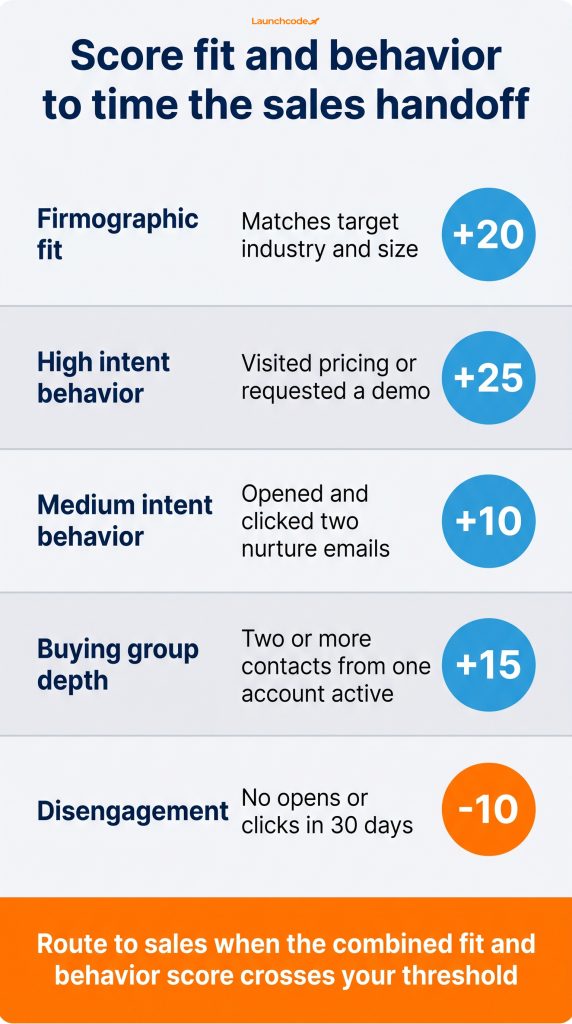
Both have a place. Drips give you a reliable backbone. Triggers give you timing. The strongest programs combine the two, with a slow educational drip running underneath and triggers layered on top to catch real moments of interest.
| Approach | Who it fits | Key strength | Watch out for |
|---|---|---|---|
| Time-based drip | Early nurture and long holds | Predictable coverage across months | Ignores buyer behavior and can feel generic |
| Behavior-triggered flow | Active evaluation and intent spikes | Right message at the right moment | Needs clean tracking and CRM setup |
| Hybrid program | Most long-cycle B2B deals | Steady presence plus timely reactions | More complex to build and maintain |
“We moved most nurture off a fixed schedule. When we tied sends to pricing page visits and repeat content views, reply rates on target accounts roughly doubled, and sales stopped chasing cold contacts.” Derick Do, Co-Founder and Chief Product Officer
The revenue case is strong. Industry benchmarks show automated sequences far outperform manual batch sends on opens, clicks, and revenue, mostly because timing and relevance improve at the same time.
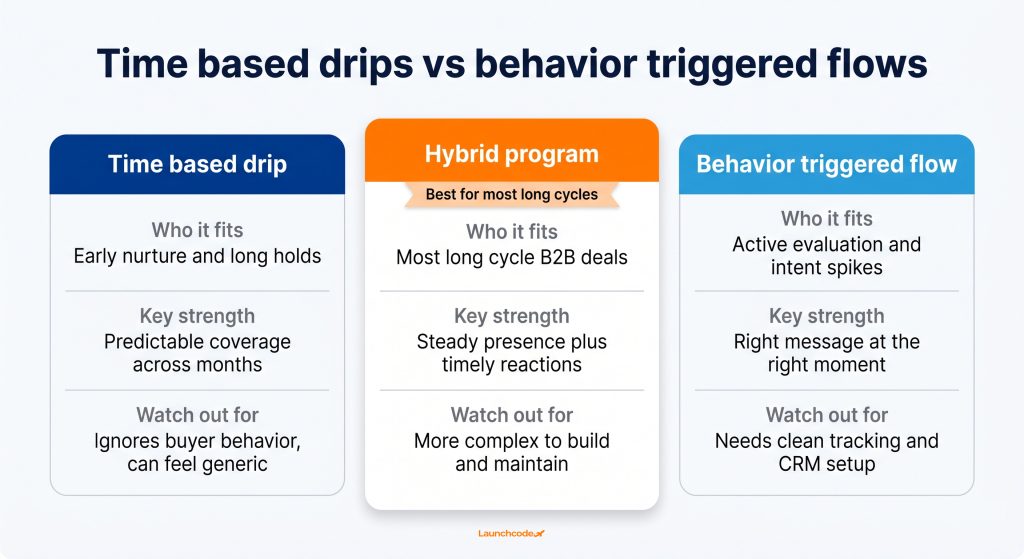
Lead scoring tells you when a nurtured contact is ready for sales. Combine firmographic fit with behavior, set a clear threshold, and route only contacts that cross it. This protects sales time, since chasing every form fill loads the pipeline with deals that take forever and rarely close.
Scoring works when it reflects both who the buyer is and what they do. Fit alone misses intent. Behavior alone misses qualification. Together they rank readiness.
| Signal type | Example signal | Points |
|---|---|---|
| Firmographic fit | Matches target industry and size | 20 |
| High intent behavior | Visited pricing or requested a demo | 25 |
| Medium intent behavior | Opened and clicked two nurture emails | 10 |
| Buying group depth | Two or more contacts from one account active | 15 |
| Disengagement | No opens or clicks in 30 days | minus 10 |
Set the handoff threshold at a number that fits your data, then test it. A common starting point is to route a contact to sales once it crosses a combined fit and behavior score, with extra weight when several people from one account engage. This aligns with research that nurtured, well-qualified leads convert better and cost less, with Forrester reporting that strong nurturing produces more sales-ready leads at lower cost.
When a lead crosses the line, pass the story. Include engagement history, the role of the contact, the account’s other active people, and a suggested opener. The handoff should feel like a warm continuation, not a cold restart.
Silent does not mean lost. Buyers go quiet during internal reviews, budget cycles, and competing priorities, then return. A re-engagement flow keeps the door open with fresh value instead of guilt-driven check-ins. Since only about 5% of buyers are in market in any quarter, most quiet contacts are simply early, not gone.
The 95-5 reality, first framed by the Ehrenberg-Bass Institute, explains why patience pays. 6sense data places the in-market share near 5% to 11% at any given time. The other 90%+ will buy later, and your job is to be remembered when they do.
Stop judging long-cycle email on last touch. A deal that closes in month nine had many touches before it, and last touch credits only the final click. Use multi-touch attribution and a pipeline-influenced view so the program gets credit for every contact it warmed along the way.
Long cycles make attribution hard because the path is not linear. Email often assists rather than closes. If you only track the last action, you will underfund the work that built the shortlist months earlier.
“Last touch made our email look weak. Once we switched to a pipeline-influenced view, we saw email had touched more than 60% of closed deals across nine-month cycles, and the budget conversation changed overnight.” Tanner Medina, Co-Founder and Chief Growth Officer
Add consistent UTM tags to every link so traffic stays identifiable. Sync email activity to the CRM so contacts tie to accounts and deals. Define the attribution model up front, whether first touch, last touch, or multi-touch influence. When 58% of B2B professionals say their cycles have grown longer, measuring across the full timeline is the only way to see what email actually did. This kind of full funnel tracking and marketing automation setup is core to how Launchcodex builds nurture programs that report on pipeline, not vanity metrics.
Deliverability decides whether any of this reaches the inbox. Over a long sequence, sender reputation either compounds or decays. Authenticate your domain, honor one-click unsubscribe, keep complaint rates low, and prune inactive contacts. A clean list that lands in the inbox beats a large list that lands in spam.
The rules tightened recently. Gmail and Yahoo now expect bulk senders to authenticate properly and make opting out easy. Skipping this quietly kills a nurture program no matter how good the content is.
A short campaign can survive a messy list. A program running for months cannot. Every dead address and disengaged contact drags reputation down over time. Pair regular cleaning with smart list segmentation so engaged buyers keep getting relevant sends while dormant ones move to a slower track or a pause.
Long B2B cycles reward teams that show up with value for months and stay visible to every stakeholder. The program that wins covers the whole buying committee, scales cadence to the real timeline, uses behavior to time sends, scores readiness for a clean handoff, recovers quiet deals, and proves influence with multi-touch attribution. As Kerry Cunningham puts it, in uncertain times trust and clarity win.
Start with one fix. Map your buying committee and build role-based tracks, or replace a fixed drip with two or three behavior triggers. Then layer in scoring and attribution so the program earns its budget. Treat nurture as a pipeline influence engine, not a newsletter, and slow deals start to close on a timeline you can plan around.
Match it to your sales cycle. Many programs run 30 to 60 days of active content, then shift to a slower monthly cadence for the long hold. Enterprise deals over six months need a longer educational track plus behavior triggers that fire whenever intent returns.
For active, engaged contacts, one to two per week works. For quiet contacts in a long hold, two to four per month is safer. Watch unsubscribe and click rates. If engagement drops across two or three sends, slow down or pause.
Nurture the committee. Buying groups average about 10 people, and the form filler is rarely the only decision maker. Tag contacts by role and build content tracks for finance, users, and executives so the program answers each one’s concerns.
Weight click rate, click to open rate, reply rate, and pipeline influenced the open rate. Privacy tools distort opens, and last touch attribution hides email’s real role. Multi-touch attribution shows how nurture warmed a deal over months.
Use both. A slow educational drip keeps the brand present, while triggers catch real intent like a pricing page visit or a return after dormancy. Triggered, automated sends consistently outperform scheduled batch emails on engagement and revenue.


Real stories from the people we’ve partnered with to modernize and grow their marketing.