
Share:

AI marketing & automation


Most email programs hit the same ceiling. Open rates settle in the low twenties. Click rates hover around two percent. Revenue per send stays flat no matter how many times the subject line gets refreshed or the send day changes. The actual problem is almost always the same: every subscriber is getting the same email.
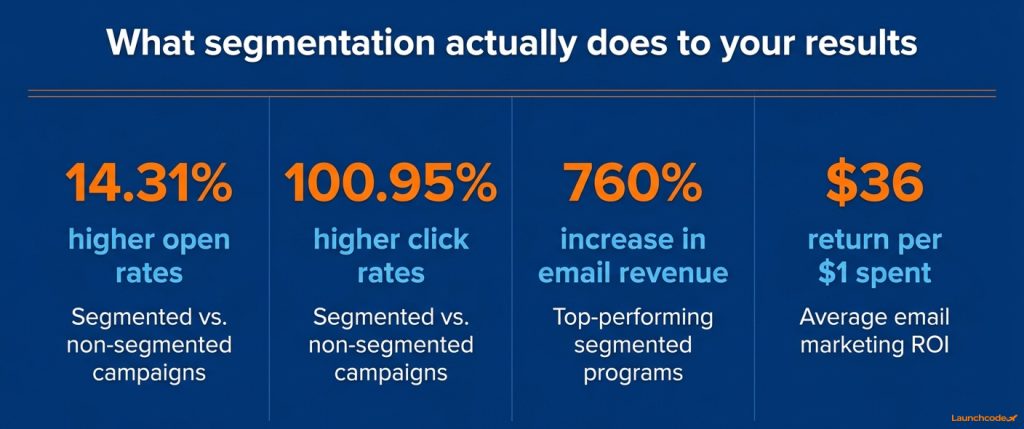
Segmentation fixes that. Mailchimp’s research on segmented versus non-segmented campaigns shows 14.31% higher open rates and 100.95% higher click rates when emails reach defined groups rather than the full list. Those results require building segmentation the right way. This guide covers how to audit your data, choose your starting segments, build them correctly, and maintain them over time.
The most common reason segmentation fails is not a strategy problem. It is a data problem. Teams build segment categories based on assumptions about their subscribers, without first checking what data is actually populated and reliable in their platform. Segments built on incomplete or stale fields produce misleading results, and those results erode confidence in the whole system.
Most segmentation guides skip this point entirely. They describe demographic, behavioral, and psychographic segments as if every program already has the data to support them. That is rarely true.
Jeanne Jennings, CEO of Email Optimization Shop, has documented the common mistake: most senders confuse surface-level personalization with real segmentation. Adding a first name to a subject line is not segmentation. Meaningful segmentation groups subscribers by behavioral data, purchase history, and engagement signals working together, so each group reflects what those contacts are likely to do next.
A common failure mode is treating segmentation as a one-time project. A team builds three groups at the start of a campaign, sees early improvement, and moves on. Within a few months, subscriber behavior shifts. New contacts land in the wrong group. Segments go stale and stop reflecting reality. Segmentation is a system that requires regular data refreshes and clear rules for how subscribers move between groups as their behavior changes.
Sending irrelevant email at scale damages more than open rates. Research from Litmus shows that irrelevant email is the primary driver of list decay. Unsubscribes, spam complaints, and disengagement all increase when subscribers consistently receive content that does not match where they are in the relationship. Protecting list health and building better segments are the same work.
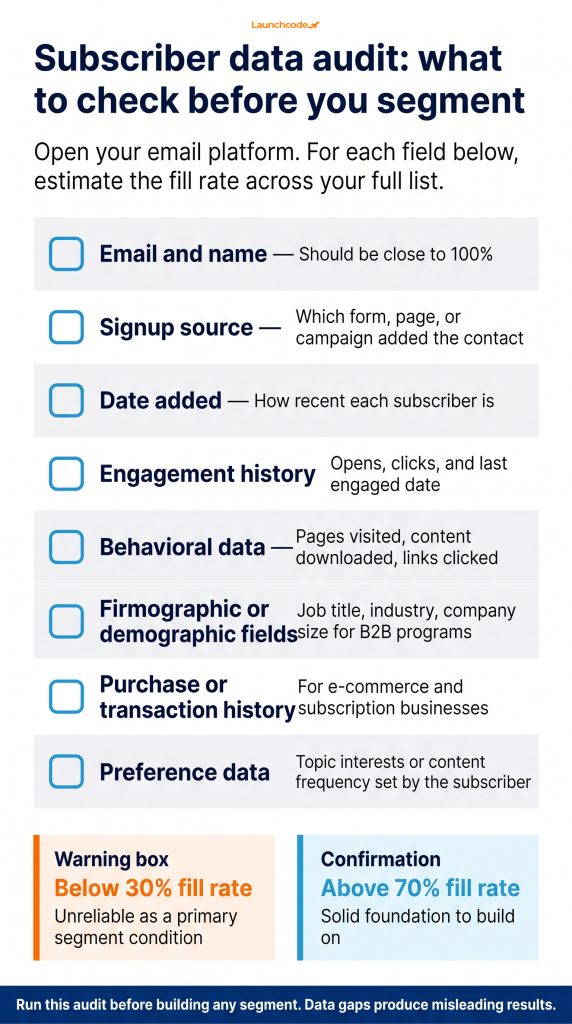
Before building any segment, audit what subscriber data you actually have, where it lives, and whether you can trust it. A clear picture of your fill rates prevents months of work on a foundation that cannot support real segmentation.
Open your email platform and check which fields are populated across your list. Most programs have clear gaps. Email addresses and first names might cover 90% of contacts while company industry covers 20% and purchase history covers 35%. The segments you can build right now depend entirely on which fields are actually filled.
Go through each subscriber field and estimate the fill rate across your full list:
Fields with fill rates below 30% are unreliable as primary segment conditions. Fields above 70% give you a solid foundation to build on.
“The programs we build start with a data audit, not a segment strategy. If the fields are not populated, the segments are just labels.” Derick Do, Co-Founder and Chief Product Officer
If your subscriber data is thin, zero-party data is the fastest way to improve it. Zero-party data is information subscribers give you directly, such as preferences selected in a signup form or answers to a short onboarding survey. Klaviyo, ActiveCampaign, and HubSpot all support preference-based tagging without custom development. A well-structured welcome sequence can fill critical data gaps within a few weeks of launch. For a broader look at building a data foundation that supports segmentation across channels, our email marketing strategy guide covers the full setup.
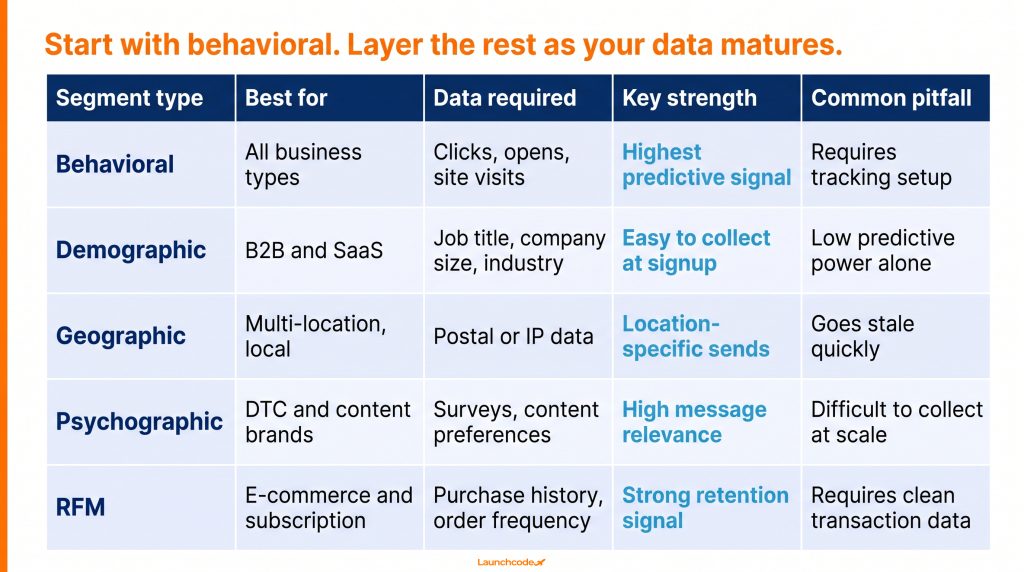
Not all segment types deliver equal value. Behavioral segmentation outperforms demographic segmentation because it reflects what subscribers do, not what they look like on paper. Start with behavior. Layer in demographics and psychographics once the behavioral foundation is in place.
| Segment type | Best for | Data required | Key strength | Common pitfall |
|---|---|---|---|---|
| Behavioral | All business types | Clicks, opens, site visits | Highest predictive signal | Requires tracking setup |
| Demographic | B2B and SaaS | Job title, company size, industry | Easy to collect at signup | Low predictive power alone |
| Geographic | Multi-location, local | Postal or IP data | Location-specific sends | Goes stale quickly |
| Psychographic | DTC and content brands | Surveys, content preferences | High message relevance | Difficult to collect at scale |
| RFM | E-commerce and subscription | Purchase history, order frequency | Strong retention signal | Requires clean transaction data |
Kath Pay, CEO of Holistic Email Marketing and author of Holistic Email Marketing, makes the case clearly: behavioral data is the most actionable segmentation signal available. What subscribers do tells you more about what they will do next than any demographic field.
RFM stands for Recency, Frequency, and Monetary value. It scores each contact by when they last purchased, how often they buy, and how much they spend. Klaviyo’s 2024 e-commerce benchmark report shows 54% of e-commerce brands use RFM as their primary retention segmentation model. The same framework applies to SaaS and subscription businesses when you replace purchase history with product usage, login frequency, and feature adoption.
An engagement tier segment is one of the most practical segments any program can build right away. Divide your list into active, at-risk, and dormant subscribers based on open and click activity over the last 60 to 90 days. This move protects your sender reputation, triggers re-engagement workflows on dormant contacts automatically, and keeps your primary send universe clean and high-quality.
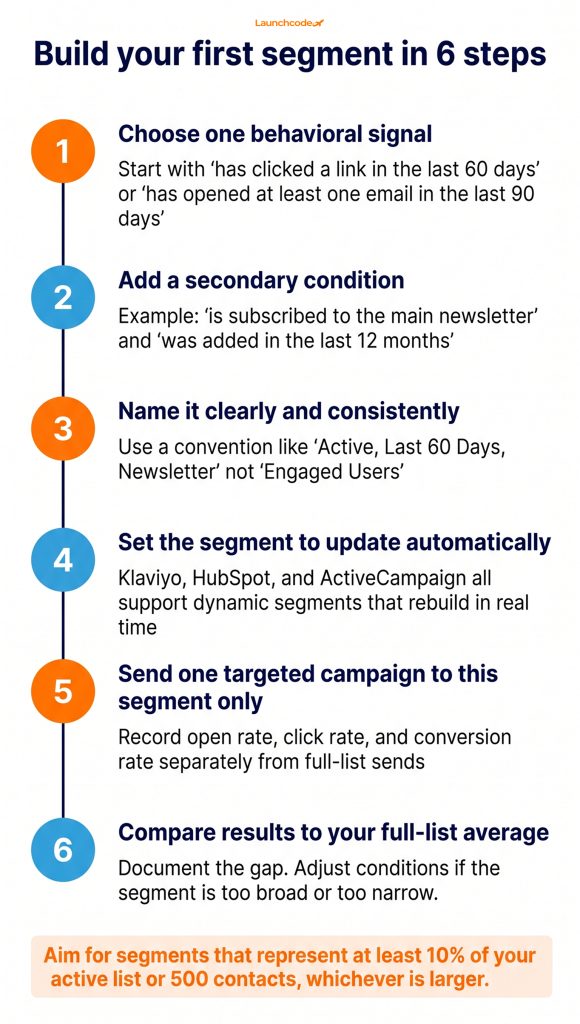
Start with one segment. Build it correctly. Measure the result. Then scale. Managing six segments at once leads to messy logic, conflicting conditions, and results that are impossible to interpret. The programs that improve fastest start with one well-defined behavioral segment and expand once they know it is working.
A segment is too broad when its performance matches your full-list average. It is too narrow when the contact count is too small to generate reliable data. Aim for segments that represent at least 10% of your active list or 500 contacts, whichever is larger.
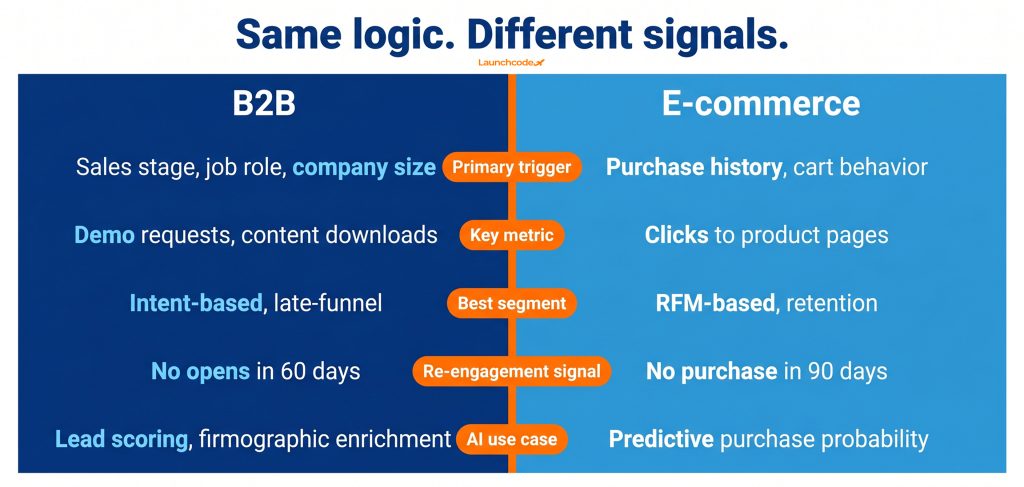
B2B and e-commerce segmentation use the same logic but different signals. E-commerce programs prioritize purchase behavior and product affinity. B2B programs prioritize sales stage, company attributes, and content engagement as signals of buying intent. Using the wrong model produces segments that do not reflect how your prospects actually make decisions.
Most segmentation guides are written for e-commerce. That leaves SaaS companies, professional services firms, and B2B teams applying frameworks built for a completely different data model and a different sales cycle.
| Signal | B2B | E-commerce |
|---|---|---|
| Primary segment trigger | Sales stage, job role, company size | Purchase history, cart behavior |
| Key engagement metric | Demo requests, content downloads | Clicks to product pages |
| Best performing segment | Intent-based, late-funnel | RFM-based, retention |
| Re-engagement signal | No opens in 60 days | No purchase in 90 days |
| AI use case | Lead scoring, firmographic enrichment | Predictive purchase probability |
Jay Schwedelson, founder of Worldata and host of the Do This, Not That podcast, has documented in his benchmark research that B2B marketers who segment by sales stage and intent signals consistently outperform those who rely on firmographic data alone. Company size and industry are useful filters, but they do not tell you where a prospect is in their decision process. Behavioral signals do.
If your CRM is connected to your email platform, these three segments are worth building first:
AI-powered segmentation uses machine learning to predict future subscriber behavior and group contacts accordingly. It is built into mid-tier platforms by default, not reserved for enterprise programs with large technical teams. Most email programs can access predictive scoring without any additional setup beyond what they already use.
Klaviyo, HubSpot, Salesforce Marketing Cloud, and Iterable all surface predictive models that score subscribers on their likelihood to purchase, churn, or engage within a defined window. These models run on your existing email and transaction data.
According to the Litmus State of Email 2024, 41% of brands now use AI for email personalization and segmentation decisions. That number is rising because AI features are now part of the standard platform set, not a separate enterprise add-on.
“In Klaviyo, predictive churn scoring runs on your existing send data. You do not need to configure it manually. Most teams miss it because they do not know it is already there.” Derick Do, Co-Founder and Chief Product Officer
Three practical tasks that AI removes from manual workflows:
These features do not replace a segmentation strategy. They make existing segments more precise and reduce the manual work of maintaining them over time. When Launchcodex builds email segmentation systems for clients, the process connects platform AI features to CRM data and paid media audiences, so a subscriber’s email behavior informs what they see across every channel.
Measure segmentation results at the segment level, not the campaign level. A campaign can average well while one segment drags and another overperforms. Segment-level reporting shows you where your system is working and where it needs adjustment.
Track three core metrics for each segment after every send:
“We audit a lot of email programs where the segments exist but the measurement is missing. Without segment-level conversion tracking, you are optimizing for opens when the goal is pipeline.” Tanner Medina, Co-Founder and Chief Growth Officer
Mailchimp’s benchmark data puts average open rates across industries between 21% and 28%. Top-performing segmented programs consistently exceed 40% open rates on their most targeted sends. If your best segment is not beating the industry average, review the segment conditions or the content matching.
Check segment performance every 30 days. If a segment’s metrics drop to match the full-list average, either the conditions need updating or the subscriber pool has aged out of the original criteria.
Building a few segments once and expecting them to stay useful is how most email programs plateau. Subscriber behavior changes. Data goes stale. Segments that performed well last quarter may not reflect the current list.
The programs that produce lasting results treat segmentation as an ongoing system. They run quarterly data audits, update segment conditions based on performance, add new behavioral signals as the platform makes them available, and connect email segments to CRM data and ad audiences so every channel reflects the same subscriber intelligence.
McKinsey research shows that faster-growing companies drive 40% more of their revenue from personalization than slower-growing peers. Segmentation is the foundation that makes personalization possible at scale. Without it, you are paying for email infrastructure and leaving the returns behind.
Start this week. Run the data audit. Pick one behavioral segment. Send to it. Measure the gap. Build from there.
Start with one or two. A single well-built behavioral segment consistently outperforms five poorly defined ones. The goal is relevance and precision, not volume. Add more segments only after your first ones are running cleanly and producing results you can measure.
You can segment a list of 500 contacts. Smaller lists will not generate statistically significant data quickly, but sending to relevant subgroups still improves subscriber experience and list health even at low volumes.
A segment is a defined group of contacts who meet a set of conditions. An automation trigger is a specific action or event that starts a workflow. They work together but serve different purposes. You can send a one-time campaign to a segment, or use segment membership as the entry condition for an automated sequence.
Yes. Sending to engaged segments improves your open and click rates while reducing bounces and spam complaints. Email service providers use those signals to score your sender reputation. A stronger sender reputation means more of your emails reach the inbox rather than the spam folder.
Review segment performance monthly. Adjust segment conditions quarterly. Run a full subscriber data audit at least twice a year to check fill rates, remove st


Real stories from the people we’ve partnered with to modernize and grow their marketing.