
Share:

AI marketing & automation


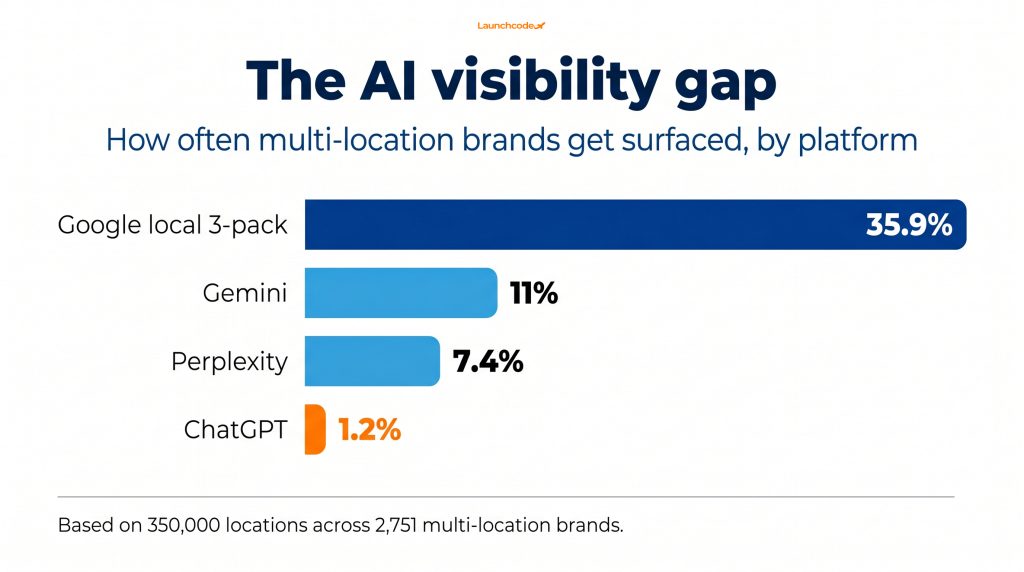
A multi-location brand can hold a spot in Google’s local 3-pack more than a third of the time and still get recommended by ChatGPT barely 1 percent of the time. That gap is the new reality of local search, and it punishes brands whose location data, pages, and reviews drift out of control as they grow.
This guide gives marketing and operations leaders a complete operating model for local SEO at scale. You will learn how to manage Google Business Profiles across dozens or hundreds of locations, build location pages that avoid the doorway page trap, run reviews as per-location infrastructure, and decide exactly which tasks corporate should own and which belong to local teams.
Multi-location SEO breaks because every new location multiplies the surface area you have to manage. Each location adds a Google Business Profile, a location page, a citation footprint, and a review profile. Without a governance system, accuracy decays, content turns generic, and individual locations quietly lose visibility while brand-level reports still look healthy.
The math works against you fast. A brand with 50 locations manages 50 profiles, 50 pages, and thousands of citations across directories, mapping apps, and data aggregators. One outdated phone number or wrong holiday schedule is a small error. Five hundred of them across the footprint is a structural visibility problem.
The stakes keep rising because consumers are constantly searching. SOCi’s Consumer Behavior Index found that 80 percent of US consumers search for a local business online at least once a week. Google’s own research shows that 76 percent of people who search for something nearby on their smartphone visit a business within 24 hours. Local visibility is foot traffic and revenue, measured weekly.
Brands respond to this complexity in one of two ways. Some centralize everything, which produces identical location pages, templated review responses, and profiles that read like corporate boilerplate. Others hand control to local managers, which produces inconsistent names, off-brand photos, and data that no longer matches across platforms.
Miriam Ellis, a local search expert writing for Search Engine Land, puts it plainly: “The keys to multi-location SEO success are organization, stakeholder empowerment, vigilance, and problem-solving.” Her full framework appears in the Search Engine Land multi-location SEO guide. The answer is not more centralization or less. It is knowing which tasks belong where.
The tactics of local SEO stay familiar. Dan Taylor, writing in Search Engine Journal’s complete guide to local SEO for multiple locations, calls the current shift “an evolution of the local SEO playbook and not a revolution.” What changes at scale is the operations: who owns each task, how data flows, and how you catch problems before they spread across 80 locations.
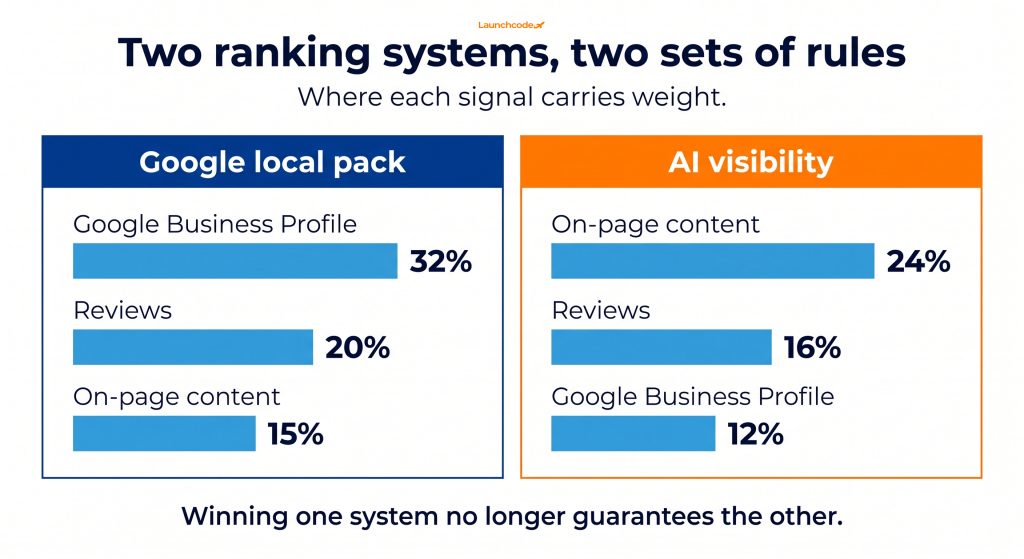
Local visibility now splits into two parallel systems. Google’s local pack rewards Google Business Profile signals above everything else. AI assistants like ChatGPT, Gemini, and Perplexity weigh your website content more heavily than your profile. Winning one system no longer guarantees the other, so multi-location brands need a strategy for both.
The evidence for this split is specific. The Whitespark Local Search Ranking Factors 2026 survey of 47 local search experts found that Google Business Profile signals account for roughly 32 percent of local pack ranking weight, with review signals at 20 percent and on-page signals at 15 percent. For AI search visibility, the weighting flips. On-page signals rise to roughly 24 percent while GBP signals fall to roughly 12 percent.
| Signal category | Local pack weight | AI visibility weight |
|---|---|---|
| Google Business Profile | ~32 percent | ~12 percent |
| Reviews | ~20 percent | ~16 percent |
| On-page content | ~15 percent | ~24 percent |
These weights come from expert survey estimates, not confirmed Google data. They still give the clearest available picture of where effort pays off.
SOCi’s 2026 Local Visibility Index analyzed nearly 350,000 locations across 2,751 multi-location brands. As reported by Search Engine Land, only 1.2 percent of locations were recommended by ChatGPT, 11 percent by Gemini, and 7.4 percent by Perplexity. The same brands appeared in Google’s local 3-pack 35.9 percent of the time.
The gap holds even for strong performers. In retail, the full SOCi index found that only 45 percent of brands leading in traditional local search also appeared among the most recommended brands in AI results. Map pack success does not transfer.
“We now run AI visibility checks in every local audit, the same way we check map pack rankings. Before cleanup, most multi-location brands we review show accurate information in ChatGPT for fewer than 1 in 10 locations. That number moves within a quarter once the data layer is fixed.” Tanner Medina, Co-Founder and Chief Growth Officer
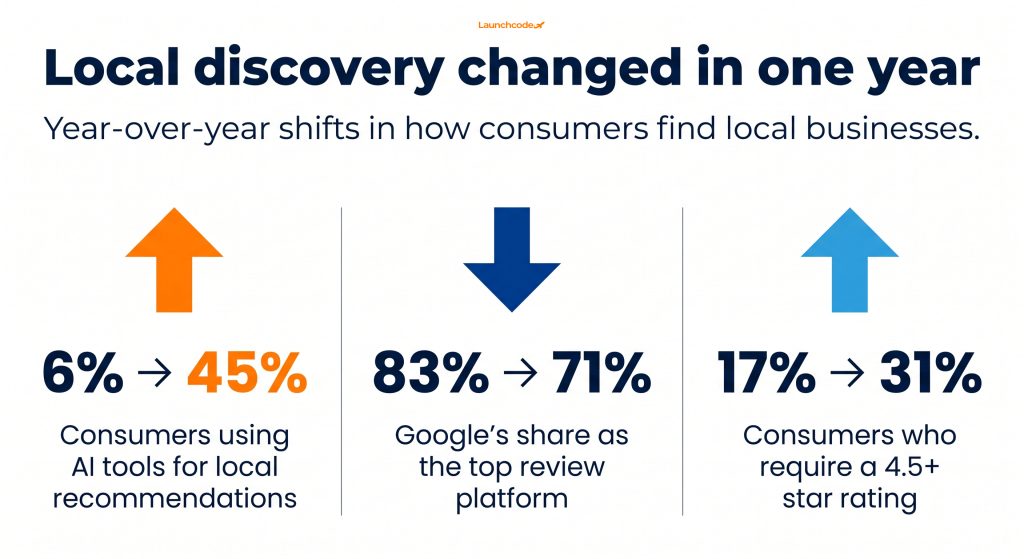
Behavior is moving faster than most marketing budgets. BrightLocal’s Local Consumer Review Survey 2026, based on a panel of 1,002 US adults, found that consumers using AI tools like ChatGPT for local business recommendations grew from 6 percent to 45 percent in a single year. Google’s share as the top platform for finding reviews dropped from 83 percent to 71 percent over the same period.
Monica Ho, CMO at SOCi, summarized the shift in the company’s index announcement: “AI has collapsed the local decision journey.” An assistant recommends one or two businesses, not ten blue links. Being absent from that answer means being invisible to a growing share of customers.
Accurate, centralized business data is the foundation for both ranking systems. Create one master record per location that holds the exact name, address, phone number, hours, services, and geo-coordinates. Push that record to your Google Business Profile, your website schema, and your priority citations. Everything else in multi-location SEO depends on this layer being right.
Data accuracy used to be a ranking hygiene task. Now it determines what AI tools tell customers about you. SOCi’s research found that business profile information was only about 68 percent accurate on ChatGPT and Perplexity, compared with 100 percent on Gemini, which pulls from Google Maps. When your listings disagree with each other, AI assistants serve customers wrong hours, wrong phone numbers, and wrong locations under your brand name.
Consistency also drives entity disambiguation. Search engines need to confirm that scattered mentions across the web all point to the same physical business. Conflicting records split that authority into competing fragments.
Build the data layer in this order:
“Treat the master record like a product, not a spreadsheet someone updates when they remember. We build it as a database with store codes as primary keys, then profiles, schema, and page variables all sync from it automatically. Drift starts the moment a human edits one platform by hand.” Derick Do, Co-Founder and Chief Product Officer
Fixing every listing on the internet is a low-return project. Tier the work:
| Citation tier | What it includes | How to manage it |
|---|---|---|
| Tier 1 | Google, Apple Maps, Bing Places, major data aggregators | Direct ownership, quarterly audits |
| Tier 2 | Industry directories such as Healthgrades, Angi, Tripadvisor | Update twice a year |
| Tier 3 | Generic low-traffic directories | Deprioritize entirely |
Apple Maps deserves more attention than it gets. BrightLocal’s 2026 data shows its usage nearly doubled year over year, which moves it firmly into tier 1 for most brands.
Manage profiles through one organization account, not dozens of personal logins. Google’s bulk verification lets brands with 10 or more locations verify everything through a single spreadsheet upload with unique store codes. From there, use business groups to organize regions and tiered access levels to let local staff contribute without risking core data.
GBP remains the highest-weight controllable factor for local pack rankings, so operational discipline here pays off more than anywhere else. The structure matters as much as the optimization.
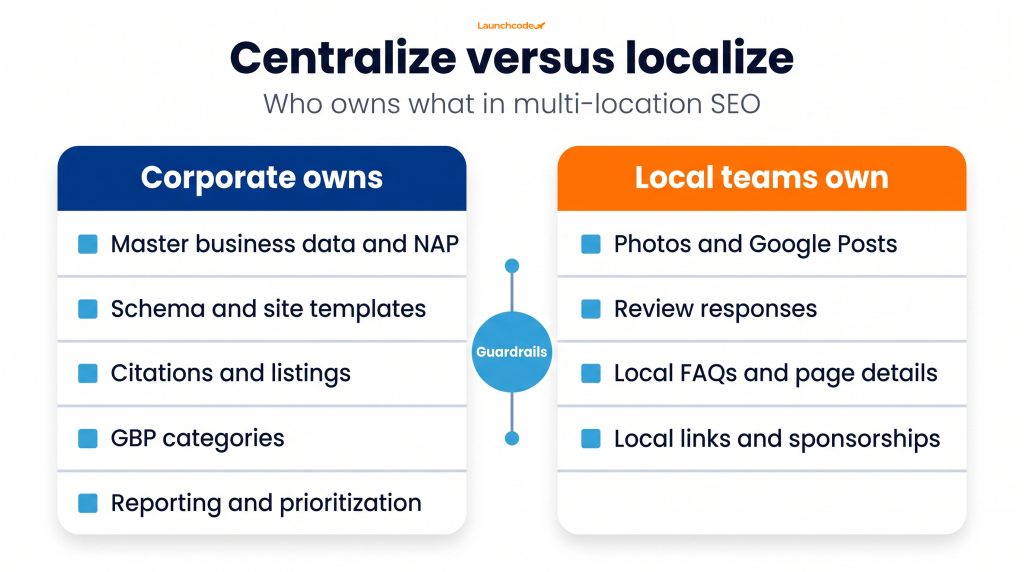
This split is the first concrete piece of the operating model. Corporate owns the data. Local teams own the local activity signals.
The primary category is the single most influential field on the profile, and a one-size-fits-all choice across the footprint costs rankings. An automotive brand might run Car Dealer as the primary category in suburban markets and Auto Repair Shop in city centers where service drives revenue. Secondary categories add detail only. Stacking loosely related categories dilutes the signal.
Service area businesses follow different rules entirely. Google requires businesses that travel to customers to hide their street address and define up to 20 named service areas. Radius-based service areas are no longer supported, and rankings still anchor to the hidden physical base, so adding distant cities to the list does not produce rankings there.
Build every location page from a fixed-plus-variable template. Roughly half the page carries consistent brand content such as service standards and guarantees. The other half must be populated with location-specific data: local services, real photos, embedded reviews from that location, staff names, and area-specific FAQs. Pages that only swap the city name get filtered as thin content.
Google’s doorway page policy targets templated pages built only to rank, and modern quality systems suppress them at indexing. The Whitespark 2026 data raises the stakes further. On-page signals are the heaviest category for AI visibility at roughly 24 percent, which makes location pages your primary asset for earning AI recommendations alongside Google rankings.
Structure each page template with explicit slots:
Pull the variable data from your master record and live feeds wherever possible. Real-time hours, recent location reviews, and local team rosters keep pages unique without manual rewrites.
Use a hub and spoke structure. A store locator hub at a clean URL such as example.com/locations links to every location page at example.com/locations/city. Every location page links back to the hub. Each page carries its own LocalBusiness schema block with the exact NAP data, geo-coordinates, and a sameAs property pointing to that location’s verified Google Business Profile. Reserve Organization schema for the homepage only.
Service area businesses should resist building a page for every suburb. Build a city page only when three conditions hold: you have staff or vehicles dedicated to that market, search demand is measurable, and the area has genuinely distinct content potential such as different housing stock, regulations, or service needs. A pest control brand serving an old port district has a real page to write. The same brand cloning that page for 30 suburbs does not.
Treat reviews as an operational system at each location rather than a brand-level campaign. Review equity cannot be shared or pooled between profiles, so every location needs its own steady generation process, its own response workflow, and its own rating target. Velocity and recency now matter more than raw volume.
Consumer expectations moved sharply in one year. BrightLocal’s 2026 survey found that 41 percent of consumers now always read reviews before choosing a local business, up from 29 percent the year before. Even more telling, 31 percent will only use a business rated 4.5 stars or higher, nearly double the 17 percent from the prior year. One weak location now actively turns customers away while the brand average looks fine.
Reviews also feed the AI layer directly. Assistants read the text of reviews, beyond the star ratings, to decide which businesses to recommend. A location whose reviews repeatedly mention specific services and outcomes gets cited ahead of a competitor with thousands of generic five-star ratings.
“The review programs that work are boring and automated. A post-visit text with a direct review link, sent within two hours, outperforms every clever campaign we have tested. Locations running that one workflow hold three to five new reviews a week without anyone thinking about it.” Tanner Medina, Co-Founder and Chief Growth Officer
Centralize data, standards, and infrastructure. Localize content, photos, reviews, and community signals. This single decision rule resolves the control problem in multi-location SEO. Most brands get it backwards by centralizing content until it turns generic while leaving data scattered across local owners until it decays.
This is the framework competitors gesture at but rarely spell out. Here is the full split.
| Task | Who owns it | Why |
|---|---|---|
| Master business data and NAP | Corporate | One source of truth prevents drift |
| Schema, site architecture, templates | Corporate | Technical consistency at scale |
| Citation and listings management | Corporate | Tooling and audits work best centrally |
| GBP categories and core fields | Corporate with regional input | Category strategy varies by market |
| Photos and Google Posts | Local | Real images of real places win trust |
| Review responses | Local with brand guardrails | Authentic, specific, indexable |
| Local FAQs and page variables | Local feeds corporate template | Relevance without chaos |
| Local links and community sponsorships | Local | Hyper-local authority cannot be faked |
| Reporting and prioritization | Corporate | Per-location accountability |
Delegation fails without rails. Give local teams a short playbook: approved photo guidelines, response tone examples, a banned-claims list, and a clear escalation path. Give corporate a monitoring layer: quarterly profile audits, automated alerts for unauthorized edits, and velocity dashboards. At Launchcodex, this audit-standardize-localize sequence is how we structure multi-location engagements, because cleanup before delegation is what keeps delegated work from recreating the original problem.
Not every location deserves equal investment. Score each one on three factors:
Flagship locations earn bespoke pages, custom photography, and active local link building. Lower-priority locations still get the minimum viable standard: accurate data, complete profiles, unique schema, and verified service lists.
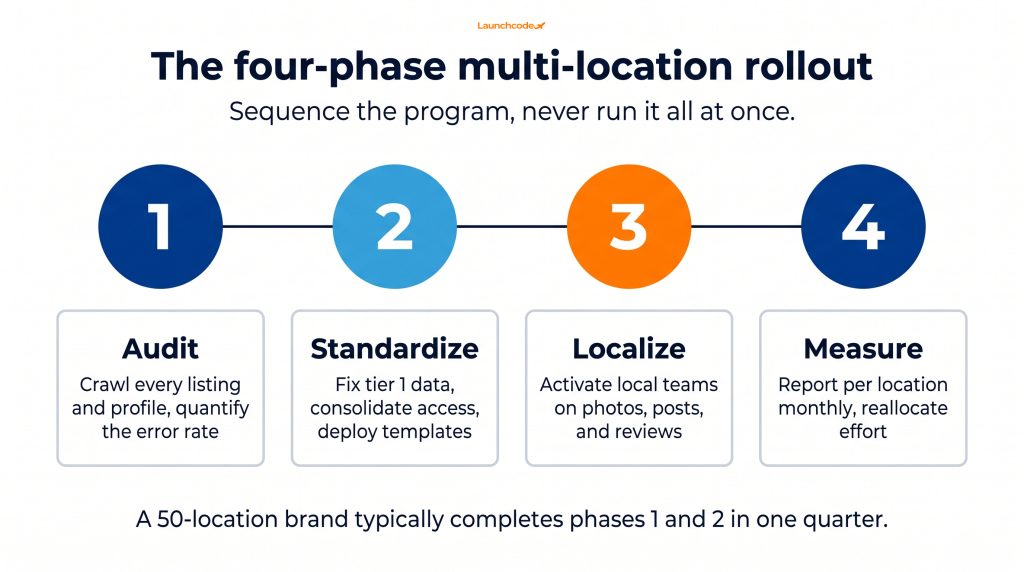
Sequence the program in four phases: audit, standardize, localize, measure. Trying to do everything across every location at once is how multi-location programs stall. Report performance by location, never only in aggregate, because rolled-up numbers hide failing locations behind healthy averages.
A realistic timeline for a 50-location brand runs about a quarter for the first two phases and another quarter to fully activate localization. Faster is possible with dedicated tooling. Slower is normal when account access is a mess, which it usually is.
“Phase order matters more than speed. Teams that skip the audit and jump to localization end up automating bad data across 50 locations, and unwinding that costs more than the original cleanup would have.” Derick Do, Co-Founder and Chief Product Officer
Track a small set of metrics for every location, every month:
That last check matters more every quarter. AI Overviews now appear in roughly 68 percent of local business queries according to Whitespark’s 540-query study, and Joy Hawkins of Sterling Sky found that AI local packs surface far fewer businesses than traditional 3-packs, 5,943 unique businesses versus 18,330 in her State of Local Search research. Fewer slots means the brands with clean data and strong location content take a disproportionate share.
The brands losing in local search are not short on tactics. They are short on a system. The data shows a market that is unevenly optimized and getting harder: rating thresholds rising, Google’s review share falling, and AI assistants recommending a tiny fraction of locations while ignoring the rest.
That difficulty is the opportunity. A brand that centralizes its data layer, standardizes its profiles and pages, and genuinely localizes its content and reviews competes in both ranking systems while most competitors compete poorly in one. Start with the audit. Quantify your listing error rate, your review velocity by location, and your AI visibility for ten priority markets. The gaps you find become your roadmap, and every gap you close is one a competitor still has open.
Multi-location SEO is the practice of optimizing local search visibility for every physical location a brand operates, including a Google Business Profile, a dedicated location page, consistent citations, and an active review profile for each one, managed through a centralized system.
There is no practical cap. Brands with 10 or more locations qualify for Google’s bulk verification, which verifies all profiles through a single spreadsheet upload, and business groups let teams manage hundreds of profiles from one organization account.
Similar structure is fine. Similar content is not. Pages that only swap the city name risk being treated as doorway pages and filtered from the index. Keep the template, but populate at least half of each page with location-specific services, photos, reviews, and FAQs.
The two systems weigh signals differently. The local pack leans heavily on Google Business Profile signals, while AI visibility leans on website content, structured data, and review text. Strong profiles with thin location pages win the first system and lose the second.
There is no universal number. Match or exceed the review counts of the top three competitors in each location’s market, and prioritize steady velocity and recent reviews over total volume, since recency now carries more weight than raw count.


Real stories from the people we’ve partnered with to modernize and grow their marketing.