
Share:

AI marketing & automation


Google gave site owners almost no detail about this update. The release came with one dashboard line, one LinkedIn post, and no blog post. The rollout lands right on top of Black Friday and Cyber Monday, which means ranking movement and holiday traffic swings will overlap.
Our view is that the bigger risk is your team’s reaction. Many December drops will be holiday swings, AI Overview click loss, or bad tracking data, not core update losses. This guide covers what Google confirmed, what the 2026 updates rewarded, what to watch during the rollout, and a four-step plan to protect your rankings.
The November 2026 core update is a broad change to Google’s ranking systems. It started on November 10, applies globally and to all languages, and may take up to two weeks. Google called it a regular update and gave no specific targets. It is the third broad core update of 2026, following March and May.
The Search Status Dashboard entry reads: “Released the November 2026 core update, which applies globally and to all languages. The rollout may take up to 2 weeks to complete.” The rollout started at 10:06 a.m. PT, according to Search Engine Journal.
Google’s Search Central LinkedIn post called it “a regular update designed to better surface relevant, satisfying content for searchers from all types of sites.” Google used the same wording for the March update. No Search Central blog post accompanied the release.
Core updates do not target specific sites. Google also ships smaller, unannounced core updates between named ones. That means a page can rise or fall without a dashboard entry.
| Update | Start date | Rollout length |
|---|---|---|
| March 2026 core update | March 27 | 12 days, 4 hours |
| May 2026 core update | May 21 | 11 days, 21 hours |
| November 2026 core update | November 10 | Up to 2 weeks |
Rollout lengths come from the Google Search Status Dashboard. Both earlier 2026 updates finished inside their two week windows.
On November 10, Google’s Rajan Patel said Gemini 4 Carbon was rolling out in AI Mode to Google AI Ultra subscribers. “Gemini 4 Carbon better understands your intent so you can have deeper back and forth convos in AI Mode,” Patel wrote. Two changes hit Search on the same day, so not every movement this month belongs to the core update.
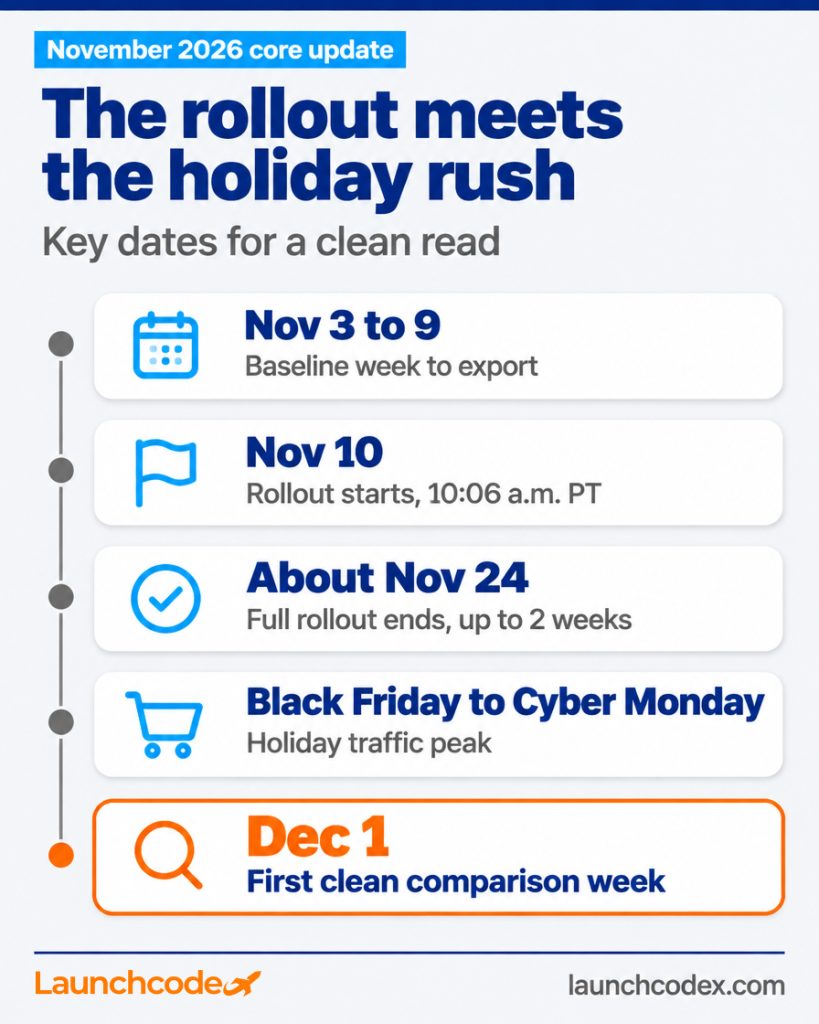
A full two week rollout ends around November 24. Google recommends waiting at least a full week after completion before analyzing Search Console data. That makes December 1, the day after Cyber Monday, the first clean comparison week. Retail, deal, and lead generation sites need a second baseline to read that week correctly.
Google’s core updates guidance tells you to confirm on the dashboard that the rollout has finished. Then wait a full week and compare that week with a week before the rollout started. The recommended baseline for this update is the first week of November.
As Hello Partner points out, the comparison Google recommends pits a normal early November week against the week after Cyber Monday. For any site with seasonal demand, that gap will show up as a ranking problem when it is really a calendar problem. Add a year over year comparison for the same week in 2025 to separate the two.
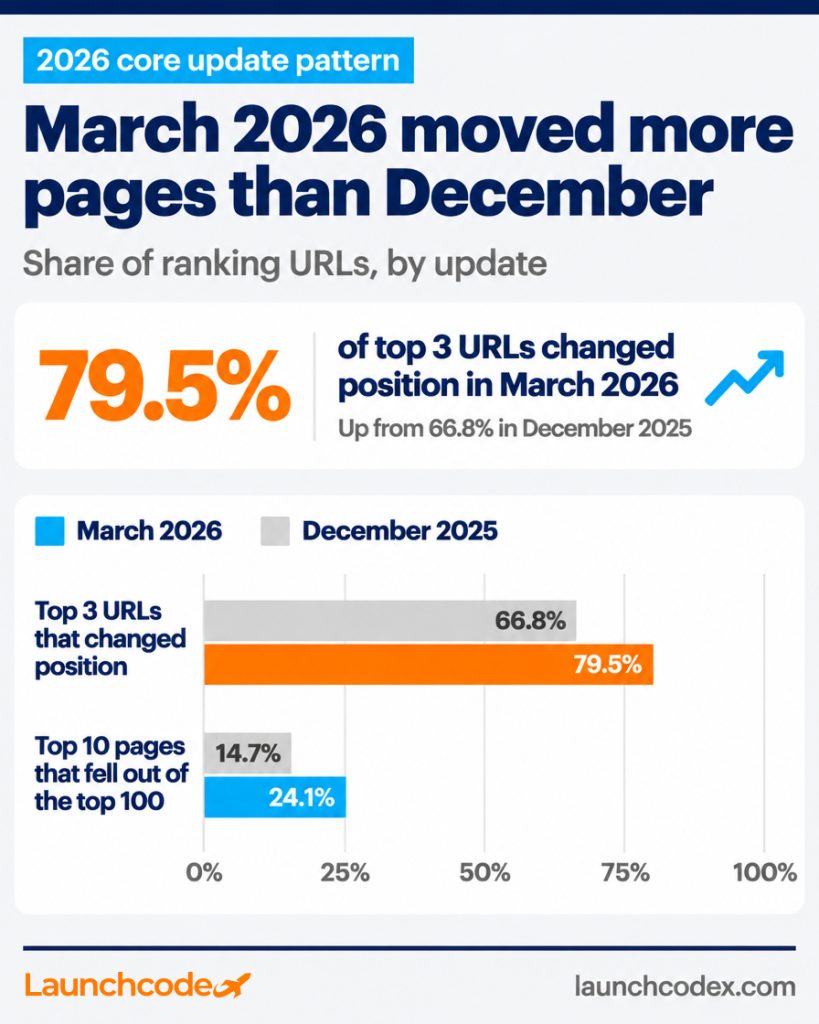
Both 2026 updates shifted visibility toward pages that best fit the query’s intent, market, and result type. March produced more volatility than December 2025. In May, local domains beat global ones in the UK, and some high authority sites dropped. Authority alone did not protect rankings.
SE Ranking data, reported by PPC Land, showed that 79.5 percent of top three URLs changed position in March, up from 66.8 percent after the December 2025 update. About 24.1 percent of pages that ranked in the top 10 dropped out of the top 100, compared with 14.7 percent in December.
Most pages moved. A minority fell off a cliff. That split matters when you decide which drops to act on.
Aleyda Solis analyzed SISTRIX data from the final days of the May rollout. She found that sites best matching a query’s intent, market, and result type gained, while sites a step removed lost ground, as Search Engine Journal reported.
Solis suggests checking which result type gained for each key query, then confirming your page is that type and not a weaker echo of a source that already owns it.
Based on the 2026 pattern, pages that repeat what stronger sources already publish carry the most risk. Look first at templated location pages, programmatic pages built from feeds, comparison pages with no original data, and bulk AI content with little editing.
On October 1, 2026, Google edited its helpful, reliable, people-first content page. It added a definition of main content, four attributes that raters assess, and a warning against fake author profiles. These are the most recent written signals of what Google wants before this update.
Google now lists four attributes raters assess in main content:
In Google’s effort definition, as read by Marie Haynes, generating pages automatically from feeds or producing large amounts of generative AI text without manual oversight or curation counts as little to no effort.
Google’s page now states: “Fabricating creator profiles (such as by using AI-generated headshots, made-up names, or false credentials to make content appear as if it was written by human experts) is a form of deception,” as Search Engine Journal reported. Audit your bylines and author pages now. Every author should be a real person with real credentials.
Watch your own Search Console data, not third party rank trackers. Track clicks, impressions, and position for your top revenue pages, plus AI Overview impressions. Expect uneven, wave-like movement for up to two weeks. Single day swings during the rollout do not tell you where you will land.
DemandSphere said Google was returning spurious results on about 11 percent of its daily rank checks after blocking intensified around September 11. Nozzle counted 8.0 percent of results pages as poisoned, according to PPC Land. Neither vendor disclosed its full method. Daily tracker readings carry more noise than usual this cycle.
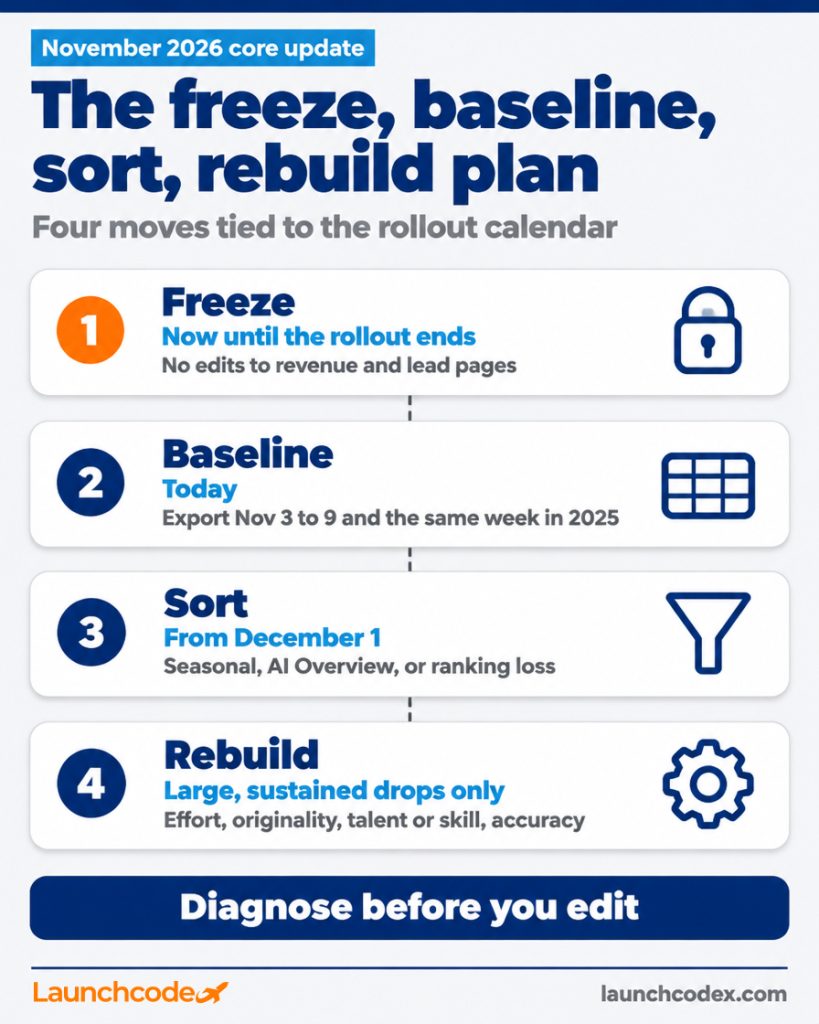
Use four moves tied to the rollout calendar. Freeze revenue pages now. Capture a baseline today. Sort drops by cause from December 1. Rebuild only pages with large, real ranking losses. This plan delays edits until you have clean data, which follows Google’s warning against quick fixes.
Do not edit, restructure, or prune your top revenue and lead pages until Google marks the rollout complete. Log any change you must ship so you can rule it out later. Google’s core updates documentation warns against “quick fix” changes and says, “Deleting content is a last resort, and only to be considered if you think the content can’t be salvaged.”
Export these from Search Console and GA4 before the data shifts:
“We tag every page in Looker Studio as revenue, lead, or support before we touch anything. That tag decides what we freeze and what we review first.” Derick Do, Co-Founder & Chief Product Officer
On December 1, compare against both baselines and put each drop into one of three buckets. The diagnosis table in the next section shows how.
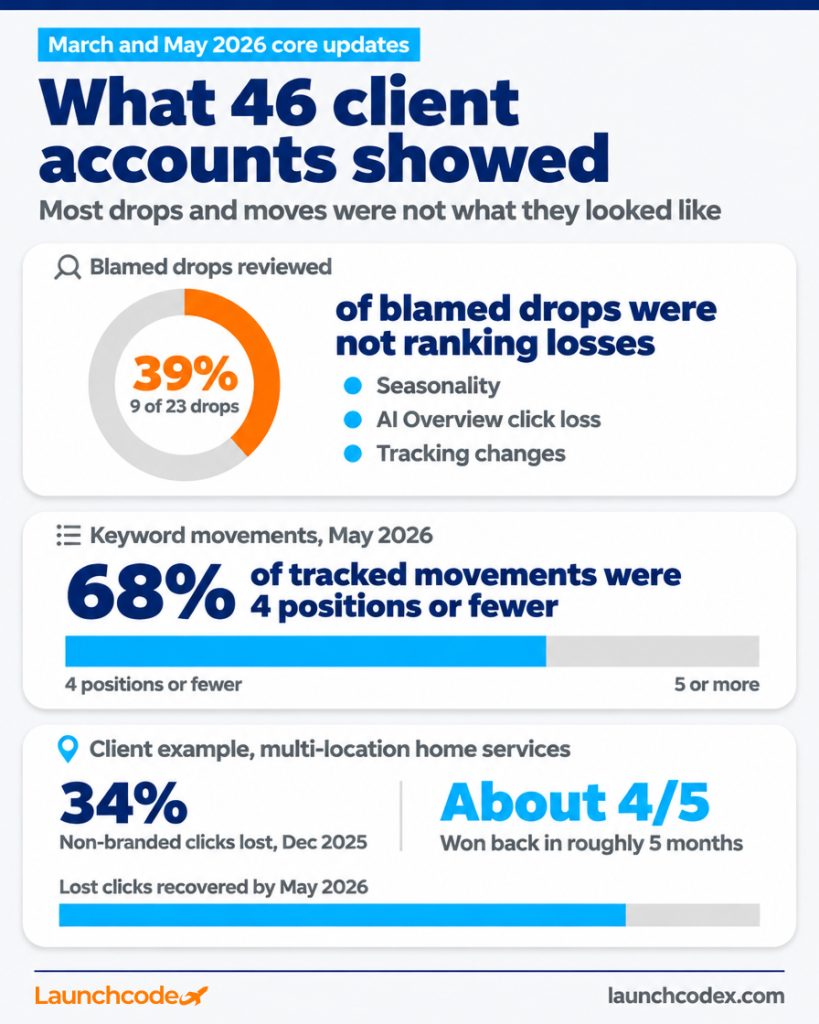
When Launchcodex reviewed 23 traffic drops that clients blamed on the March and May 2026 core updates across 46 accounts, 9 of them, or 39 percent, traced back to seasonality, AI Overview click loss, or tracking changes rather than lost rankings.
“Nine of those 23 drops needed no content work at all. A year over year view in Search Console settled each one in under an hour.” Tanner Medina, Co-Founder & Chief Growth Officer
Across those same 46 accounts, 68 percent of tracked keyword movements during the May 2026 core update were shifts of four positions or fewer. Most movement falls in the range Google says needs no drastic action.
For large drops on revenue pages, review the page against effort, originality, talent or skill, and accuracy. Improve the page rather than delete it.
One multi-location home services client lost 34 percent of non-branded clicks to its city pages in the December 2025 core update. The team replaced templated city copy with job photos, local price ranges, and technician notes. Those pages won back about four fifths of the lost clicks by the end of the May 2026 rollout, roughly five months later.
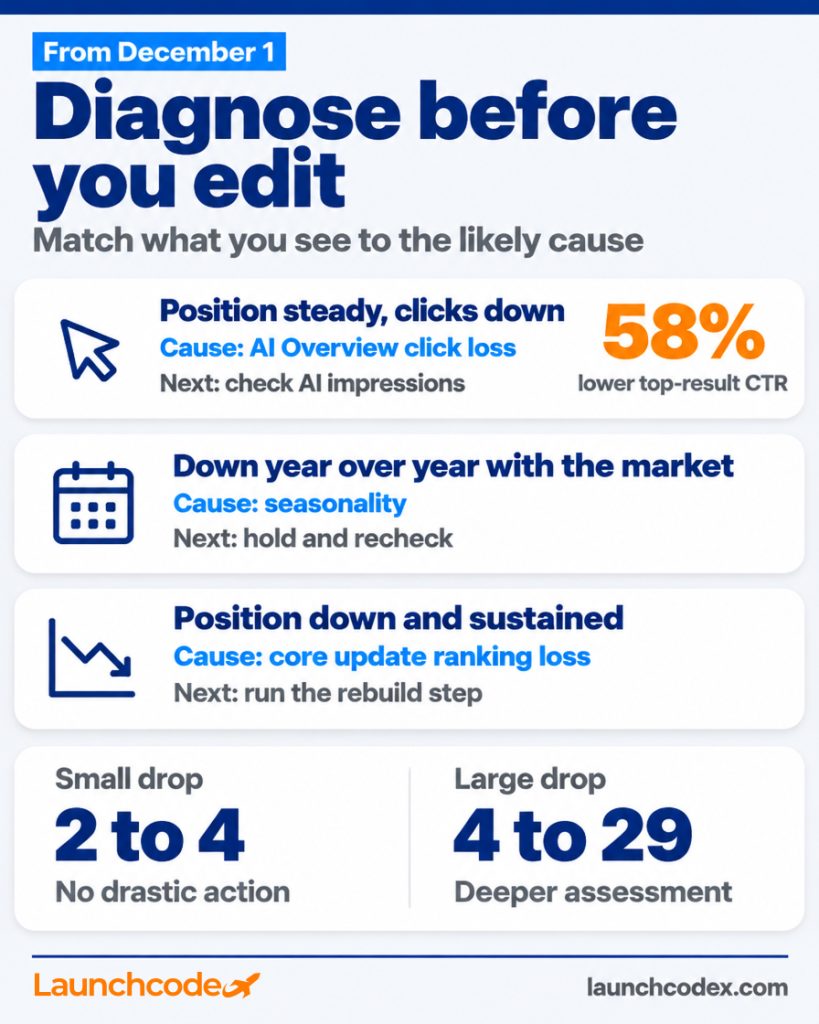
Check position first. If position held but clicks fell, AI Overviews are a likely cause. If traffic fell year over year across your market, the cause is seasonal. Only a sustained position drop on important queries points to the core update. Google treats a slide from position 2 to 4 as small and 4 to 29 as large.
| What you see | Likely cause | Next step |
|---|---|---|
| Position steady, clicks down | AI Overview click loss | Check AI impressions and keep the page |
| Down year over year, in line with your market | Seasonality | Hold and recheck after the holidays |
| Position down and sustained | Core update ranking loss | Run the rebuild step |
Ahrefs found that the presence of an AI Overview correlates with a 58 percent lower average clickthrough rate for the top ranking page, based on 300,000 keywords and December 2025 data. The April 2025 version of the same study found 34.5 percent.
“Regardless of how you feel about AI Overviews, they’re already taking the majority of clicks that used to go to top-ranking pages,” said Ryan Law, Director of Content Marketing at Ahrefs, in the study’s announcement.
Google’s guidance draws the line with two examples. A drop from position 2 to 4 needs no drastic action, and Google recommends avoiding changes to content that is already performing well. A drop from position 4 to 29 calls for a deeper assessment of the page and the site as a whole. As Google puts it, “There might be nothing wrong with pages that may not be performing as well as they were before a core update.”
Expect months, not weeks. Google says some improvements take effect in a few days, while others take several months, and some only show at the next core update. Gary Illyes put typical core update recovery at three to six months, and six months to a year in the slowest cases.
Illyes shared these timing ranges at Search Central Live Deep Dive Europe in Barcelona on October 2, 2026, as Search Engine Journal reported. The attendee recap did not report a sample size or define “typical.”
Recovery can also happen between named updates. Google states that smaller, unannounced core updates can lift pages that have improved. Plan budgets and reporting around a three to six month window, and judge progress in Search Console month over month.
The November 2026 core update will move rankings through the busiest weeks of the year, and Google has not said what it targets. Export your Search Console baseline today, freeze your top revenue pages, and diagnose on December 1 using both the pre-rollout week and the same week last year. Rebuild only the pages with large, sustained position losses. The Launchcodex SEO and GEO team can help separate real losses from noise. For more coverage of core updates and AI search, follow our industry news.
Google says up to two weeks, which points to about November 24. The March and May 2026 updates took 12 days, 4 hours and 11 days, 21 hours.
No. Wait until Google marks the rollout complete, then wait one more full week before you analyze Search Console data.
No. Core updates are broad changes that do not target specific sites. A drop usually means other pages now serve the query better.
Google has not said. Track AI Overview and AI Mode impressions in Search Console separately from web results.


Real stories from the people we’ve partnered with to modernize and grow their marketing.