Share:

AI marketing & automation


Most brands are not getting what they think they are paying for. They sign with an agency expecting a strategic partner and end up with a skilled order taker. The agency delivers on scope. Reports land on time. But nothing changes at the revenue level.
This article explains what separates a client services model from a genuine client partnership, why it matters for your growth, and how to tell the difference before you commit to a contract.
Client services is a delivery model. The agency receives a brief, executes against it, and reports on activity. The relationship runs on scope, not strategy. This works when the problem is well defined and the client knows exactly what they need. It breaks down when the goal is growth, because growth requires more than execution.
In a services model, the agency waits to be told what to do. Questions come from the client. Ideas come from the client. The agency’s job is to produce outputs. This keeps the engagement clean and manageable, but it places the entire strategic burden on the buyer.
This dynamic is more common than it should be. According to R3’s benchmarking data, the average client-agency relationship lasts just 3.2 years. Two thirds of brands work with three or more agencies at the same time. Both numbers point to the same thing: fragmented, transactional relationships that cycle out when they stop feeling useful.
A vendor relationship keeps the client in the driver’s seat at all times. The agency executes what it is given. Feedback loops are slow. Reporting shows activity, not impact. The agency rarely surfaces problems before they show up in the data.
Only 56% of clients report feeling satisfied with their agency relationship. That number reflects what happens when the model is built around delivery rather than outcomes. Clients feel serviced, not supported.
Kevin D. Wilde, former Chief Learning Officer at General Mills and advisory board member at GP Strategies, puts it directly: “A supplier or vendor relationship is primarily transactional. A partnership is more value added and moves you toward being part of strategizing and deliberating before, during, and after the transaction is needed.”
Client partnership is a model where the agency shares accountability for business outcomes. The agency brings strategy, surfaces problems early, challenges assumptions, and connects its work directly to the client’s revenue goals. It operates as an extension of the internal team, not as an external supplier.
The shift is structural, not stylistic. A partner agency needs visibility into your business goals. It needs to understand your pipeline, your sales cycle, your growth targets. Without that context, its recommendations are based on guesswork.
Caitlin Copple Masingill, co-founder of INK Co., frames the contrast this way: “Client service is ‘yes.’ A client relationship is ‘yes, and.’ Service means just doing the work. A client relationship means Be There Before.”
A partner agency does not wait for you to flag a problem. It monitors, anticipates, and comes to the table with a recommendation before you have to ask.
“The brands that get the most from us are the ones who treat us as accountable for their numbers, not just their deliverables. That shift in expectation changes everything about how we show up.”
Brittany Charles, SVP, Client Services, Launchcodex
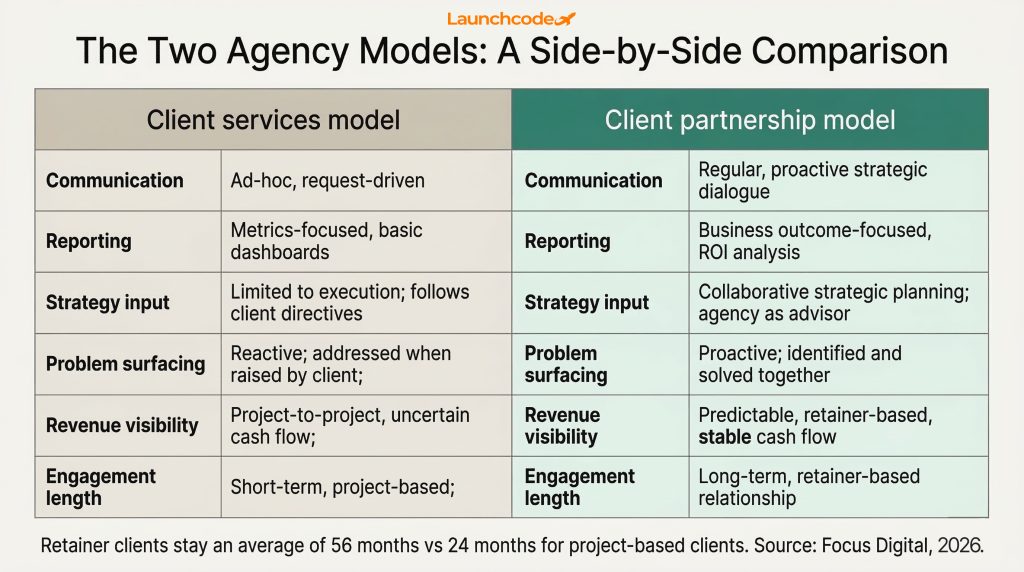
The behavioral differences between service and partnership are specific and observable:
| Behavior | Client services model | Client partnership model |
|---|---|---|
| Communication | Reactive, triggered by client | Proactive, calendar-driven and initiative-led |
| Reporting | Activity metrics (impressions, clicks, hours) | Business outcomes (leads, revenue, pipeline) |
| Strategy input | Provided by client | Co-developed with agency |
| Problem surfacing | After client flags an issue | Before it affects results |
| Revenue visibility | Limited or none | Shared goals and targets |
| Engagement length | Short, project-based cycles | Long-term retainer structure |
Amy Stettler, VP of Client Partnership at Level Agency, describes it this way: “What we call client partnership, a lot of companies call client services. I like to think of the difference as being handed a tray of food versus getting together in the kitchen and cooking a meal together.”
The difference between service and partnership is not about relationship quality. It is about business performance. Agencies operating in a partnership model produce measurably better retention, longer relationships, and higher client spend. The data across multiple industry benchmarks points in the same direction.
Companies that invested in strategic partnerships from 2020 to 2022 saw 29% revenue growth per year, according to research from Impact.com. A separate McKinsey study found that 47% of managers believe business success depends directly on alignment of objectives with partners.
The retention data is equally direct. Retainer-based agencies achieve 2.3 times better client retention than project-based models, with annual churn of 18% versus 42%. Clients in retainer structures stay for an average of 56 months compared to 24 months in project-based arrangements.
A major behavioral difference between the two models shows up in how results are communicated. Service agencies report on activity. Partnership agencies report on outcomes.
47% of agency leaders identified business-focused reporting as critical to client retention, according to a 2024 industry study. Clients need to show internal stakeholders that the agency is driving real results, not just completing tasks.
One B2B agency client achieved a 93% retention rate after shifting to automated monthly impact recaps focused on business outcomes rather than deliverables. When clients can see the connection between agency activity and business performance, they stay.
“Growth content only works when it ties directly to pipeline. If an agency is reporting impressions to a CFO, the relationship is already in trouble.”
Tanner Medina, Co-Founder & Chief Growth Officer, Launchcodex
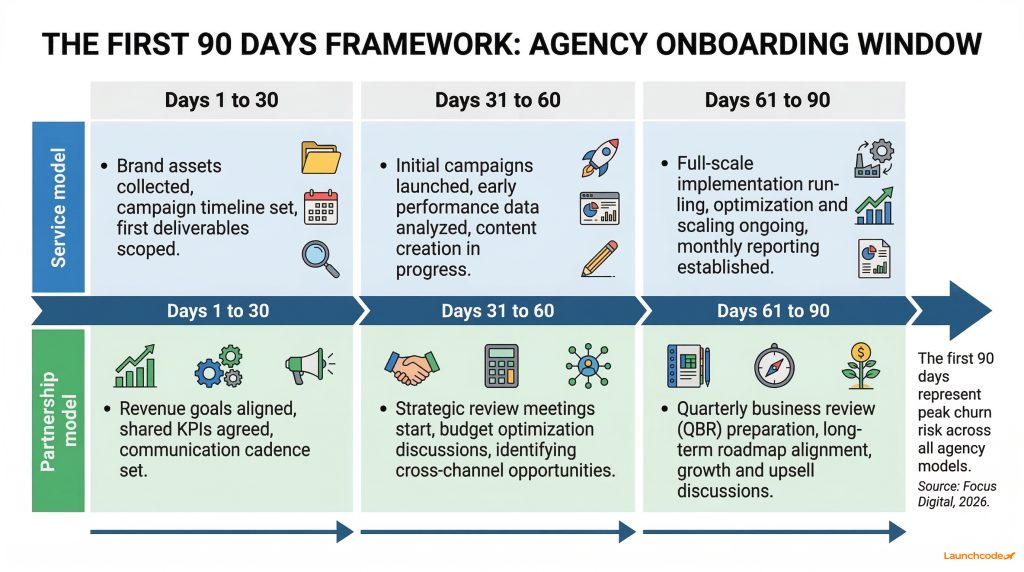
How an agency behaves in the first 90 days tells you everything about which model you are in. The structure of onboarding, the depth of goal-setting conversations, and how quickly reporting connects to your business targets all signal whether this will be a service relationship or a genuine partnership.
Research from Focus Digital shows that the first 90 days represent peak churn risk across all agency models. This is where the tone gets set. Agencies that treat onboarding as an operational intake process build transactional relationships. Agencies that use onboarding to align on business goals, stakeholder expectations, and success metrics build partnerships.
If your agency is operating in a partnership model, these things happen in the first month:
Service-model onboarding tends to look like this: a kick-off call focused on deliverables, a request for brand assets and login credentials, and a timeline for the first campaign. The agency is organized and professional, but the conversation never reaches revenue goals or business strategy.
The difference is easy to spot in retrospect. It is harder to spot before you sign. That is why asking the right questions before the engagement starts matters.
A partnership model requires input from both sides. Agencies cannot operate as strategic partners without access to your business data, your goals, and your honest feedback. If you treat your agency as a vendor, it will behave like one.
This is the angle most agency content ignores. The client’s behavior shapes the model as much as the agency’s.
A true partner agency needs you to:
An agency that recommends against a tactic because it will hurt your domain authority or reduce pipeline quality is behaving like a partner. One that executes the request without comment is behaving like a vendor.
85% of 8-figure agencies document processes for all core services and maintain dedicated client success teams. These are structural commitments to a partnership model at scale.
Brands that stay in service-model relationships tend to under-invest in the agency relationship, rotate agencies frequently, and absorb the true cost of shallow engagement through lost growth, not just contract fees.
AI-native agencies operate at a different capability level than those that use AI as a bolt-on tool. When AI is embedded into research, reporting, automation, and decision-making by default, the agency delivers more informed recommendations faster and connects strategy to execution without manual friction.
89% of agencies now use AI in their operations, up from 54% in early 2023. Early adopters report productivity gains of up to 49%. The agencies getting the most from AI are not using it to save time on tasks. They are using it to improve the quality of strategic outputs and the speed at which they surface insights for clients.
At Launchcodex, AI sits inside every client engagement by default. That means faster research cycles, smarter content and SEO workflows, and reporting that links activity to business metrics in real time.
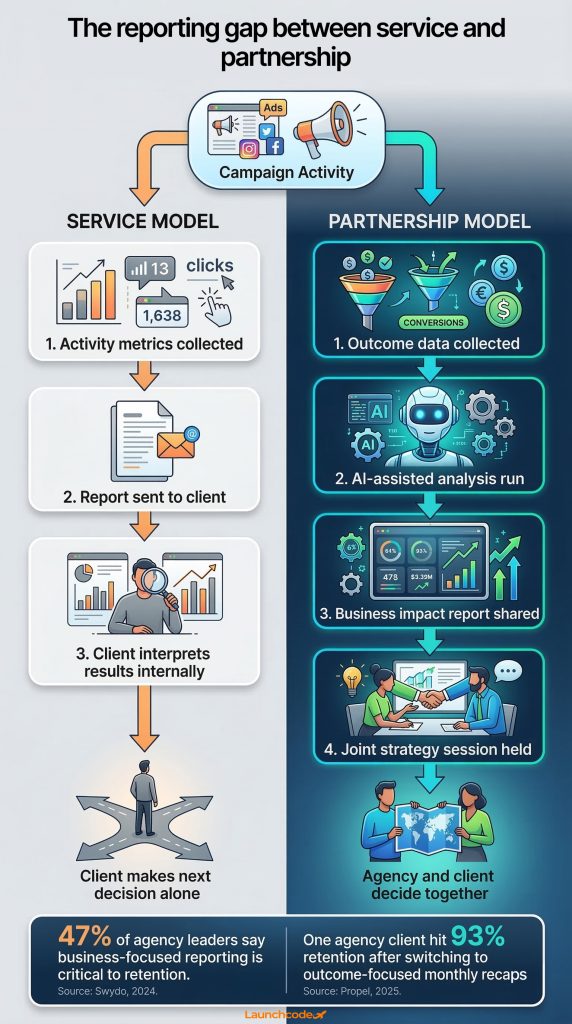
For a partnership model specifically, AI changes three things:
You can identify a partnership-oriented agency before you commit. The signals are visible in how they run the pitch, what they ask about your business, and what their reporting structure actually measures.
Use this checklist when evaluating any new agency relationship:
A service agency will answer most of those questions with scope, deliverables, and team credentials. A partner agency will answer them with outcomes, frameworks, and honest accountability.
Most brands switch agencies because the results are not there or the relationship has gone stale. Both problems trace back to the same root cause: the agency was never operating as a partner.
The service model produces clean deliverables and predictable friction. The partnership model produces shared accountability, harder conversations, and measurably better outcomes. The data across retention rates, revenue growth, and client longevity all point in the same direction.
If your agency is executing without advising, reporting on activity without connecting to revenue, and waiting for your next brief instead of bringing the next idea, you are in a service relationship. That might work for a defined project. It will not drive growth.
The question is not whether your agency is competent. It is whether you are both operating in the right model.
Client services is a delivery model where the agency executes agreed scope. Client partnership is a model where the agency shares accountability for business outcomes and drives strategy alongside the client. The key difference is where the strategic responsibility sits.
According to R3 benchmarking data, the average client-agency relationship lasts 3.2 years. Retainer-based partnerships average nearly five years, compared to two years for project-based engagements.
Yes. The partnership model scales to any business size. What changes is the complexity of shared goals and reporting, not the fundamental approach. A growth-stage SaaS company or a multi-location brand benefits from outcome-aligned agency support just as much as an enterprise client does.
Revenue targets, pipeline data, lead quality feedback, quarterly business goals, and honest evaluation of what is and is not working internally. Without that visibility, even the best agency is working with incomplete information.
AI-native agencies can surface insights faster, connect campaign activity to business outcomes in real time, and flag performance issues before they escalate. When AI is embedded by default rather than added on request, the agency can spend more time on strategy and less time on manual reporting.



Real stories from the people we’ve partnered with to modernize and grow their marketing.