
Share:

AI marketing & automation


Every guide to AI overview optimization repeats the same checklist. Write helpful content. Use clear headers. Add schema. Stay fresh. None of that advice is wrong, but none of it says which tactic actually works, or which one Google has already told marketers to drop.
This article sorts confirmed factors from correlation and guesswork. It draws on Google’s own May 2026 generative AI guidance, independent research from Ahrefs and Washington University in St. Louis, and the academic paper that founded generative engine optimization. By the end, you will know what to prioritize, what to drop, and what risk comes with getting cited at all.

Google AI overviews trigger most often on question-based, informational searches of four or more words, and rarely on short, high-commercial-intent queries. Overall activation sits around 13.7 percent of all searches, but that rate jumps to 64.7 percent for question-form queries, according to a large-scale study out of Washington University in St. Louis. Write your headings as real questions if you want a shot at inclusion.
This matters because a lot of content never gets a chance at citation, regardless of quality, simply because it targets the wrong kind of query. A page built around a short, transactional keyword is optimizing for something entirely different than a page built around a specific question.
Query patterns most likely to trigger an overview:
The researchers behind the Washington University study analyzed 55,393 trending queries over a 40 day window and found this activation gap held consistently across categories. Separate data from SE Ranking’s own AI overview tracking backs this up, showing that queries with four or more words trigger an overview in about 60.85 percent of cases. Semrush has also tracked how much overall search real estate this covers, with AI overviews appearing on roughly 16 percent of all searches as of late 2025, after peaking near 25 percent that summer.
Before you rewrite a single headline, check whether your target query is even the kind Google tends to summarize. If it is short, branded, or purely transactional, your time is better spent elsewhere.
“When we audit a client’s top queries, the four-word-plus question searches are almost always where the AI overview opportunity actually sits. Chasing a two-word head term for this is wasted budget.” Tanner Medina, Co-Founder and Chief Growth Officer
Only 37.9 percent of pages cited inside Google AI overviews also rank in the top 10 organic results for the same query, down sharply from 76 percent about seven months earlier. That means citation now runs through a selection process that is partly separate from traditional ranking, pulling almost a third of its sources from pages ranked 11 to 100, and another third from pages that do not rank in the top 100 at all.
Ahrefs reached this conclusion after analyzing 863,000 keyword searches and 4 million AI overview URLs, one of the largest datasets published on the topic. The firm attributes part of the shift to improved detection methods, and part to Google leaning more heavily on query fan out, where a single search spins off several related sub-queries behind the scenes.
The practical takeaway is not that ranking stopped mattering. It is that ranking alone is no longer sufficient. A page can sit on page three and still earn a citation if it answers a fan out query well. A page can rank first and still get skipped if it only covers the headline topic.
Three things this means for your content plan:

Google’s official May 2026 guidance states plainly that AI overviews and AI Mode run on the same index, ranking systems, and quality signals as regular search. There is no separate AI ranking system, no required schema, and no special file format. The guidance also tells site owners to stop chasing several popular tactics, including llms.txt files, breaking content into small chunks for AI, rewriting content specifically for AI systems, and hunting for inauthentic brand mentions.
This document settles more open questions about AEO and GEO than most of what circulates in SEO forums. Google Search Central’s guide on optimizing for generative AI features confirms that a page must already be indexed and eligible for a snippet under standard technical requirements, and must be enrolled in Search Console’s generative AI features, to have any shot at citation. Everything past that point runs on the same quality systems Google has used for years.
John Mueller, Google’s Search Advocate, has made a similar point when pushing back on AEO and GEO hype. Asked to weigh in on the SEO versus GEO debate, he urged marketers to be realistic and look at actual usage metrics and understand your audience. That is a useful filter for every tactic in this article. If a claim cannot survive contact with your own traffic data, treat it as unproven.
Here is how to weigh the tactics that get recommended most often, sorted by how strong the evidence actually is.
| Factor | Evidence level | What to do with it |
|---|---|---|
| Ranking in the top 10 | Correlated, not required | Keep pursuing it, but don’t rely on it alone |
| Structured data and schema | Unconfirmed for AI overviews specifically | Use it for broader SEO, not as a citation requirement |
| Content freshness | Strongly correlated across multiple studies | Refresh stats, dates, and examples on a regular schedule |
| Specific facts, citations, and quotes | Confirmed in a controlled academic study | Add sourced data points throughout your content |
| llms.txt files, content chunking, AI-specific rewrites | Explicitly named as unnecessary by Google | Stop spending time here |
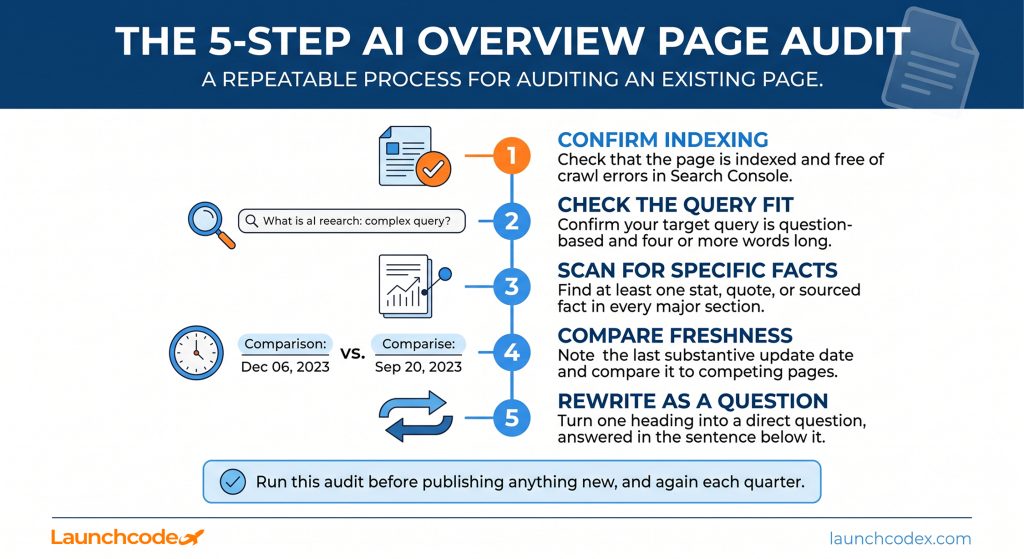
Query fan out is the process where Google splits a single search into several related sub-queries before generating an overview, then pulls citations from whichever pages answer each piece best. A page that only covers the headline topic can lose out to a page that also answers the follow-up questions a reader would naturally have next.
This is why two competitors can rank similarly and still get cited unevenly. One of them wrote for the whole cluster of questions around a topic. The other wrote a single, narrow answer.
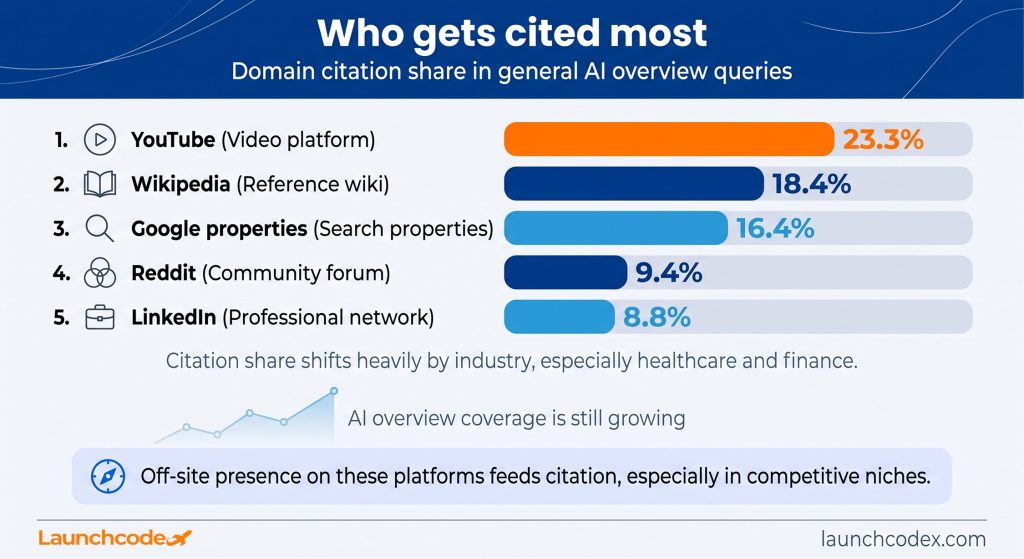
Fan out also explains where citations come from once you look past the obvious top 10 pages. Search Engine Land’s breakdown of citation data shows that the domains cited most often for general queries include YouTube, Wikipedia, Google’s own properties, Reddit, and LinkedIn, though the exact ranking shifts heavily by industry. Health queries, for example, favor government and clinical sources far more than general search does. This tells you two things: off-site presence on the platforms your industry actually cites matters, and a single set of “top domains” will not apply evenly across every niche.
Overviews rarely appear alone, either. SE Ranking’s tracking found that an AI overview shows up alongside at least one other SERP feature 99.25 percent of the time, most often People Also Ask. If your content already earns space in Featured Snippets or PAA, you are more likely to be positioned for overview citation as well.
Practical ways to cover a fan out cluster:
A controlled academic study found that adding citations, quotations from relevant sources, and statistics to a page increased its visibility in generative AI responses by more than 40 percent, outperforming tactics like keyword stuffing or rewording for uniqueness alone. Generic, unsupported claims are the single easiest thing to fix in most existing content, and the data shows they carry the least weight with AI systems.
This research comes from the paper that founded generative engine optimization, published by researchers at Princeton and Georgia Tech. It tested nine optimization methods across roughly 10,000 queries and found that specificity consistently outperformed vague, generalist writing. This is the strongest piece of controlled evidence in this article, and it should shape how your team writes, not just how it formats.
Compare these two sentences.
The second version gives an AI system something concrete to extract and attribute. The first gives it nothing worth citing over a competitor’s page.
This is also where E-E-A-T and information gain connect. Content that merely follows E-E-A-T guidelines qualifies for consideration. Content that adds a fact, a number, or a firsthand observation the top ranking pages do not already have is what gets pulled into a synthesized answer.
“When we rebuild a client’s page at Launchcodex, the paragraphs that survive into an AI summary are almost always the ones carrying a number, a name, or a dated source. The paragraphs making a broad claim get skipped every time.” Derick Do, Co-Founder and Chief Product Officer
Content freshness correlates with AI overview citation, but the relationship is more forgiving than most guides suggest. About 44 percent of citations come from content published the prior year, 30 percent from two years back, and 11 percent from three years back, meaning roughly 85 percent of citations come from content published within a three year window, not just the past few weeks.
This gives you a realistic target. You do not need to republish a page every month to stay eligible. You need a review cycle that catches outdated stats, dead links, and stale examples before they pile up.
Seer Interactive’s research on content recency and AI visibility is the source behind that three year distribution, and it lines up with what practitioners are seeing across other AI platforms too. Metehan Yeşilyurt, co-founder of AEO Vision, summed up the broader pattern in a widely shared post, noting that ChatGPT prioritizes recent over perfect. A three year old page with strong bones still needs a periodic pass to stay competitive against something published last quarter.
A simple freshness cadence:
Getting cited in an AI overview is not pure upside. A large-scale study found that 11.0 percent of individual factual claims inside AI overviews are unsupported by the pages they cite, with omission as the most common failure mode. That means roughly one in nine claims tied to your brand inside an overview could misstate or oversimplify what your page actually says, and almost no competing guide addresses this.
This finding comes from the same Washington University research referenced earlier, based on nearly 100,000 individual claims analyzed across 40 days of AI overview activity. The researchers also found that source quality and claim accuracy are largely independent of each other, meaning a well-written, authoritative page is not automatically immune from being misrepresented once it gets pulled into a synthesized answer.
Common ways this shows up:
What to do if it happens to you:
“We treat this like any other production system. If an output can misrepresent your data, you monitor it on a schedule. You do not just hope it stays accurate.” Derick Do, Co-Founder and Chief Product Officer
Treat this as a standing part of your monitoring process, not a one-time check. As long as AI overviews keep synthesizing rather than quoting directly, some rate of misrepresentation is likely to persist.
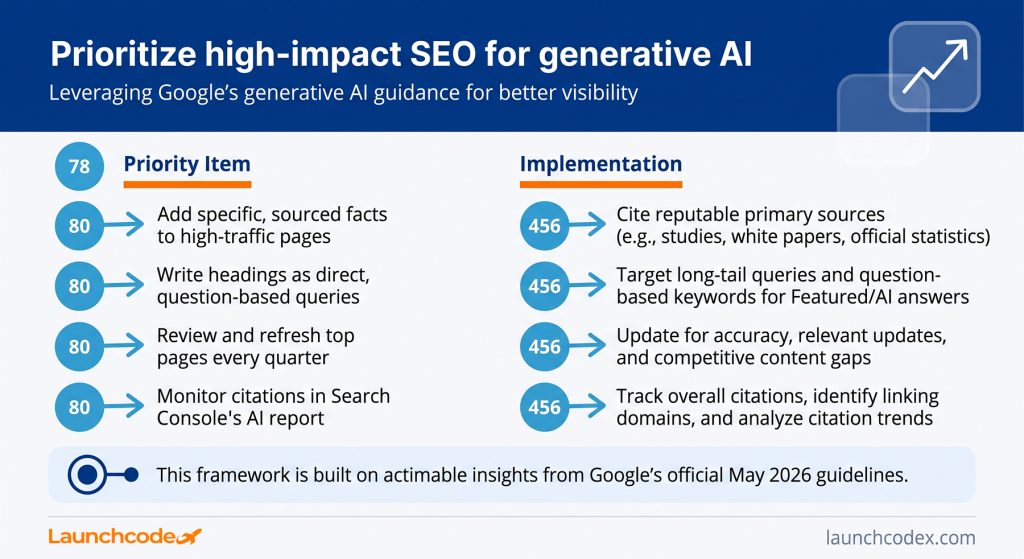
Start with the two moves backed by the strongest evidence. Add specific, sourced facts to your highest-traffic pages, and restructure your top queries around question-based headings that match how fan out actually works. Both are supported by controlled research, not just correlation.
After that, build a quarterly freshness review instead of chasing a monthly rewrite schedule, and add AI overview monitoring to whatever reporting cadence you already use for organic traffic. Skip the llms.txt file, skip the content chunking, and skip chasing inauthentic mentions. Google has already said those do not affect eligibility.
As SEO consultant Andrew Holland has framed it, the goal was never GEO for its own sake, it was organic revenue growth, and GEO is just one tactic inside that larger goal.
“That is the same test we apply to every GEO tactic before it goes into a client’s roadmap. If it does not tie back to pipeline or revenue, it does not get priority, no matter how popular the tactic is online.” Tanner Medina, Co-Founder and Chief Growth Officer
No. Google’s own guidance confirms there is no special schema required for AI overview eligibility. Schema still helps with broader SEO, including rich results, so it is worth using, just not as an AI overview shortcut.
There is no fixed rule, but data shows roughly 85 percent of citations come from content published within the prior three years. A quarterly review of high-traffic pages is a realistic, sustainable cadence.
Yes. Independent research shows a large share of cited pages rank outside the top 10, and some rank outside the top 100 entirely, largely due to query fan out pulling in sources for related sub-questions.
Check the Generative AI performance report in Search Console to see which queries are involved, compare the cited text against your original page, and use Google’s feedback option on the overview if the misrepresentation is material.


Real stories from the people we’ve partnered with to modernize and grow their marketing.