
Share:

AI marketing & automation


If you searched for schema markup advice this year, you probably found two contradictory answers. One camp says schema is essential for getting cited by ChatGPT and Google AI Overviews. Another points to a large 2026 study claiming schema does almost nothing for AI visibility. Both camps are citing real research. Neither is telling you the whole story.
This guide sorts out what is actually confirmed, what is still contested, and what you should do about it. You will learn which schema types still earn rich results in 2026, how to build an entity graph that ties your brand together across pages, and how to structure the visible content on your site so both search engines and AI systems can use it. By the end, you will have a working plan instead of a set of conflicting rules of thumb.
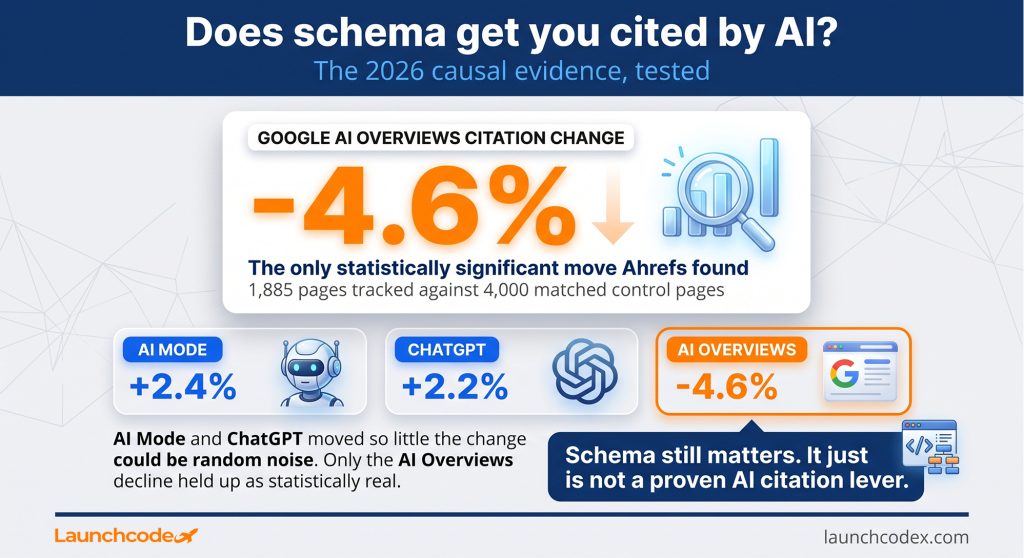
No single study settles this question yet. A 2026 Ahrefs study tracking 1,885 pages found adding schema produced no meaningful citation lift on Google AI Mode or ChatGPT, and a small decline on Google AI Overviews. A separate 2025 experiment found the opposite: a page with well-built schema was the only one of three test pages to reach an AI Overview. Both results are legitimate, and the difference comes down to what each study actually tested.
Neither study is wrong. They measured two different questions, and reading them side by side tells you more than either one alone.
Ahrefs ran a matched study of nearly 2,000 pages that added JSON-LD schema between August 2025 and March 2026, comparing them against 4,000 similar pages that made no schema changes. Every page in the dataset already had at least 100 AI Overview citations before the test started. The result: adding schema moved citations by 2.4 percent on AI Mode and 2.2 percent on ChatGPT, both too small to count as real change, and Google AI Overviews actually dropped 4.6 percent, a small but statistically real decline.
The same research also found that AI-cited pages were nearly three times more likely to carry JSON-LD than uncited pages. That correlation is what fuels most schema-boosts-AI-visibility claims. But once the team isolated the effect of adding schema to pages that were already being cited, the lift disappeared. Sites with schema also tend to have stronger content and more authority, and those factors were likely doing the real work.
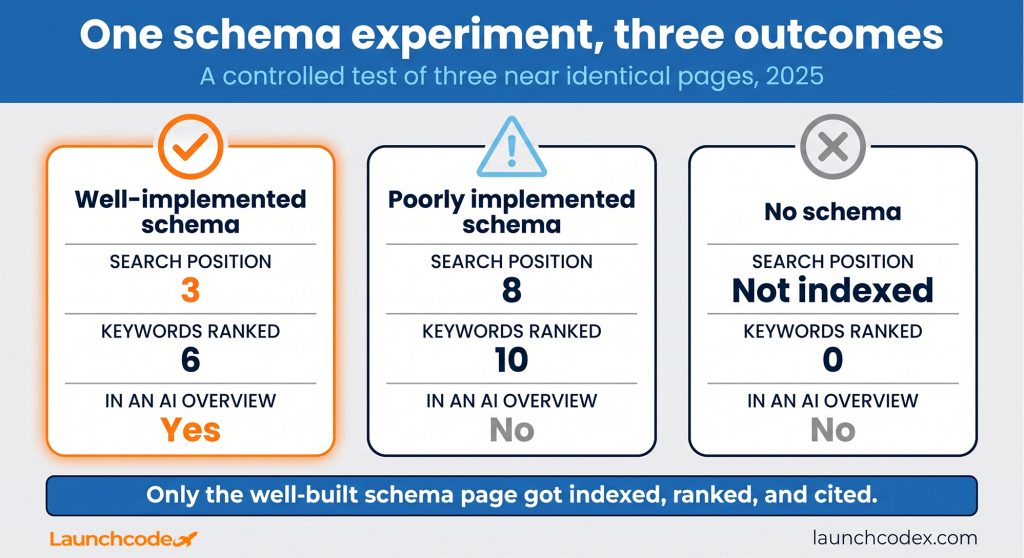
Five months earlier, a different team ran a controlled three-page test: one page with well-implemented schema, one with poor schema, and one with none, all targeting keywords of similar difficulty. Only the well-implemented schema page appeared in a Google AI Overview, and it also reached position 3 in traditional search. The poor-schema page ranked for 10 keywords but never triggered an AI Overview. The no-schema page got crawled within minutes but was never indexed at all.
That last detail matters. This experiment measured whether a brand-new page could get indexed and become eligible for an AI Overview in the first place. The Ahrefs study measured whether adding schema to a page already inside that consideration set pushed it higher. Those are different questions with different answers.
Strip away the competing studies and two platform-level facts remain. In April 2025, Google’s Search team confirmed that structured data gives an advantage in search results, a point reviewed alongside the wider research on schema and AI. Separately, Microsoft’s Bing team confirmed at SMX Munich in March 2025 that schema markup helps its large language models understand content for Copilot. ChatGPT, Perplexity, and Claude have not made an equivalent statement either way.
Here is how the current evidence breaks down:
| Status | Platform or claim | What we actually know |
|---|---|---|
| Confirmed | Google AI Overviews | Google’s Search team has confirmed structured data gives an advantage in search results |
| Confirmed | Microsoft Bing Copilot | Bing has confirmed schema helps its LLMs understand page content |
| Contested | Citation frequency on already-cited pages | Ahrefs found no meaningful lift from adding schema to pages already being cited |
| Contested | New page indexing and AI Overview eligibility | An earlier three-page test found schema helped a new page get indexed and reach an AI Overview |
| Settled negative | FAQ rich results | Google ended these outright in May 2026, regardless of schema quality |
Treat schema as infrastructure that supports indexing, entity clarity, and confirmed platforms like Bing Copilot, not as a guaranteed lever for ChatGPT or Perplexity citations.
“Clients ask us if schema will get them cited by ChatGPT. We tell them it is not that kind of lever. It is entity clarity and rich result eligibility, and that still moves pipeline when it is paired with real content.” Tanner Medina, Co-Founder and Chief Growth Officer
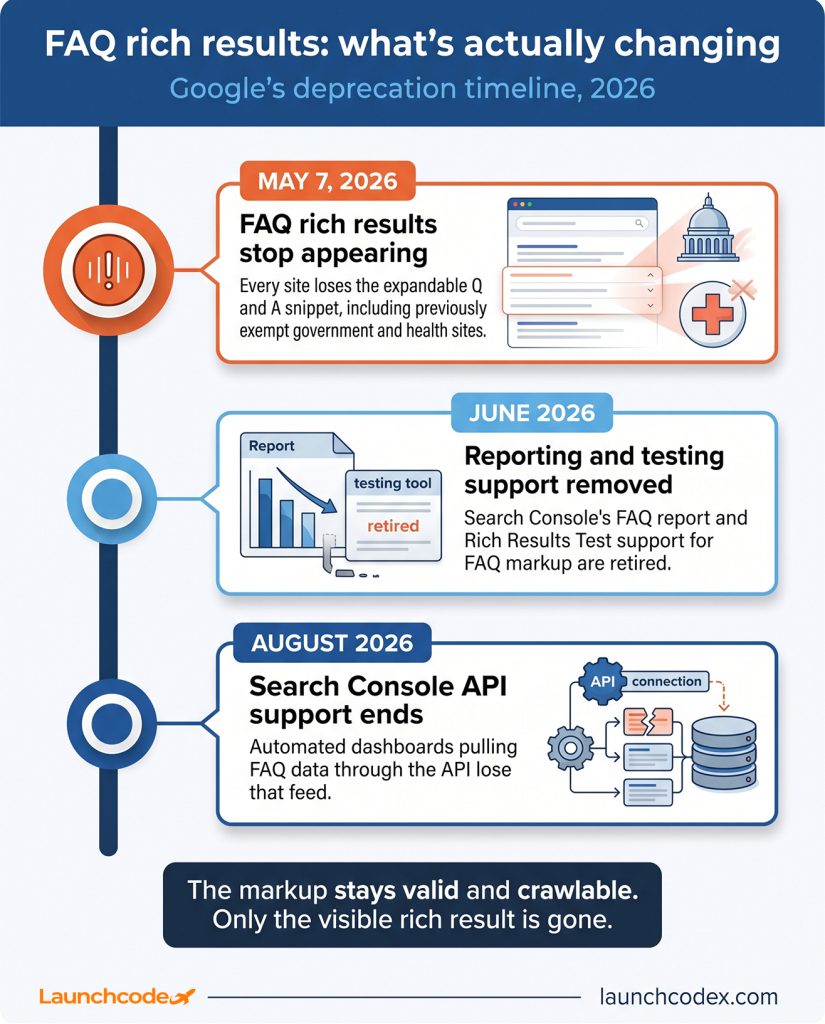
Google ended FAQ rich results in Google Search as of May 7, 2026, and confirmed the change in its FAQ structured data documentation. Reporting and Rich Results Test support followed in June, with Search Console API support removed in August. If you built years of strategy around the expandable question and answer snippet, that visual reward is gone for every site, not only the ones that abused it.
This is not a sudden reversal. Google narrowed FAQ rich results to authoritative government and health sites back in 2023, after widespread misuse by sites bolting generic FAQ blocks onto pages that did not need them. The May 2026 update closes that loop for good.
You do not need to rip out existing FAQ schema. Google’s own documentation still confirms the markup remains a valid Schema.org type, and it stays crawlable by Bing, PerplexityBot, and other retrieval crawlers even though the visible rich result is gone. What you should stop doing is adding new FAQ schema purely to chase a SERP feature that no longer exists. Redirect that effort toward Organization, Article, and Product markup, which still earn visible rich results in 2026.
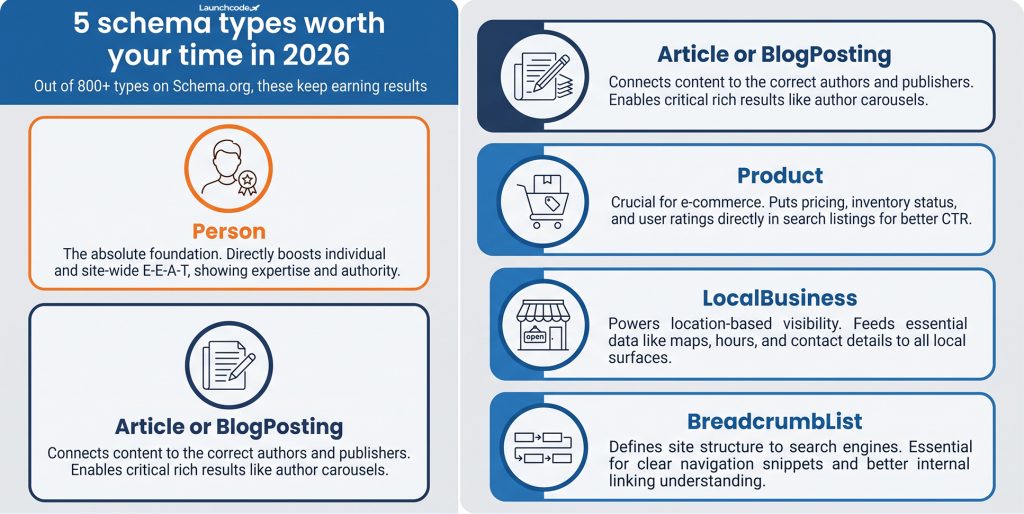
Focus on five schema types for most businesses: Organization, Article or BlogPosting, Product, LocalBusiness, and BreadcrumbList. Google’s John Mueller has said structured data types “come and go, but a precious few you should hold on to,” and these five are the ones that keep earning rich results and entity clarity year after year.
Schema.org lists over 800 types, and chasing all of them wastes development time. Search Engine Journal reported on Mueller’s comment after Google deprecated several lesser-used types in January 2026, including Practice Problem markup and most Dataset support outside Dataset Search. The point was not that schema is disappearing. It was that specific types rotate out while the foundational ones stay.
| Business type | Priority schema | Why it matters |
|---|---|---|
| SaaS and B2B | Organization, Article, SoftwareApplication or Product | Establishes the brand as a clear entity and supports feature and pricing pages |
| Ecommerce | Product, Organization, BreadcrumbList | Powers price, availability, and rating rich results directly in search |
| Local and multi location brands | LocalBusiness, Organization, Review | Feeds hours, address, and ratings into local search and map results |
| Content and media sites | Article or BlogPosting, Organization, Person | Strengthens authorship and publisher identity across rich results and entity graphs |
“We stopped chasing every schema type years ago. Organization, Article, and Product cover most of the rich result value for the SaaS and ecommerce clients we work with, and that is where we tell teams to spend their time.” Tanner Medina, Co-Founder and Chief Growth Officer
The highest value technique in 2026 is linking separate schema blocks into one connected structure instead of leaving them as isolated fragments. Give your organization a stable @id, then reference that same @id as the publisher on every article and the employer on every author. The result is one verified brand node connected to everything it publishes.
A simple entity graph looks like this:
{
"@context": "https://schema.org",
"@graph": [
{
"@type": "Organization",
"@id": "https://yoursite.com/#organization",
"name": "Your Company Name",
"url": "https://yoursite.com"
},
{
"@type": "Person",
"@id": "https://yoursite.com/#author-jane-doe",
"name": "Jane Doe",
"worksFor": { "@id": "https://yoursite.com/#organization" }
},
{
"@type": "Article",
"headline": "Your article title",
"author": { "@id": "https://yoursite.com/#author-jane-doe" },
"publisher": { "@id": "https://yoursite.com/#organization" }
}
]
}
“We start with a stable organization @id before touching a single article page. Getting that foundation right once means every new page inherits a clean, connected identity instead of starting as a disconnected fragment.” Derick Do, Co-Founder and Chief Product Officer
That discipline is what we build into our entity-first SEO and GEO work at Launchcodex, and it is why the setup order matters more than the code itself.
Use JSON-LD for nearly all schema markup on your site. It is the format Google recommends, it lives in a single script tag separate from your visible content, and it is far less error-prone than editing HTML elements directly. Reserve Microdata for narrow cases like DiscussionForumPosting, where Google specifically recommends it to avoid duplicating large blocks of text in your code.
Choosing a format is the first decision, and it is an easy one for most sites.
| Format | Where it lives | Best for |
|---|---|---|
| JSON-LD | A single script tag, usually in the page head | Most sites and schema types, since Google recommends it |
| Microdata | Inline attributes inside existing HTML elements | Legacy setups or specific types like DiscussionForumPosting |
| RDFa | Inline attributes similar to Microdata | Rare today, mostly older publishing systems |
Schema markup describes your content to machines, but the content itself still has to be written in a way AI systems can extract cleanly. That means answer-first paragraphs, descriptive headings, and entities named explicitly in the text rather than implied through pronouns or vague references.
This is the half of the work that markup alone cannot do. A page with clean schema and a rambling, unstructured body still gives AI systems very little to work with.
Open every major section with the direct answer to the question implied by its heading, then support it with detail. This is the same inverted pyramid structure used throughout this guide. A section that opens with three sentences of setup before answering anything forces both readers and AI systems to work harder to extract the point.
Write “the Rich Results Test flags eligibility errors” instead of “this tool flags errors.” Use full names for tools, standards, and organizations the first time you reference them in a section, since AI systems build understanding from explicit entity mentions in visible text, not just from schema tags a person never reads.
A generic paragraph might read: “Adding structured data can help your content get noticed by search engines and AI tools.” Restructured for extraction, it becomes: “Organization schema with a stable @id property tells Google and AI systems your brand is one connected entity, which supports Knowledge Graph accuracy and consistent brand recognition across search results.” The second version names the specific schema property, the specific systems involved, and the specific outcome, giving both a search engine and an AI system something concrete to extract and cite.
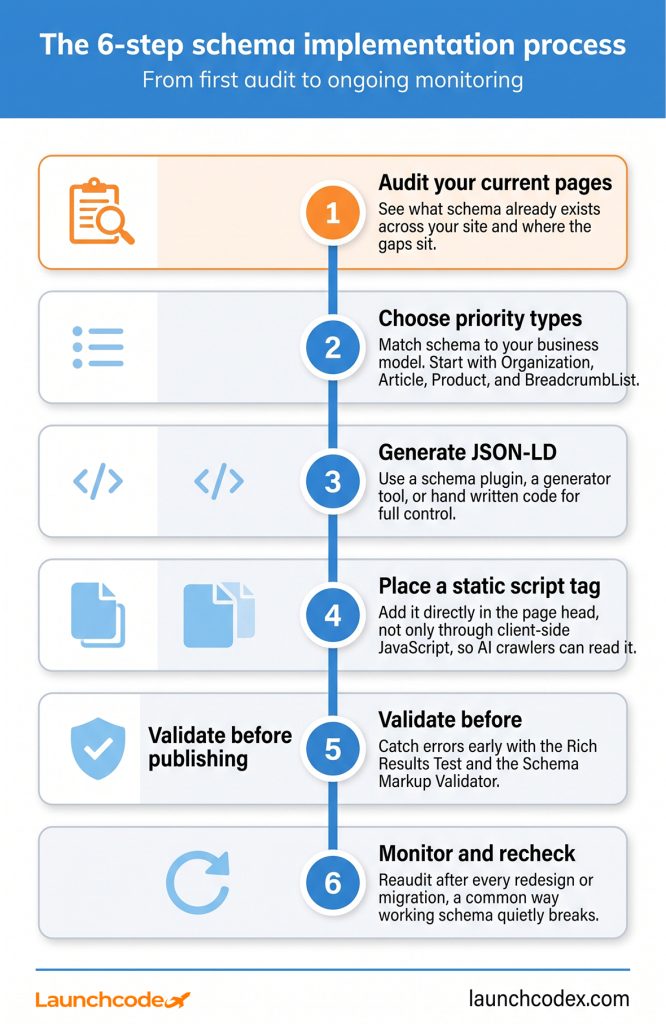
Test individual pages with Google’s Rich Results Test and the Schema Markup Validator at validator.schema.org, since each checks a different thing. The Rich Results Test only confirms eligibility for Google’s specific rich result features, while the validator checks your markup against the full Schema.org specification.
Testing one page at a time works for spot checks, but most sites need a way to catch problems across hundreds or thousands of pages at once.
Run new or changed pages through the Rich Results Test before publishing, then check the Schema Markup Validator if you want to confirm compliance beyond Google’s supported feature set. Fix any errors first, since a single missing property can suppress an entire rich result.
Use Google Search Console’s structured data reports under Enhancements to see valid, warning, and error counts across your whole domain. A full-site crawler such as Ahrefs Site Audit or Screaming Frog adds the ability to sort by organic traffic, so you can prioritize fixing schema errors on your highest-value pages first instead of working through the list in random order. Recheck after any site migration or redesign, since template changes are one of the most common ways working schema quietly breaks.
“Schema audits are a workflow problem before they are a technical one. Once you sort issues by organic traffic instead of working the list top to bottom, you fix the pages that actually matter first.” Derick Do, Co-Founder and Chief Product Officer
Schema markup in 2026 is not the AI citation shortcut some guides promise, and it is not the dead tactic others claim either. The honest position sits in between. Organization, Article, Product, and entity graph markup remain worth building because they earn rich results, sharpen entity recognition, and are confirmed to help on Google AI Overviews and Bing Copilot specifically. What schema will not do on its own is guarantee a citation from ChatGPT or Perplexity, or rescue content that is thin, generic, or poorly structured.
Start with an audit of what schema already exists on your site, prioritize the five types covered in this guide, and pair that markup with answer-first, clearly structured content. That combination, not either half alone, is what gives you the best shot at showing up across both traditional search and AI-generated answers. If you want a second set of eyes on where your site stands today, our schema and content structure checklist walks through the same audit steps in more detail.
No. The markup is still valid and still crawlable by Bing and other AI crawlers. Just stop adding new FAQ schema purely to chase a rich result that no longer exists.
Schema is not a direct ranking factor. It affects rich result eligibility and how clearly search engines and some AI systems understand your entities, which can indirectly support visibility and click-through rate.
Use JSON-LD for almost everything. It is the format Google recommends and the easiest to maintain. Reserve Microdata for narrow cases like DiscussionForumPosting.
It is not confirmed either way. Google AI Overviews and Microsoft Bing Copilot have both confirmed they use structured data. ChatGPT and Perplexity have not made an equivalent statement.
Check after every redesign, template change, or migration, since those are the most common ways working schema breaks. Beyond that, a full-site audit every quarter catches drift before it affects rich results.


Real stories from the people we’ve partnered with to modernize and grow their marketing.