
949.822.9583
support@launchcodex.com

How to compare GEO services agencies

Last Date Updated:
February 22, 2026
Time to read clock
15 minute read
Choosing a GEO agency comes down to proof and execution. The right partner can show how they measure AI mentions and citations, what they will change on your site, and how that work connects to pipeline. Use a scorecard, require a proof bundle, and reject vague reporting.
How to compare GEO services
Table of Contents
Primary Item (H2)
Build-operate-transferCo-buildJoint ventureVenture sprint
Ready for a free checkup?
Get a free business audit with actionable takeaways.
Start my free audit
Key takeaways (TL;DR)
Compare GEO agencies with a weighted scorecard that prioritizes measurement, proof, and shipping capability.
Require a minimum proof bundle that includes a fixed query set, before and after evidence, and a sample report.
Key takeaway 3Choose agencies that connect AI visibility to pipeline and qualified leads, not only rankings.

GEO services are easy to pitch and hard to verify. Many agencies promise AI visibility but cannot explain how they measure citations or what they will change on your site.

This guide gives you a practical scorecard, proof standards, and the exact questions to ask so you can choose a GEO partner that can measure results and ship work that moves revenue.

What a good GEO agency should do, and what it should not do

A strong GEO agency runs controlled visibility tests across AI surfaces, improves your entity and content coverage, and ships technical changes that make your site easier to cite. A weak GEO agency sells “AI optimization” but cannot define success, show prior evidence, or explain what they will implement on your site. Treat this as a vendor validation exercise with clear pass fail criteria.

What GEO is, in buyer terms

GEO focuses on inclusion in AI-generated answers such as Google AI Overviews, ChatGPT responses, and Perplexity citations. Your progress shows up as measurable mentions and citations tied to specific queries.

Your success often appears as:

  • Mentions of your brand or products inside AI answers
  • Citations and links to your pages
  • Better coverage on comparison and “best” queries
  • More qualified demand even when clicks decline

If you need a shared definition, use the academic framing from the paper that introduced Generative Engine Optimization and reported measurable visibility gains in controlled tests, up to 40 percent in their experiments (arXiv GEO paper).

What GEO is not

Avoid agencies that define GEO in these ways:

  • “We will rewrite content to sound more like ChatGPT.”
  • “We will add one file or one tag and you will rank in AI.”
  • “We guarantee citations.”

Platforms change frequently. Query results vary by location, device, and prompt wording. A credible agency will say that clearly.

Red flags that show up in the first call

  • They cannot name the AI surfaces they track, such as AI Overviews, Perplexity, ChatGPT, Copilot, or Gemini
  • They only discuss rankings and never mention citations or share of voice
  • They cannot explain a query set methodology
  • They cannot show a sample report with shipped changes
  • They sell a fixed GEO package with no discovery phase

Use a GEO agency scorecard so you compare apples to apples

The most reliable way to compare GEO agencies is a weighted scorecard that forces specific evidence. Weight measurement and proof higher than claims. Weight shipping capability higher than strategy decks. A scorecard also helps your CFO or leadership team understand why you selected a vendor.

A practical scorecard you can use today

Use a 100 point model so you can rank agencies quickly.

CategoryWeightWhat good looks likeWhat to watch out for
Measurement and reporting25Fixed query sets, citation tracking, monthly share of voice, clear definitions“We will report AI visibility” with no method
Proof and case evidence20Before and after examples tied to a query set, dates, screenshots, change logCase studies with no evidence or only rankings
Implementation and shipping20Technical plus content plus data capability, clear backlog, weekly ship cadenceStrategy only or advisory deliverables
Content and entity strategy15Entity map, topic coverage plan, page brief system, QA processGeneric content production packages
Platform coverage and prioritization10Clear focus on the surfaces that matter for your category“We do everything” with no priorities
Governance and brand safety10Accuracy controls, review workflow, escalation processNo process for brand misrepresentation

Minimum pass fail checks before you score anything

Fail the agency early if they cannot do these three things:

  1. Define success metrics in plain language, such as mentions, citations, and share of voice.
  2. Explain exactly how they will measure those metrics and how often.
  3. Show a sample report that includes shipped work and outcomes.

“Most failed GEO engagements trace back to weak measurement definitions. If you cannot define the metric, you cannot manage the outcome.”
Tanner Medina, Co-Founder and Chief Growth Officer

If they pass these checks, then score them.
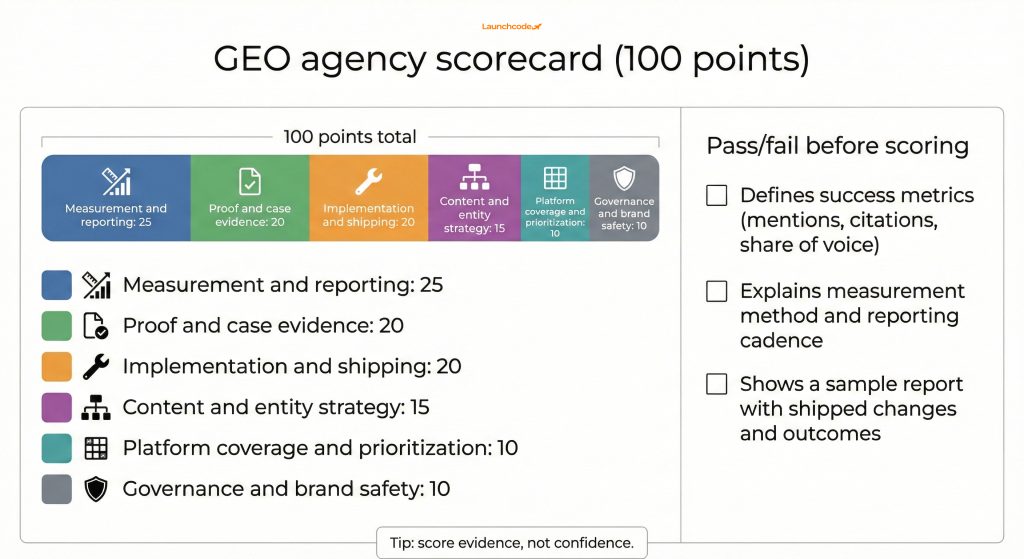
GEO agency scorecard

Demand a proof bundle before you sign

You should not select a GEO agency without a minimum proof bundle. The bundle proves they can measure, execute, and explain results. Without it, you are buying a narrative. A proof bundle also reduces risk because you can audit their work if performance stalls.

What should be in a minimum proof bundle

Request these items during selection, not after onboarding.

  • A sample query set with 30 to 100 prompts
    • Split by intent: informational, comparison, best, alternatives, vendor, pricing
    • Include at least 5 to 10 high intent queries tied to pipeline
  • A before and after example for at least one client
    • Show the query text, date, and visible output
    • Show which page was cited and why
  • A measurement definition sheet
    • What counts as a mention
    • What counts as a citation
    • How they handle variance across runs
  • A sample monthly report
    • Wins and losses
    • Shipped changes
    • Prioritized next actions

What real evidence should look like

Evidence should connect three elements:

  • The change shipped, such as content updates, schema work, or internal linking fixes
  • The visibility movement, including mentions, citations, and share of voice
  • The business signal, such as qualified lead lift or assisted conversions

This connection matters because top rankings do not always translate to citations. Ahrefs analyzed AI Overviews and found that even pages ranking first appear among the top cited links only about half the time in their sample (Ahrefs citation research).
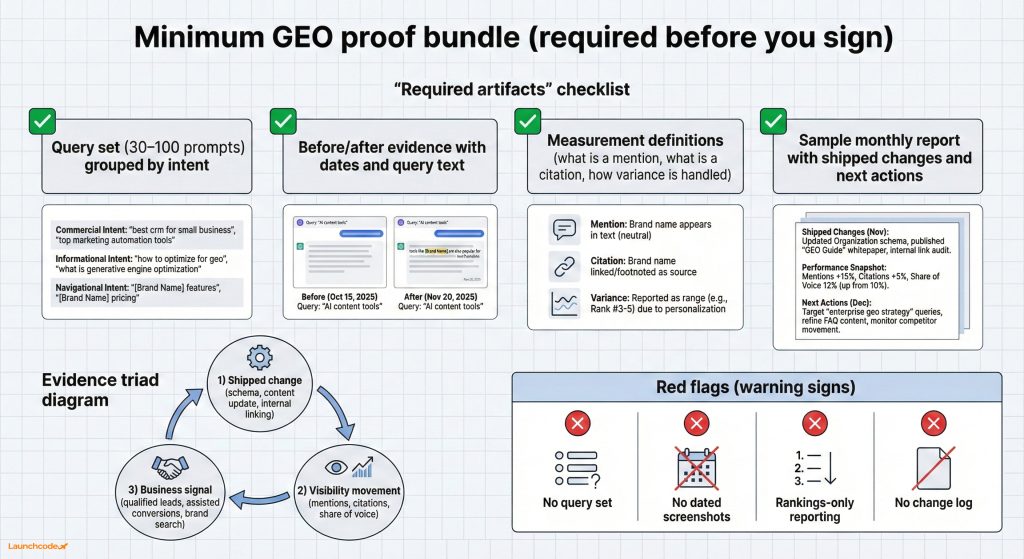
GEO Proof bundle checklist

Compare reporting and measurement

GEO success is difficult to evaluate if reporting is weak. Choose an agency that measures how AI answers change over time using a controlled query set and consistent sampling. Reporting should also connect visibility to funnel metrics because AI answers often reduce clicks while awareness rises.

What metrics should appear in a GEO report

At minimum, expect:

  • Query set coverage
    • How many tracked prompts show your brand mentioned
    • How many show your pages cited
  • Citation position
    • Whether you appear first cited, second cited, or lower
  • Share of voice by intent group
    • Informational versus comparison versus purchase intent
  • Content and technical changes shipped
    • With dates and affected pages
  • Business metrics
    • Qualified leads influenced
    • Pipeline influenced
    • Brand search trends
    • Assisted conversions

Why click-only reporting is no longer enough

When AI summaries appear, users click less often. Pew Research analyzed tens of thousands of searches and documented reduced click behavior when AI summaries appear on results pages (Pew Research AI summaries and clicks).

Your agency should reflect this reality. If they only promise more organic traffic without AI visibility metrics, they are not running a full GEO program.

Tooling questions that reveal real capability

Ask which tools they use for each layer:

  • Crawling and technical QA, such as Screaming Frog
  • Search performance baselines, such as Google Search Console
  • AI surface monitoring and SERP intelligence, such as Semrush or Ahrefs
  • Trend validation, such as Similarweb

The goal is not the tool brand. The goal is whether they can explain how each tool supports measurement and execution.

Evaluate whether the agency can actually ship the work

Many GEO engagements fail because the agency cannot execute across content, development, and data. GEO requires implementation, not advice. Choose agencies that can produce a prioritized backlog, ship weekly improvements, and document changes so results are attributable.

What a real GEO implementation roadmap looks like

A practical 30, 60, 90 plan should include:

  1. Days 1 to 30: baseline and instrumentation
    • Define the query set
    • Capture baseline outputs
    • Audit entity coverage, schema, and internal linking
    • Set reporting templates and governance
  2. Days 31 to 60: ship high leverage fixes
    • Update priority pages for entity completeness
    • Improve structured data where it reflects real content
    • Fix internal linking to strengthen topical clusters
    • Publish missing comparison and alternatives content
  3. Days 61 to 90: scale and optimize
    • Expand the query set based on winners
    • Build repeatable content briefs
    • Improve authority signals through credible references
    • Refine based on platform variance

What to ask so you can verify they ship

  • What do you ship in the first two weeks, and on which pages?
  • Who writes, edits, and implements technical changes?
  • How do you log changes so we can attribute outcomes?
  • What does a weekly status update include?

If they cannot answer with specifics, expect slow progress.
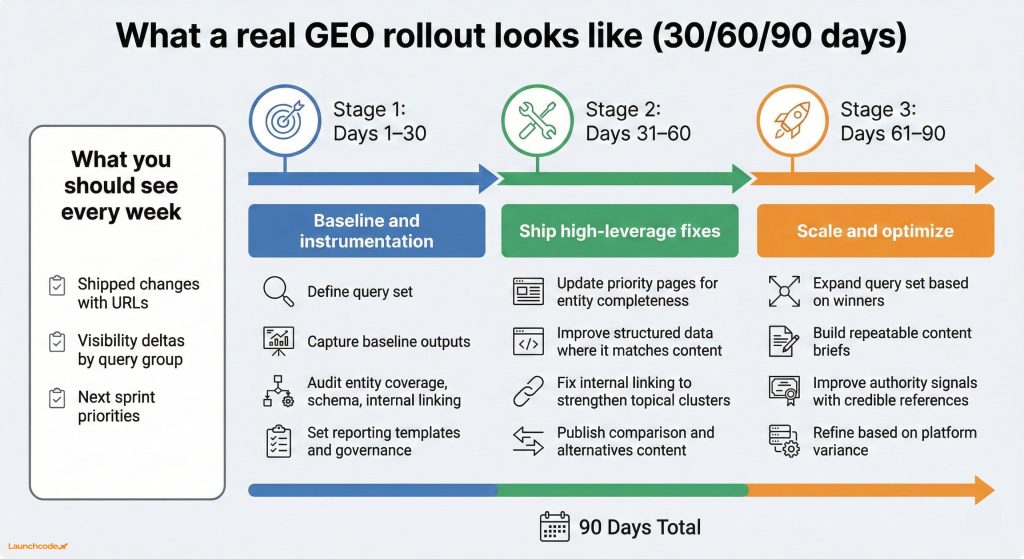
30 60 90 GEO implementation roadmap

A practical note from delivery teams

If your internal team cannot ship development work quickly, choose an agency that can implement or coordinate implementation. Recommendation-only engagements often stall. For a structured vendor evaluation model, adapt a classic SEO RFP process and apply GEO-specific proof requirements.

Check content and entity strategy depth, not content volume

GEO performance improves when your site answers the full set of related questions a model expects, using clear entities and supporting evidence. Agencies that focus on content volume often miss entity coverage, source quality, and internal linking. Choose an agency that can build a coverage map and a briefing system.

What entity coverage looks like in practice

For a B2B SaaS example, strong coverage includes:

  • Product category definitions
  • Use cases by role and industry
  • Alternatives and comparisons
  • Pricing and implementation considerations
  • Integrations and technical constraints
  • Evidence such as benchmarks and methodology

This structure helps both human readers and retrieval systems. It also reduces hallucination risk because your pages contain clear, citable facts.

Quality controls you should expect

  • Author and reviewer standards with credentials
  • Source requirements for claims
  • Update policies for fast changing topics
  • On page structure that is easy to extract
    • Clear headings
    • Direct answers
    • Tight paragraphs

If the agency cannot describe a QA workflow, expect inconsistent outputs.

Prioritize platforms and surfaces based on your category

A credible GEO agency does not optimize every platform equally. They select the surfaces that matter for your buyers and map your query set to those surfaces. Platform prioritization should be explicit and tied to demand patterns.

A simple way to decide what matters first

Use your buyer journey as the filter.

  • Google AI Overviews matters when your category has strong informational demand and mid funnel comparisons.
  • Perplexity matters when buyers rely on citation heavy research.
  • ChatGPT matters when conversational research appears in your funnel.

Semrush reported AI Overviews appearing across a meaningful share of queries in its large scale study, which supports treating this as an active channel (Semrush AI Overviews study).

What to ask about platform testing

  • Do you test with consistent locations, devices, and logged in states?
  • How do you handle prompt variance across runs?
  • Do you track both mentions and citations across surfaces?

If the agency cannot describe a testing protocol, their results will be difficult to trust.

Validate governance and brand risk controls

GEO influences how your brand appears inside answers you do not control. A serious agency uses governance, review workflows, and accuracy standards to reduce misrepresentation risk. This is critical for regulated industries and any brand that depends on trust.

Governance controls you should require

  • Claim verification rules
    • Sources for statistics
    • Evidence for comparisons
  • A review workflow
    • Who approves copy changes
    • Who approves structured data
  • An escalation path
    • What happens when AI outputs misrepresent your brand
    • Expected response time
  • Change logging
    • What changed, when, and why

“Delivery quality depends on process discipline. Clear review steps and change logs prevent small errors from becoming client issues.”
Brittany Charles, SVP, Client Services

Technical nice to have versus must have

Do not let agencies oversell emerging standards. For example, llms.txt is a proposed convention to help LLMs interpret site content at inference time, but adoption varies and it is not a guaranteed lever (llms.txt proposal). Treat it as a due diligence question.

A simple shortlisting process you can run in one week

You can shortlist GEO agencies quickly with a structured process: align goals, collect comparable artifacts, score with weights, then run a proof review call. This removes demo bias and forces real evidence. Most teams can complete this in about one week with two stakeholders.

Step by step shortlisting workflow

  1. Define your goal and scope
    • Which products or categories matter
    • What success means in measurable terms
  2. Ask every agency for the same five artifacts
    • Proof bundle
    • Implementation roadmap
    • Measurement definitions
    • Team roles and responsibilities
    • Governance process
  3. Score them using the 100 point scorecard
  4. Run a proof review call with your top two vendors
    • Focus on evidence and methodology
  5. Select the agency with the strongest proof to execution ratio

Common mistakes that waste budget

  • Selecting based on thought leadership alone
  • Accepting vanity metrics without definitions
  • Choosing strategy only vendors when you need execution
  • Ignoring governance until a brand issue appears
  • Letting the agency define success after the contract

How Launchcodex approaches GEO engagements

A practical GEO engagement combines measurement, shipping, and a repeatable content system. You need clear visibility baselines, a prioritized backlog, and reporting that connects AI presence to pipeline. Controlled query sets and disciplined implementation cycles create the most reliable progress.

Launchcodex treats GEO as part of a full funnel search system, combining technical execution, content development, and data instrumentation so teams can attribute outcomes and iterate. For related context, review:

What to do next to choose the right GEO partner

Select three agencies, request the same proof bundle, and score them with weights that favor measurement and execution. Your next step is a proof review call where the agency must walk through a real before and after example tied to a fixed query set. Clear evidence indicates a strong pilot candidate.

If you want alignment with your existing search program, review your current stack and confirm the agency can operate within it. For related support, see:

FAQ

What is the fastest way to compare GEO agencies?

Use a weighted scorecard and require a proof bundle from every agency. If the bundle is missing, disqualify them.

What deliverables should I expect in the first 30 days?

Expect a query set, baseline captures, an entity and schema focused audit, a prioritized backlog, and a reporting template with metric definitions.

Should a GEO agency guarantee citations or rankings?

No. Platform outputs vary by query and user context. Agencies should focus on controllable actions, measurement, and iteration.

How do I know if an agency can measure AI visibility correctly?

They should define mention and citation, explain how they sample prompts, and provide a report example using a consistent query set.

Is GEO separate from SEO?

GEO builds on SEO foundations but shifts the target outcome. You still need crawlability, content quality, and authority. GEO adds AI surface measurement, citation optimization, and entity coverage.

Launchcodex author image - Tanner Medina
— About the author
Tanner Medina
- Co-Founder & Chief Growth Officer
Tanner leads growth, strategy, and marketing operations. He helps brands build scalable systems across SEO, AI, and content that generate qualified pipeline. He focuses on frameworks that connect effort to revenue.
Launchcodex blog spaceship

Join the Launchcodex newsletter

Practical, AI-first marketing tactics, playbooks, and case lessons in one short weekly email.

Weekly newsletter only. No spam, unsubscribe at any time.
Envelopes

Explore more insights

Real stories from the people we’ve partnered with to modernize and grow their marketing.
View all blogs

Move the numbers that matter

Bring your challenge, we will map quick wins for traffic, conversion, pipeline, and ROI.

Get your free audit today

Marketing
Dev
AI & data
Creative
Let's talk
Full Service Digital and AI Agency
We are a digital agency that blends strategy, digital marketing, creative, development, and AI to help brands grow smarter and faster.
Contact Us
Launchcodex
3857 Birch St #3384 Newport Beach, CA 92660
(949) 822 9583
support@launchcodex.com
Follow Us
© 2026 Launchcodex All Rights Reserved
crossmenuarrow-right linkedin facebook pinterest youtube rss twitter instagram facebook-blank rss-blank linkedin-blank pinterest youtube twitter instagram