

Share:

AI marketing & automation


A spam update landed on August 18 and the SEO community asked one question within the hour. Is this the enforcement pass for AI search manipulation? Google added manipulation of generative AI responses to its spam definition on May 15, then shipped two spam updates after that clause went live. The timing invites the conclusion. Google has not confirmed it.
This article separates what Google confirmed from what the industry is inferring, gives a reasoned position on the AI spam question, and names which AI visibility tactics carry real penalty risk right now. You also get a realistic timeline for reading your own Search Console data before you change anything.
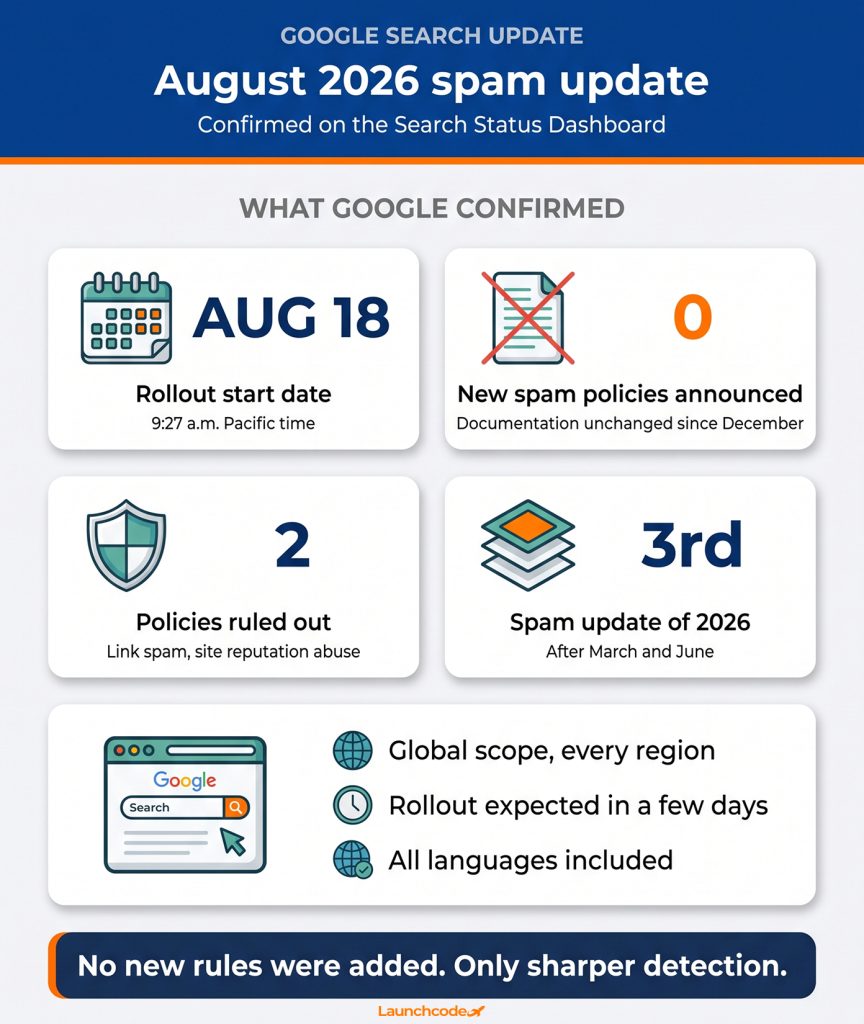
Google started the August 2026 spam update at 9:27 a.m. Pacific on August 18. It applies globally and to all languages, with a rollout Google expects to take a few days. No new spam policies shipped with it, and there was no companion blog post. Reporting also confirms the update does not target link spam or the site reputation abuse policy.
This is the third spam update of 2026, following March and June. The Search Status Dashboard logged it as an incident affecting ranking.
Barry Schwartz reported in his breakdown at Search Engine Roundtable that this update does not target link spam and does not target site reputation abuse, along with some other policies. That detail matters more than the announcement. Two of the largest enforcement categories are excluded, so whatever moved this week sits somewhere in the remaining list. Scaled content abuse, cloaking, doorway pages, scraping, and expired domain abuse all stay in scope.
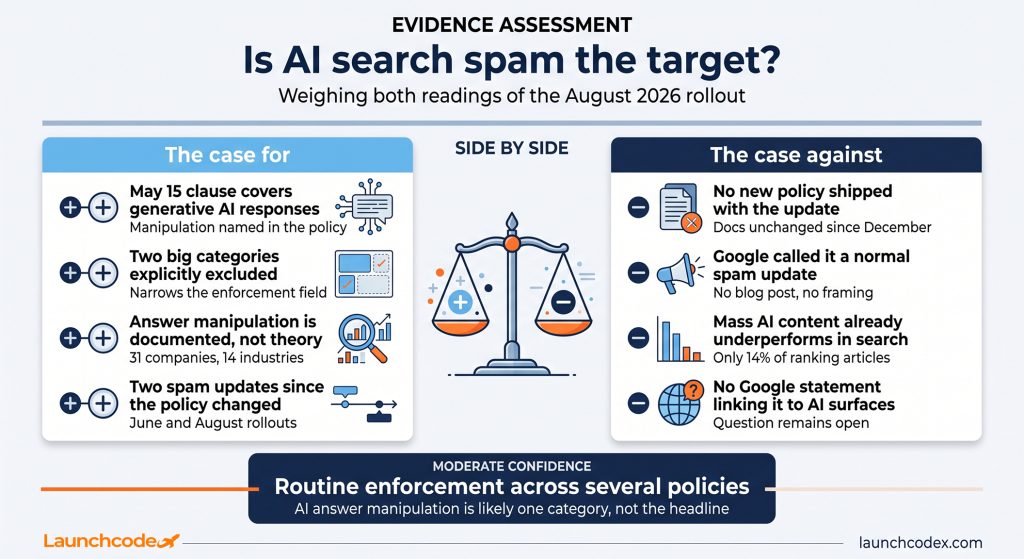
Google has not confirmed AI search spam as the target. Our read, at moderate confidence, is that this is routine detection enforcement across several policies at once, with AI answer manipulation likely one category among them rather than the headline. The strongest counter evidence is procedural. When Google changes the rules, it publishes documentation. This update arrived bare.
Both sides have real support. Here is how they compare.
| The case for AI search spam | The case against |
|---|---|
| The May 15 clause put manipulation of generative AI responses inside the spam definition | No documentation, no blog post, and no new policy shipped with this update |
| Google excluded link spam and site reputation abuse, which narrows the field | Google called it a normal spam update |
| Manipulation of AI answers is a documented commercial practice, not a theory | Mass AI content already underperforms in search without an enforcement pass |
| Two spam updates have now followed the policy change | Google has said nothing connecting this rollout to AI surfaces |
On May 15, 2026, Google widened its spam definition to cover attempts to manipulate generative AI responses in Search. Search Engine Land documented the wording change, which named AI Overviews and AI Mode as covered surfaces for the first time.
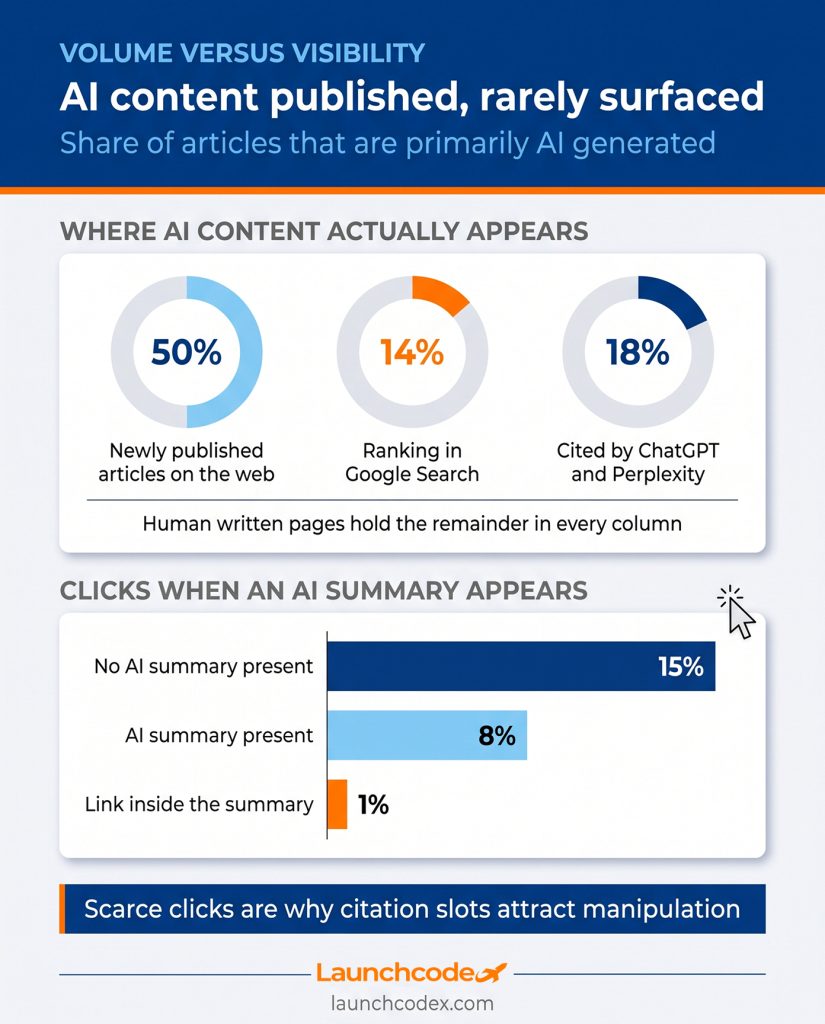
The motive is easy to trace. Pew Research Center tracked 68,879 Google searches from 900 US adults and found that users clicked a traditional result in 8 percent of visits when an AI summary appeared, against 15 percent without one. Only 1 percent clicked a link inside the summary. Scarce clicks make citation slots valuable, and valuable slots attract manipulation.
That manipulation already operates at scale. Microsoft’s security team tracked a pattern it calls AI recommendation poisoning for more than 60 days and, as TechRadar Pro reported, identified over 50 unique manipulation prompts from 31 companies across 14 industries.
Teams often assume any spam update is an AI content crackdown. The research does not support that. Independent analysis of Common Crawl data, covered by Axios, found AI-generated articles holding near half of newly published English-language articles for five straight quarters. In the same body of work, 86 percent of articles ranking in Google Search were human-written, and 82 percent of citations across ChatGPT and Perplexity went to human-written pages.
Mass-produced AI content already fails to rank. Google does not need a spam update to suppress what its ranking systems suppress on their own.
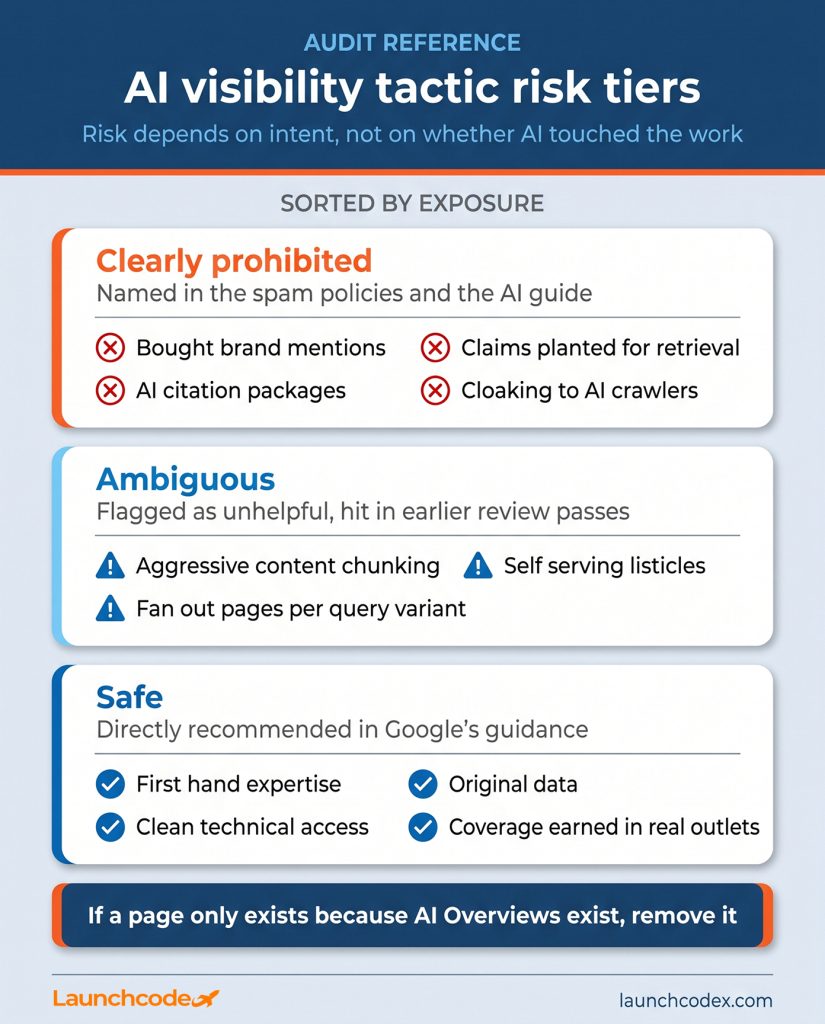
Risk depends on intent, not on whether AI touched the work. Tactics built only to force a brand into AI Overviews or AI Mode sit inside the spam definition. Google names inauthentic mentions directly. Using AI to help produce genuinely useful content is not a violation, and Google has stated that structured data is not required for generative AI search.
Google’s official guide to optimizing for generative AI features is the primary source here. It warns that seeking inauthentic mentions across the web is not as helpful as it might seem, because core ranking systems focus on quality while other systems block spam, and AI features depend on both.
| Risk tier | Examples | Why |
|---|---|---|
| Clearly prohibited | Bought brand mentions, AI citation packages, planted claims placed for retrieval, cloaked content served to AI crawlers | Named in the spam policies and the AI guide |
| Ambiguous | Aggressive content chunking, fan-out pages built per query variant, self-serving listicles | Not banned outright, but flagged by Google as unhelpful and hit in earlier review passes |
| Safe | First-hand expertise, original data, clean technical access, accurate titles, real coverage earned in real publications | Directly recommended in Google’s guidance |
Schwartz drew the historical parallel plainly, noting the practice reminds him of “the pre-Penguin link building services.” Gary Illyes made the same comparison at Search Central Live Sydney, putting mention buying in the same category as paid links.
“We audit AI visibility work the same way we audit links. If a page or a placement only exists because an AI surface exists, it comes out. On one inherited account we removed 40 paid mention placements before the June rollout, and organic sessions never dipped.” Derick Do, Co-Founder and Chief Product Officer, Launchcodex
Do not diagnose from a single day. Mark August 18 in your reporting, wait for the rollout to finish, then compare Search Console performance by page and by query. Past spam updates have completed anywhere from under 20 hours to 27 days, so a few days is a guideline rather than a promise. Open the manual actions report before you change anything.
Rollout length directly affects when your data becomes readable.
| Spam update | Rollout length |
|---|---|
| August 2026 | In progress, a few days expected |
| June 2026 | June 24 to June 26 |
| March 2026 | Under 20 hours, fastest on record |
| August 2025 | Nearly four weeks |
The full diagnosis sequence, including how to separate a spam update from a core update, is laid out in our walkthrough of the June 2026 spam update. The method has not changed. Only the date has.
“Volatility trackers like Semrush Sensor and Mozcast sample high-volume keywords, so a spam pass can barely register there while forums fill up. We run the 28-day Search Console comparison by query instead, and we wait for the dashboard to mark the rollout complete before we read it.” Tanner Medina, Co-Founder and Chief Growth Officer
Auditing AI visibility is harder than auditing rankings. Google launched Search Generative AI performance reports in Search Console on June 3, 2026, covering AI Overviews, AI Mode, and generative AI features in Discover. The reports show impressions, pages, countries, devices, and dates. They do not show clicks. You can see whether your pages appear in AI answers. You cannot yet see what that appearance is worth.
The answer to the title question is not confirmed, and your action is the same either way. Audit for manipulation built specifically around AI surfaces, remove anything you could not defend to a reviewer, and expect recovery in months if you find a violation. Google’s documentation is explicit that reassessment takes time.
Three moves for this week:
Google’s spam updates documentation states that automated systems may take months to reassess a site after a fix, and that ranking benefit from spammy links cannot be recovered. That is why the durable answer is structural. Teams building generative engine optimization on clean signals rather than manufactured ones spend update weeks checking dashboards instead of rebuilding pages.
This article reflects what Google had confirmed as of August 18, 2026, and will be updated when the rollout is marked complete. The read on AI search spam is an assessment based on available evidence, not a confirmed target. A Google blog post, a documentation change, or clear third-party impact data on manipulated mention profiles would change it. Recovery outcomes depend on your site and Google’s systems, so no result is guaranteed.
No. Google announced a normal spam update with no new policies and has not connected it to AI surfaces. Any AI target claim you read today is inference.
Not for using AI. The policies target content produced at scale with little value to users, regardless of how it was made. Original, expert content is safe.
Google’s AI optimization guide warns against seeking inauthentic mentions, and Gary Illyes compared the practice to paid links. Treat purchased mentions as spam risk.
Google said a few days. Recent spam updates have ranged from under 20 hours in March 2026 to nearly four weeks in August 2025.
Mark August 18, wait for clean data, then compare Search Console performance by page and query and check the manual actions report before making changes.


Real stories from the people we’ve partnered with to modernize and grow their marketing.