
Share:

AI marketing & automation


Your team has probably already started work on AI search. The harder question is whether it is the right work. AI answers now shape which sources a buyer sees first, and Pew Research Center found that Google users who saw an AI summary clicked a traditional result in 8% of visits, against 15% for those who did not. With fewer clicks left, effort spent on a weak tactic costs more.
Launchcodex tested where that effort goes in a three part study run in October and November 2026. It combined a survey of 155 qualified marketers, an audit of 390 public pages across 11 domains, and 58 marketing queries run on Google AI Overviews, Google AI Mode, ChatGPT, and Perplexity. The main result: schema and answer first rewrites drew almost the same share of effort, 32% and 35%, but the audit evidence behind them differs widely. Our stance is that teams pick AI visibility work by how easy it is to ship. Your next sprint should go to page openings and refresh cycles before more markup. Below you will find a scorecard for five common tactics, the likely reason for the gap, and a five step plan to rebalance your roadmap.
Evenly, and that is the problem. Of the 124 marketers who answered the actions question, 89% had taken at least one step to improve AI visibility. Answer first rewrites (35%), schema (32%), community forums (31%), original research (29%), and third party mentions (25%) all sit within the margin of error of each other. No tactic leads, even though the evidence behind them is far from equal.
Most teams took one or two actions. 46 marketers took one, 49 took two, and 15 took three. The gap is not activity. It is a clear way to choose between tactics.
The full study findings show that belief and action do not line up either. When 152 marketers picked the single page trait that matters most for AI citations, they chose:
Schema ranks last on belief but second on action. Few marketers rank it first, yet about a third shipped it. That mismatch is the first sign that effort is following something other than evidence.
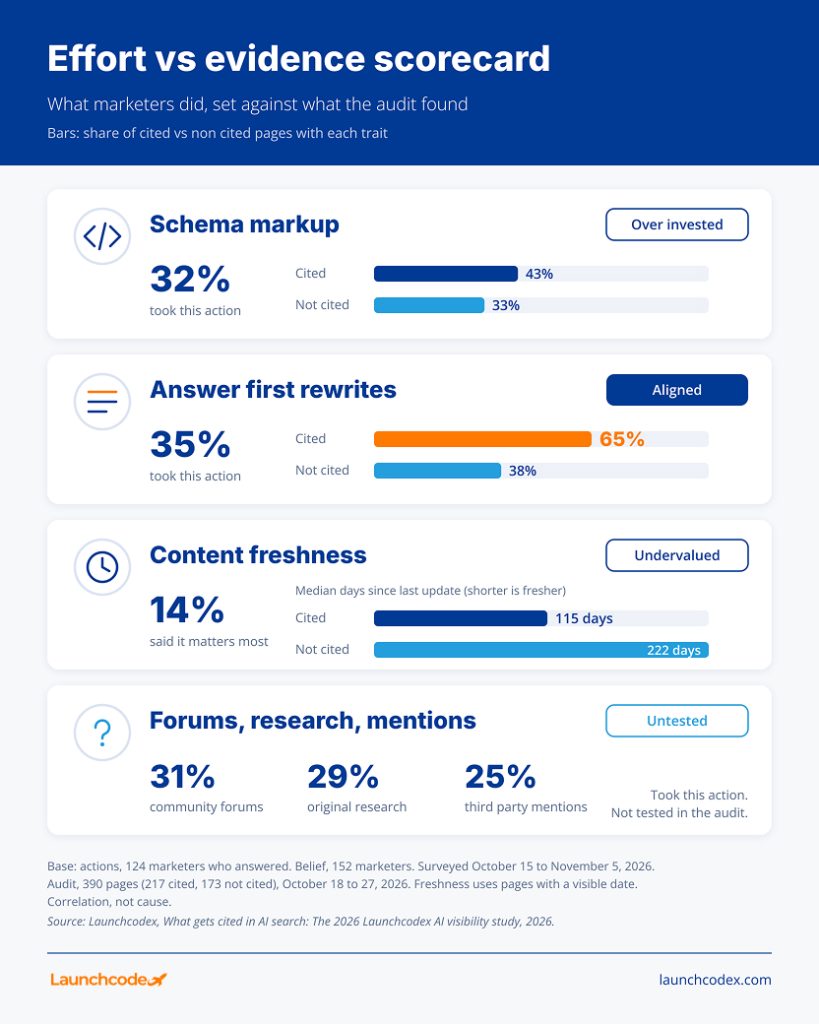
The scorecard places each common tactic by two measures: the share of marketers who took it on, and what the audit or answer study found. Schema lands as over invested, answer first openings as aligned, freshness as undervalued, and Google ranking as a misread signal. Forums, original research, and third party mentions stay untested.
| Tactic | Took this action (124 marketers) | Said it matters most (152 marketers) | What the study found | Verdict |
|---|---|---|---|---|
| Schema markup | 32% | 11% | On 43% of cited pages vs 33% of non cited pages | Over invested |
| Answer first rewrites | 35% | 26% | 65% of cited pages led with a direct answer vs 38% of non cited pages | Aligned |
| Content freshness | Not asked | 14% | Cited pages updated a median of 115 days before the audit vs 222 days | Undervalued |
| Google ranking | Not asked | 22% | 31% of AI citations came from Google’s top 10 | Misread signal, directional |
| Forums, original research, third party mentions | 31%, 29%, 25% | Not asked | Not tested in the audit | Untested |
The audit compared pages at one point in time across 11 domains. Each gap shows a trait that appears alongside citations. None of them prove that a trait causes a citation. Use the scorecard to rank your work, not to predict results.
Say a B2B SaaS team closed 12 AI visibility tickets last quarter. Seven added schema, three were forum posts, and two rewrote page openings. On the scorecard, seven tickets sit in the over invested row and only two sit in the aligned row. The team does not need more output. It needs a different mix.
Not as a lead tactic. In the Launchcodex audit of 390 pages, schema appeared on 43% of cited pages and 33% of non cited pages, the smallest gap of any trait measured. Yet 32% of marketers added it. Keep schema as a supporting step for rich results and accurate page labels, and add it after the page itself answers the query well.
Outside research points the same way. Google’s own guide to generative AI features in Search states that “Structured data isn’t required for generative AI search.” It adds that there is no special schema.org markup to add, and still recommends structured data as part of overall SEO for rich results eligibility.
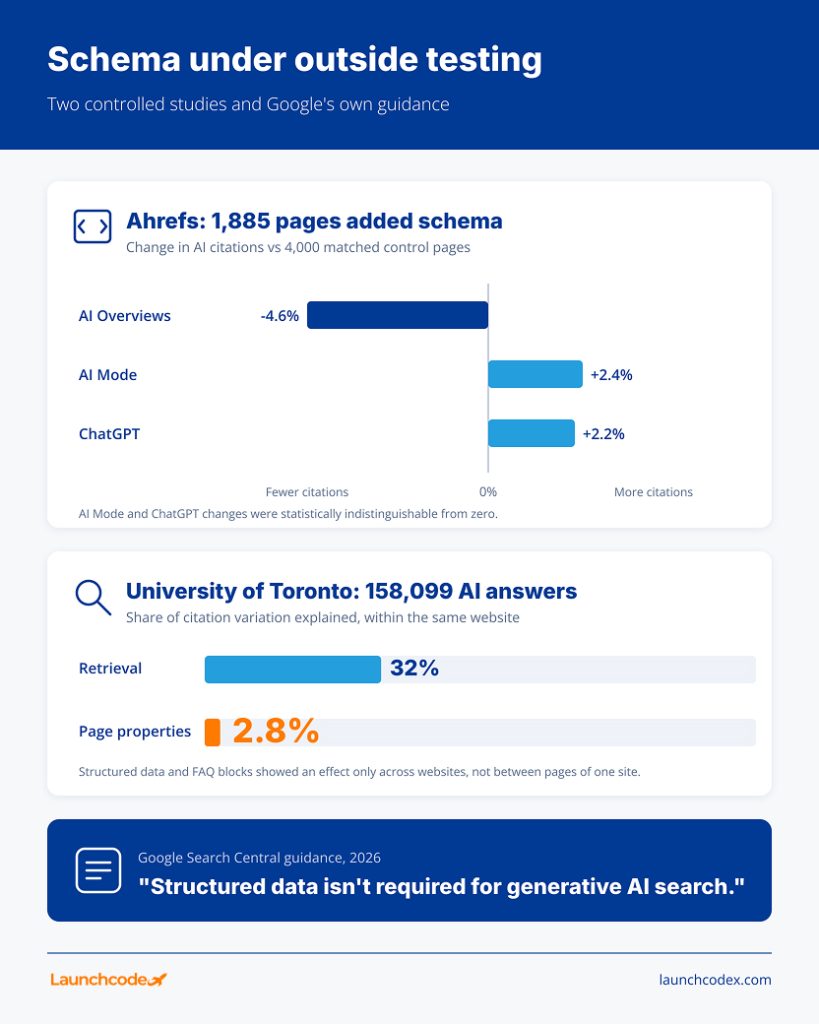
Schema tends to sit on better maintained sites that also do the other work. That can make it look like a citation driver when it may not be one.
Louise Linehan, who wrote the Ahrefs study, said schema “could also just be riding the wave of every other signal.” One caveat applies. The test covered only pages that were already heavily cited.
A University of Toronto study adds a second angle. Mahe Chen and Nick Koudas analyzed 158,099 AI answers with 468,037 citations. Within the same website, retrieval explained 32% of citation variation and page properties explained 2.8%. Structured data and FAQ blocks showed an effect only across websites, not between pages of the same site. In their words, “Page properties nevertheless explain little of the variation between pages of a website.” The Launchcodex audit also compares pages across 11 domains, so part of the schema gap may reflect site differences rather than the markup itself.
The schema emphasis is not limited to one sample. Conductor’s 2026 CMO investment report, based on 250 plus enterprise digital leaders, found 94% planned to increase AEO and GEO investment in 2026. It named optimizing structured data and schema as one of the top two content strategies. One of the tactics drawing the most enterprise attention has some of the weakest controlled evidence.
The survey does not say why. The most likely reason is workflow fit. Schema is a contained technical task with a clear done state. An answer first rewrite needs a writer, a subject expert, and agreement on what the answer is. Work that closes inside one sprint tends to get picked for the sprint, whatever the evidence says.
“Marketers took on schema and answer first rewrites at almost the same rate, 32% and 35%. My read is that schema is a ticket a developer can close in an afternoon, while rewriting a page to lead with the answer needs a writer, a subject expert, and agreement on what the answer is. Teams pick the work that fits in a sprint.” Derick Do, Co-Founder & Chief Product Officer
Answer first rewrites are the one tactic where action, belief, and audit evidence agree. 35% of marketers made them, 26% named answer first content as the trait that matters most, and 65% of cited pages led with a direct answer against 38% of non cited pages. This is where more of your next sprint should go.
This result also holds up best in outside research. Chen and Koudas found that pages whose titles and paragraphs matched the questions people ask were cited more, and that effect held within single websites. Schema did not pass that test. Google’s Danny Sullivan has put the broader point simply: “Good SEO is really having good content for people.” An opening that answers the question serves the reader first, and AI platforms second.
Say a page targets “how much does a CRM cost for a 20 person sales team.” A story first page opens with the company’s history. An answer first page gives the typical price range and the main factors that move it in the first two sentences, then explains each factor below.
Our deep dive on answer first content covers how to write these openings and what the 217 cited pages did differently. Read the audit result with care. 13% of pages were coded unclear on this trait and counted as not answer first, and the gap is a correlation, not proof of cause.
Freshness is the clearest undervalued signal. Only 14% of 152 marketers named it as the trait that matters most, yet cited pages had been updated a median of 115 days before the audit, against 222 days for pages that were not cited. Google ranking is the most likely misread signal, though that result is directional.
Planned priorities may widen this gap. In Search Engine Journal’s State of Search 2027 survey of 166 respondents, planned priority for content refreshes fell from 50% this year to 36% next year. Teams plan to cut back on work the audit finds alongside cited pages.
Older pages may differ in other ways, such as topic or format. Treat this as a pattern to act on, not proof that a new date earns a citation. A real refresh means new data, current examples, and corrected steps. Our post on how recently a page should be updated covers refresh cycles in detail.
22% of marketers named Google ranking as the trait that matters most. In the Launchcodex answer study, only 31% of the 1,827 sources cited across 204 first run AI answers ranked in Google’s top 10 for the same query. Ahrefs found the same direction in a much larger dataset of 863,000 keyword results. 38% of pages cited in AI Overviews also ranked in the top 10, down from about 76% in its July 2025 study.
Read this one with caution. Ranking (22%) and answer first content (26%) sit within the survey margin of error of each other, and the survey and answer study used different samples. Rankings still matter for the citations that come from page one. They cannot stand in for AI visibility. Our post on whether Google rankings still predict AI citations covers this in depth.
The study shows which traits appear alongside citations and what marketers say they did. It does not prove that any trait causes a citation. It does not measure hours or budget. And it cannot grade community forums, original research, or third party mentions, which 25% to 31% of marketers took on.
Keep these limits in view before you change your roadmap:
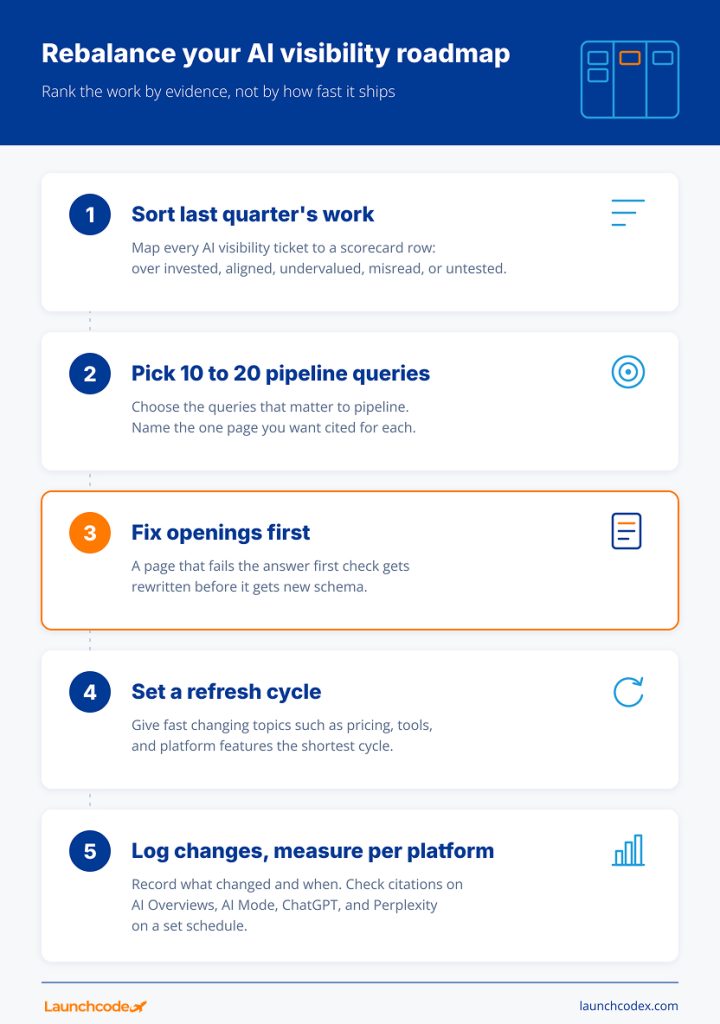
Rank the work by evidence, not by how quickly it ships. Start with answer first openings on your priority pages, put those pages on a refresh cycle, add schema only after the page format passes, and log every change so you can compare it with citation results on each AI platform.
The budgets involved justify the discipline. Branch’s survey of 300 US enterprise leaders found 65% dedicate at least 25% of their 2026 marketing budget to AI search optimization. Spend at that level needs a clear order of work.
“When I review an AI visibility backlog, I don’t start with how many tickets closed. I ask how many of them changed what a reader sees in the first two sentences of a priority page. That is the number most teams need to grow, and it rarely shows up in a sprint report.” Tanner Medina, Co-Founder & Chief Growth Officer
Plan each rewrite as a sprint story with three named roles: a writer, a subject expert, and an approver who signs off on the answer. Give writers capacity on the same board as developers in Asana or Jira, so schema tickets do not fill every open slot by default.
Marketers are acting on AI search, but they are not choosing by evidence. Schema and answer first rewrites drew almost the same effort, 32% and 35% of 124 marketers. Yet schema appeared on 43% of cited pages vs 33% of non cited pages, while answer first openings appeared on 65% vs 38%. Freshness gets little weight from marketers despite a wide age gap between cited and non cited pages. Ranking may be getting more credit than the citation data supports.
Your next step is to score last quarter’s work against the scorecard above and move part of the next sprint to page openings and refreshes. If you want an outside review, the Launchcodex team runs this kind of evidence ranked review on priority pages as part of its GEO work.
For the full method, every chart, and the six check readiness audit, download the complete ebook, What gets cited in AI search: The 2026 Launchcodex AI visibility study.
Answer first openings are where effort, belief, and audit evidence line up best. In the Launchcodex audit, 65% of cited pages led with a direct answer, against 38% of non cited pages. Freshness also showed a wide gap. Schema works best as a supporting step after the page format is fixed.
Schema alone shows weak evidence. In the Launchcodex audit it appeared on 43% of cited pages and 33% of non cited pages. Google says structured data is not required for generative AI search, and an Ahrefs controlled test found no major citation uplift after pages added it.
Yes, but less than many marketers assume. Only 31% of the 1,827 sources cited in the Launchcodex answer study ranked in Google’s top 10 for the same query. Track AI citations as their own metric next to rankings.
There is no single number, but recency shows up alongside citations. Cited pages in the Launchcodex audit had been updated a median of 115 days before the audit, against 222 days for pages that were not cited. Set a refresh cycle for priority pages and make each update substantive.
Most of them. 89% of the 124 marketers who answered the Launchcodex actions question had taken at least one step to improve AI visibility. Most took one or two actions.


Real stories from the people we’ve partnered with to modernize and grow their marketing.