
Share:

AI marketing & automation


Pages that AI platforms cited had been updated more recently than pages they did not cite, and you can check your own pages against that gap. In the Launchcodex AI visibility study, we audited 390 public pages across 11 domains between October 18 and 27, 2026. Cited pages had been updated a median of 115 days before the audit. Pages that were not cited had a median of 222 days.
That is a pattern, not proof that updating a page earns a citation. This article compares the audit with outside research, shows you how to rank your pages against the benchmark, and explains what counts as a real update.
Cited pages had been updated a median of 115 days before the audit. Pages that were not cited had a median of 222 days. The comparison covers 319 audited pages with a visible date, 189 cited and 130 not cited. Treat 115 days as a benchmark for page age, not a refresh deadline.
For each audited page with a visible date, the audit counted the days since its last update, then compared the median (the middle value) for each group.
| Group | Audited pages | Median days since last update |
|---|---|---|
| Cited | 189 | 115 |
| Not cited | 130 | 222 |
Base: 319 audited pages with a visible date (189 cited, 130 not cited). Correlation, not cause.
The medians show how old each page was on the audit date. They do not show how often anyone updated it. A page last updated 115 days ago could sit on a six month cycle or a yearly one, so use the two medians as markers for each priority page:
Older pages may also differ in other ways, such as format or topic. A refresh does not guarantee a citation. It removes one visible difference between your page and the cited pages.
Outside studies point the same way. An Ahrefs analysis of 16.975 million URLs found that pages cited by AI assistants averaged 909 days since their last update, against 1,047 days for Google organic results. A lab test found that recent timestamps helped across six models. We found no refresh interval in Google or Bing guidance.
The table shows what each study covers and where its limits sit.
| Source | Base | Finding | Watch out for |
|---|---|---|---|
| Ahrefs, top ChatGPT citations | 564 of the top 1,000 pages ChatGPT cited in September 2025 had detectable dates | After Ahrefs removed pages whose last modified date matched the data request date, pages with a 2025 update still made up over 80% of the set | Last modified can reflect the request date, not a real edit |
| AirOps | More than 4,000 pages cited by ChatGPT across 900 high intent queries in 15 industries | 35.2% were updated within 3 months and 53.4% within 6 months. The report says over 70% were updated within 12 months | ChatGPT only. It describes cited pages, so it shows no gap. Vendor study |
| SIGIR ’26 paper | 252,000 trials across six language models | A page dated 2026 beat the same page dated 2019 in all six models | Two sources per trial with brands anonymized, so it is a lab result |
| Muck Rack, May 2026 | Journalism citations with known publish dates | 57% were published within the last 12 months | News content only |
Four points shape how you read these studies.
The lab test fits our pattern, but it tests timestamps in a controlled setup. Authors Rahul Vishwakarma, Shushant Kumar, and Ratnesh Jamidar write that “a recent timestamp also helps consistently.” Real pages differ in many ways at once. The paper also found mixed results for pages with no timestamp, so we do not claim that a missing date costs you a citation.
Only 14% of the 152 marketers who answered our survey named freshness as the trait that matters most. The audit still showed cited pages updated a median of 115 days before the audit, against 222 days for pages that were not cited. That makes freshness one of the clearest gaps between belief and evidence in our data.
The survey covered 155 qualified marketers from October 15 to November 5, 2026, with a margin of error of plus or minus 8 points at 95 percent confidence for the full sample. Survey answers show what marketers say they believe. The data does not say why they rank freshness low.
Whatever the reason, you can make page age visible. Add each priority page’s last meaningful update date to the report your team already reads, next to its traffic in GA4 or Search Console. Budget owners then see page age beside the numbers they already track.
“Cited pages in our audit had been updated far more recently. You do not need a new content program to act on that. Put your priority pages on a refresh calendar and treat each update as real work, not a date change.”
Tanner Medina, Co-Founder & Chief Growth Officer
Our post on AI search effort versus evidence covers how marketer effort compares with the data across other tactics.
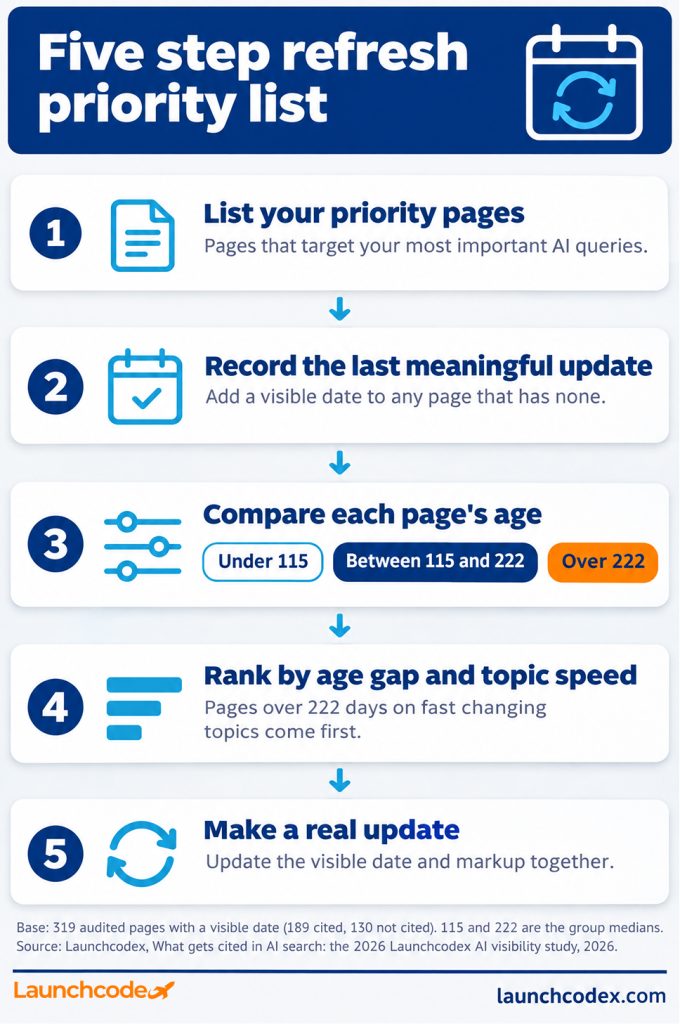
Refresh the pages that target your most important AI queries, start with any past 222 days, and rank the rest by how fast the topic changes. Pricing, tools, and platform features go first. A five step refresh priority list turns page age into a ranked queue, so writer time goes where the age gap is widest.
Google says its query deserves freshness systems are designed to show fresher content for queries where it would be expected. That describes Google ranking systems, not every AI platform. Use it as context for ordering pages, not as a rule.
| Page type | Why it ages | Refresh order |
|---|---|---|
| Pricing and plan comparisons | Prices and plans change | First |
| Tool and platform feature pages | Features ship and retire | First |
| Statistics and benchmark roundups | New data replaces old | Second |
| Definitions and concept pages | Meaning changes slowly | Later |
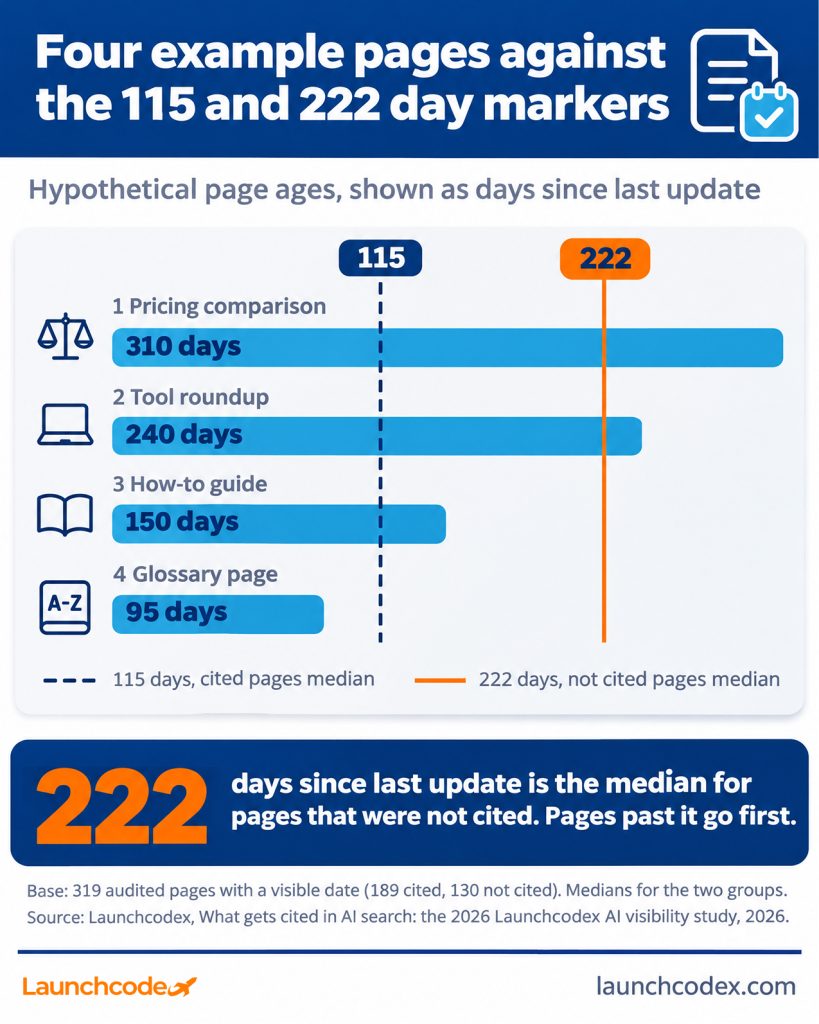
Say a SaaS company has four priority pages. This example is hypothetical.
| Page | Days since last update | Marker | Order |
|---|---|---|---|
| Pricing comparison | 310 | Over 222 | 1 |
| Tool roundup | 240 | Over 222 | 2 |
| How-to guide | 150 | Between 115 and 222 | 3 |
| Glossary page | 95 | Under 115 | 4 |
The pricing comparison and the tool roundup go first because both are past 222 days on topics that change. The how-to guide comes third and can wait for the next review. The glossary page is under 115 days and needs no work yet. While you are in a page, check its opening as well. Our post on answer first content explains how, and our readiness audit checklist covers the full six check audit.
“Turn the list into a repeatable workflow. Give each page an owner and a review date, and log what changed in every update, so the next editor knows what is current and what still needs checking.”
Derick Do, Co-Founder & Chief Product Officer
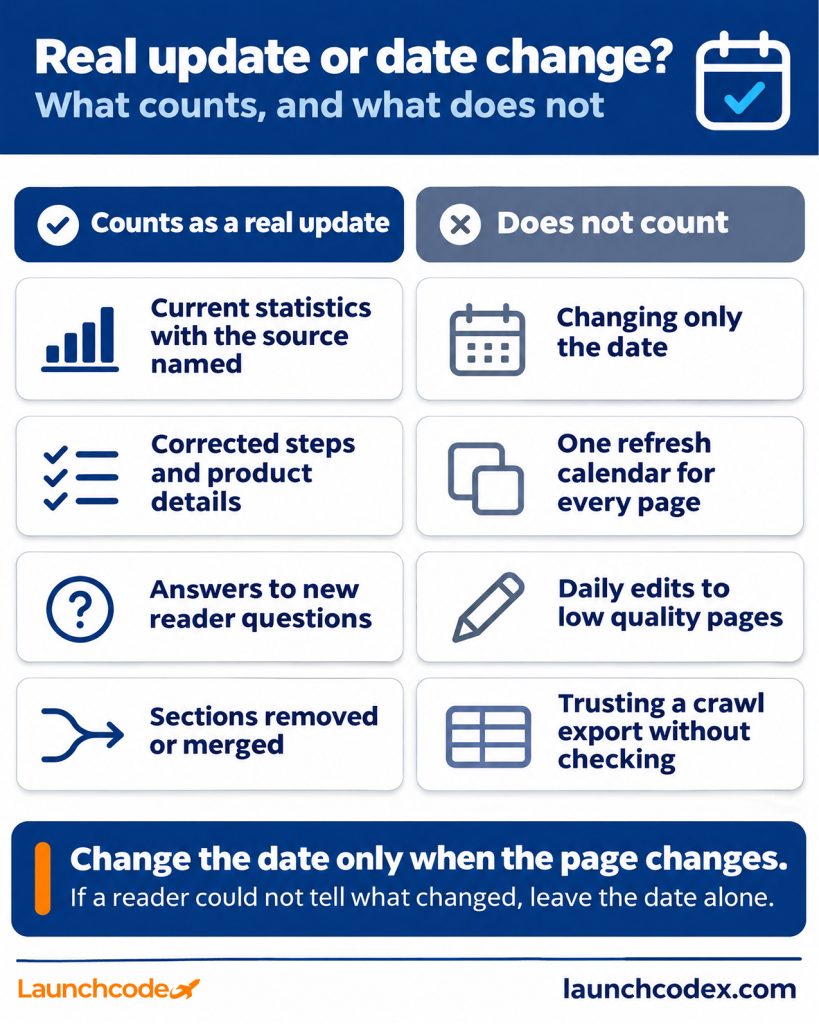
A real update changes facts, examples, steps, or structure, and only then changes the date. Google’s John Mueller said on X in 2022, “Is there no significantly new content? Then don’t update the dates.” If a reader could not tell what changed, leave the date alone.
A real update usually includes at least one of these:
Avoid four mistakes:
Show a visible last updated date and match it in your structured data. In our audit, 18% of pages showed no visible date, 71 of 390 pages, so those pages sit outside the 115 and 222 day comparison. Google estimates a page’s date from several signals, so give it clear evidence.
Google defines a byline date as “the date that Google estimates that the web page was updated or published.” The Google Search Central guidance on byline dates asks for a visible date, labeled as published or last updated, that matches the structured data. Follow these steps:
Step 3 matters for crawling. Microsoft’s Fabrice Canel and Krishna Madhavan wrote on the Bing Webmaster Blog, “The lastmod field in your sitemap remains a key signal.” Accurate lastmod values help Bing focus crawling on updated content, and freshness signals affect how quickly updates show in results and AI generated answers. That describes how fast a change is picked up, not whether a new lastmod value wins a citation.
The 115 and 222 day figures are correlations from one audit at one point in time, drawn from 11 domains where large platforms make up much of the sample. They help you rank your own pages. They do not predict a citation, and no refresh interval appears in the Google guidance we reviewed.
Cited pages had been updated a median of 115 days before the audit, and pages that were not cited a median of 222. That is a pattern, not a cause. Build your refresh list this week, start with the priority pages past 222 days, and change a date only when the page itself changes.
Pull your priority pages, record their last meaningful update dates, and sort them against 115 and 222 days. Put the oldest pages on fast changing topics at the top, such as pricing and tool pages, and give each one an owner and a review date. After each update, check the page in your citation tracking to see whether it gains citations.
Launchcodex helps teams rank and update priority pages as part of its SEO and GEO content work. For the full findings and their limits, download the ebook, What gets cited in AI search: the 2026 Launchcodex AI visibility study.
Google and Bing guidance gives no refresh interval. In our audit, cited pages had been updated a median of 115 days before the audit and pages that were not cited a median of 222 days. Compare each priority page with those markers, then set a cycle that matches how fast its topic changes.
Not on its own. Google’s John Mueller advises updating dates only when a page has significantly new content. Change the date together with a real update, and keep the visible date and the markup in agreement.
Not necessarily. Ahrefs found that the average age since last update of cited pages ranged from 831 days for Gemini to 1,067 days for Google AI Overviews. That shows the pages each platform cites differ in age. It does not show how each platform weighs freshness. Our audit did not report freshness by platform.
Start with pages that target your most important AI queries and sit past 222 days. Within that group, put pricing, tools, and platform feature pages ahead of definitions.


Real stories from the people we’ve partnered with to modernize and grow their marketing.