
Share:

AI marketing & automation


LLM search optimization sounds like one job. It is closer to four. ChatGPT, Perplexity, Google AI Overviews, and Google AI Mode each build answers their own way. Here, the term means earning citations in AI answers, not tuning a model.
Treat each AI platform as its own channel. A single “LLM optimization” score hides the differences between them. In our study, the median Perplexity answer cited 19 sources and the median ChatGPT answer cited 4. This post compares the four platforms on answer rate, citation volume, Google alignment, and consistency. It also explains why published numbers disagree and shows you how to build a profile for each platform you care about.
No. On the same 58 marketing queries, Perplexity cited a median of 19 sources per answer and ChatGPT cited 4. One in three ChatGPT answers cited nothing from Google’s top 10, and no Perplexity answer did. ChatGPT also answered 78% of queries, against 93% for Perplexity. The four platforms differ on every measure we tracked.
Launchcodex ran 58 marketing and martech queries on Google AI Overviews, Google AI Mode, ChatGPT, and Perplexity between October 10 and 30, 2026. We ran each query twice. For every answer, we recorded whether an answer appeared, every cited source, and how many cited sources ranked in Google’s top 10 for the same query.
| Platform | Answer rate | Median sources per answer | Answers with no top 10 source | Same outcome on both runs |
|---|---|---|---|---|
| Perplexity | 93% | 19 | 0% | 88% |
| Google AI Overviews | 97% | 7 | 5% | 95% |
| Google AI Mode | 90% | 6.5 | 12% | 91% |
| ChatGPT | 78% | 4 | 33% | 64% |
Base: 58 queries per platform. Sources per answer cover 207 first run answers. The top 10 column covers 204 first run answers with a valid overlap check. The last column covers all 58 queries run twice. These results describe 58 marketing queries, not AI search as a whole.
A blended score would hide every gap in this table. The next sections take the four measures in turn: answer rate, citation volume, Google alignment, and consistency.
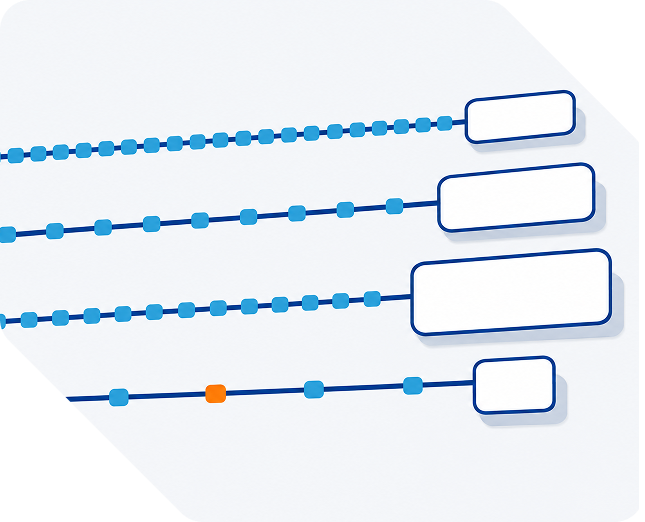
Perplexity cited a median of 19 sources per answer, almost five times ChatGPT’s median of 4. Google AI Overviews cited 7 and Google AI Mode cited 6.5. A longer list gives your page more places to appear. On a shorter list, each citation takes up a larger share.
The base was 207 first run answers: 54 from Perplexity, 56 from AI Overviews, 52 from AI Mode, and 45 from ChatGPT.
Product design may explain part of the gap. Perplexity says each answer includes numbered citations that link to the original sources, and that it searches the web in real time for each question. We did not test why the counts differ, so treat that as context, not a finding.
Take a hypothetical SaaS company with a CRM comparison page that both Perplexity and ChatGPT cite. On Perplexity, the page is one of 19 sources in a typical answer. On ChatGPT, it is one of 4. The same citation takes up a larger share of the list on ChatGPT, so read each platform’s count against its own median.
ChatGPT returned an answer for 45 of the 58 queries, or 78%. Perplexity answered 93%. A platform that skips a query gives no citation at all. Check answer rate before you read any citation count.
What to do with this:
Not closely. One in three ChatGPT answers (33%) cited no source from Google’s top 10, compared with 12% for AI Mode, 5% for AI Overviews, and 0% for Perplexity. Perplexity is closest to Google’s top 10, yet only 33% of its citations ranked there. ChatGPT is farthest, at 24%.
Read two measures together. The first shows how often a platform ignored page one entirely. The second shows how much of what it cited came from page one.
| Platform | Answers with no top 10 source | Citations that ranked in the top 10 |
|---|---|---|
| Perplexity | 0% | 33% |
| Google AI Overviews | 5% | 30% |
| Google AI Mode | 12% | 29% |
| ChatGPT | 33% | 24% |
Base: answers with no top 10 source cover 204 first run answers with a valid overlap check (ChatGPT 45, AI Mode 52, AI Overviews 56, Perplexity 51). Citation shares cover 1,827 citations in 204 first run answers. AI Overviews cited 376 sources across 56 answers, and AI Mode cited 324 across 52.
Perplexity never ignored page one, but most of its citations still came from outside it.
“I would not use a rank report as a stand-in for ChatGPT visibility. Check the citations themselves, query by query, before you assume page one work carries over.” Derick Do, Co-Founder and Chief Product Officer
Whether rankings predict citations overall is a separate question that another post in this research series covers.
Ahrefs studied 15,000 long-tail prompts and found that 28.6% of Perplexity citations ranked in Google’s top 10. For ChatGPT, the figure was 8.00% for in-text citations and 6.10% for bottom-of-response references. The order matches ours. The sizes do not. Ahrefs published in August 2025 and collected ChatGPT data in early July 2025. Our queries are marketing and martech queries from October 2026. We cannot say how much each difference explains.
Ahrefs also found that 37.9% of URLs cited in AI Overviews appeared in the first 10 SERP blocks, down from about 76% in July 2025. That study used 863K keyword SERPs and was published March 2, 2026.
Each platform retrieves pages with its own search, and researchers find that citations follow what that search returns. Google says its AI features use query fan-out. OpenAI says sites that opt out of its OAI-SearchBot crawler do not appear in ChatGPT search answers. Launchcodex did not measure these causes.
Here is what the platforms and researchers say:
A preprint by Mahe Chen and Nick Koudas tests the retrieval idea directly. They analyzed 158,099 AI answers with 468,037 citations. Every page ChatGPT cited was one its own search had retrieved. Retrieval explained about 32% of the variation in citations, against 2.8% for page properties. In their words, “Pages are thus cited when searched.” The paper is not peer reviewed.
Google’s guide says its AI features need no special optimization and no special schema.org markup. That does not contradict our stance. Google speaks to page work, and we measured platform behavior.
Our guides on how ChatGPT actually picks sources and how to optimize for each LLM cover the mechanics and tactics. This post stays on measurement.
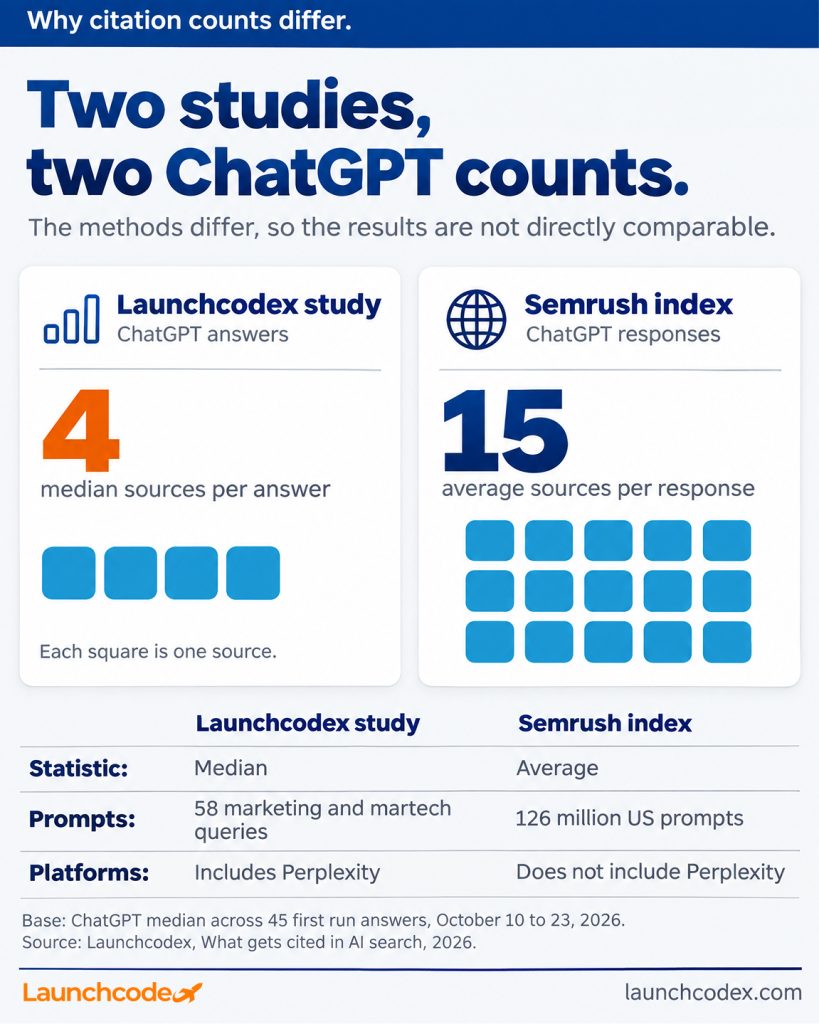
Counts depend on method. Semrush reports that ChatGPT cited an average of 15 sources per response and Gemini an average of 3. We found a ChatGPT median of 4, the lowest of four platforms. The studies differ in prompts, statistics, and platforms, so the results are not directly comparable.
Semrush’s 2026 AI Visibility Index covers 126 million US prompts from January through April 2026. Its figures are averages, and it did not include Perplexity. Ours are medians from 58 marketing and martech queries. An average rises when a few answers cite many sources. A median does not. The published figures do not show how much each difference explains.
Perplexity’s count also depends on where you measure it. Strauss and colleagues studied Perplexity’s Sonar models using LMArena logs and found a median of 10 sites visited and a median of 5 cited. The abstract says three to four. Those were API based model variants, collected in March and April 2025. They were not the consumer product we tested.
Treat any citation count as a result for one method. Your topics, prompts, and counting method decide your own numbers.
“When someone sends me a citation number, I ask two questions first. Is it an average or a median, and which prompts produced it? Without those answers, the number is hard to use.” Tanner Medina, Co-Founder and Chief Growth Officer
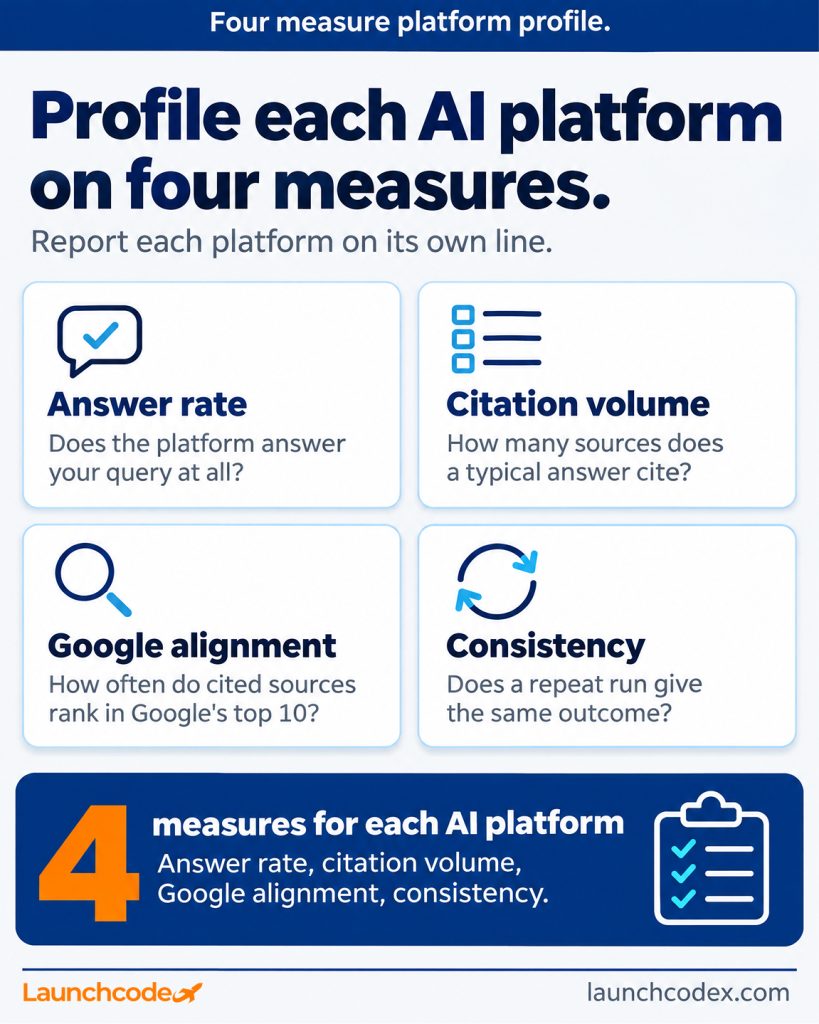
Build one profile per platform with four measures: answer rate, citation volume, Google alignment, and consistency. Run a fixed set of queries on each platform at least twice, record the four numbers, and report them side by side. Our study shows why. ChatGPT repeated its outcome on 64% of queries, against 95% for Google AI Overviews.
| Measure | What to record | Why it matters |
|---|---|---|
| Answer rate | Share of queries that return an AI answer | A skipped query gives no citation |
| Citation volume | Median sources per answer | Shows how many places a page can win |
| Google alignment | Share of cited sources in the top 10, and share of answers with none | Shows whether rankings carry over |
| Consistency | Same outcome on repeat runs | Shows whether one check can be trusted |
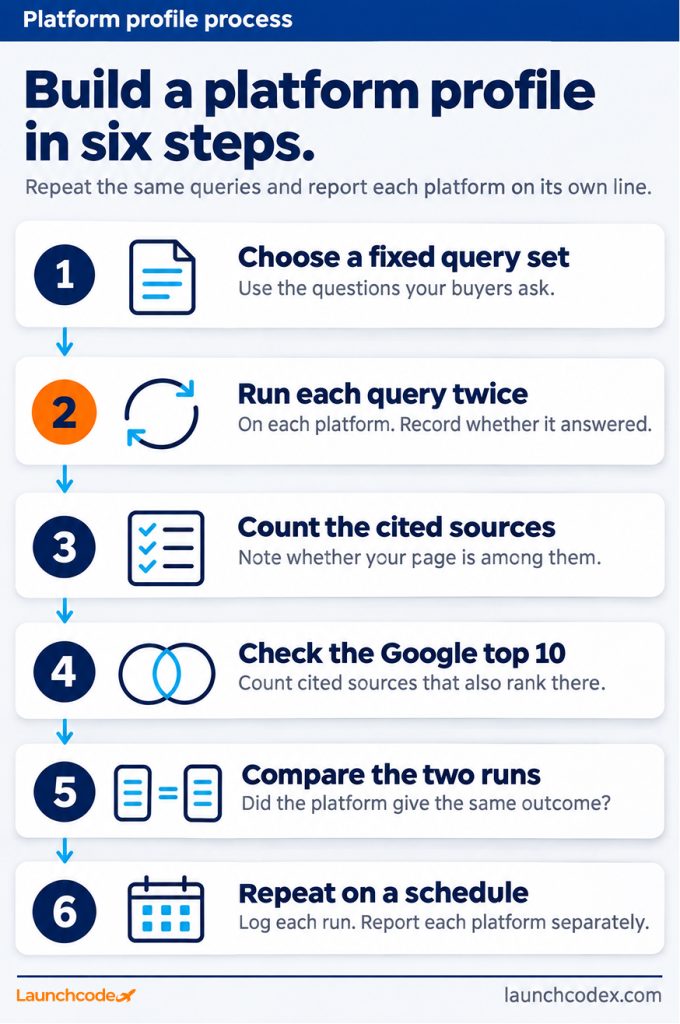
Follow these steps:
Rand Fishkin, co-founder of SparkToro, ran a study of 2,961 prompt runs across ChatGPT, Claude, and Google AI. He wrote, “These tools are probability engines: they’re designed to generate unique answers every time.” His study covered brand recommendation lists, not citations.
Our study could compare answer outcomes between runs. It did not capture cited URLs consistently across runs, so we cannot say the cited sources changed. A separate post in this series covers how to track citations when answers change.
Build the four measure profile for ChatGPT, Perplexity, Google AI Overviews, and Google AI Mode before you plan page work. In our study, Perplexity cited a median of 19 sources per answer and ChatGPT cited 4, and one in three ChatGPT answers cited no top 10 source.
Pick your priority queries, run them on each platform twice, and set a separate expectation for each platform.
The AI citation readiness audit in the ebook turns the study into a short checklist, and its sixth check covers measuring per platform. The full ebook also shows how cited pages differed from pages left out, and it lists the methodology and limits behind every number in this post. Download the full ebook to get the audit and the platform breakdowns.
In the Launchcodex study, ChatGPT cited a median of 4 sources per answer, based on 45 first run answers. It answered 45 of 58 queries. Semrush reports an average of 15 sources per ChatGPT response from a different prompt set, so counts depend on method.
In our study, yes. Perplexity cited a median of 19 sources per answer and ChatGPT cited 4, based on 54 and 45 first run answers. The result describes 58 marketing and martech queries.
Perplexity. No Perplexity answer lacked a top 10 source (base 51 answers), and 33% of its citations ranked there. ChatGPT was farthest, with 33% of answers citing no top 10 source and 24% of citations in the top 10.
Yes, measure each platform separately. Google says its AI features need no special optimization, but our data shows the platforms differ in answer rate, citation count, and Google alignment. Set separate expectations and reports for each one.


Real stories from the people we’ve partnered with to modernize and grow their marketing.