
Share:

AI marketing & automation


Your team probably holds a long list of AI search tactics and no way to tell which of your own pages fail. Fixing a page you already own costs less than publishing a new one, so score what exists first. This post gives you six checks, a pass or fail test for each, and a rule for sorting pages into fix queues. It also covers what a page audit cannot tell you.
The order of the checks comes from original data. Launchcodex audited 390 public pages across 11 domains from October 18 to 27, 2026. Of those pages, 217 were cited in AI answers and 173 were not. Among the 51 pages with none of three format traits, 27% were cited. Among the 51 pages with all three, 86% were cited. The traits are an answer first opening, a clear heading structure, and schema markup. The sample leans toward large platforms such as YouTube, Forbes, G2, HubSpot, and LinkedIn, so small and mid sized sites are underrepresented. We read these results as correlations at one point in time. Our stance on AI visibility optimization best practices is plain: run the audit in evidence order, and fix openings and headings before you touch schema or speed scores.
An AI citation readiness audit checks six things on each page you own: an answer first opening, a clear heading structure, a visible and current date, schema that matches the page, a passing Core Web Vitals result, and citations measured by platform. Score each check pass or fail. Run them in that order, because the largest measured gaps sat in page format, not in markup or speed.
Treat the audit as ordinary page quality work. Google states there are “no additional requirements to appear in AI Overviews or AI Mode.” It also lists matching structured data to visible page text as a recommended fundamental. So the audit does not rely on AI only tactics. It finds the pages where basic quality traits are missing.
| Check | Pass test | Launchcodex audit result | First fix |
|---|---|---|---|
| 1. Answer first opening | The first one or two sentences answer the target query | 65% of cited pages vs 38% of pages not cited | Rewrite the opening |
| 2. Clear heading structure | Headings name the question each section answers | 67% vs 47% | Rename headings and split long sections |
| 3. Current and dated | A visible last updated date and a refresh schedule | Median of 115 days since update vs 222 days | Add the date and refresh the content |
| 4. Schema as support | Valid markup that matches the visible text | 43% vs 33% | Fix errors and mismatches |
| 5. Core Web Vitals | Passes in PageSpeed Insights or Search Console | 37% vs 21% | Fix the largest speed issue |
| 6. Measure by platform | Citations logged per platform on a schedule | Not scored on the page | Start a citation log |
Each pair of figures shows the share of cited pages first and the share of pages not cited second. Check 3 uses the 319 pages that showed a date. Checks 1, 2, and 4 are the three format traits counted in the next section.
Open the URL Inspection tool in Search Console and check that each page is indexed. Google treats indexing as the basic requirement for appearing in AI features. Fix any indexing problem before you score the page.
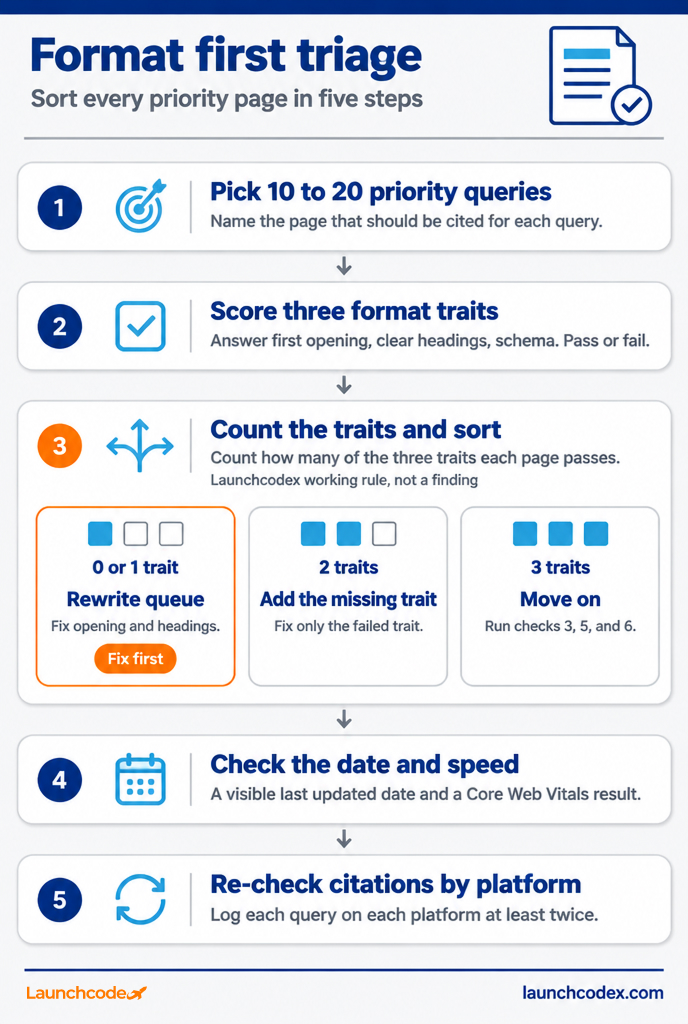
Score the three format traits pass or fail, then count them. Pages with none or one trait go to the rewrite queue. Pages with two traits get the missing trait. Pages with all three move on to the currency and speed checks. In the Launchcodex audit, the share of pages cited rose from 27% to 86% as pages added traits.
The table shows how the cited share moved across the 390 audited pages, grouped by how many of the three traits each page had.
| Traits on the page | Pages audited | Share cited |
|---|---|---|
| None | 51 | 27% |
| One | 145 | 48% |
| Two | 143 | 63% |
| All three | 51 | 86% |
Every figure is the share of audited pages that were cited. The sample held more cited pages than not by design, so none of these numbers is the chance that a page gets cited. The two end groups hold 51 pages each, so read them with some caution. The audit also cannot separate the effect of each trait, so no single trait earns credit for the jump.
The sorting rule below is a Launchcodex working rule, not a finding. The data shows a pattern, and the rule gives you a way to act on it.
| Traits found | Queue | What to do |
|---|---|---|
| None or one | Rewrite | Fix the opening and the headings, then score again |
| Two | Add the missing trait | Fix only the trait that failed |
| All three | Move on | Run checks 3, 5, and 6 |
Schema counts as one of the three traits, yet it comes fourth in the audit. The count shows that traits add up. The order shows where to start, and schema showed the smallest gap of the three.
“We run this audit before anyone writes a new page. Fixing the opening and the headings on a page you already have is cheaper than publishing a new one, and those two traits showed the biggest gaps in our audit.” Tanner Medina, Co-Founder & Chief Growth Officer
Say a software company runs a page called Best email marketing tools. This is an illustrative example, not a client result. The page opens with a long paragraph on the history of email. Its headings read Overview, Features, and More. It shows no update date. It carries valid Article markup.
Scoring gives a clear result:
The page holds one trait, schema, so it goes to the rewrite queue. The fix starts with two sentences that name the best tool for each use case. Then the team renames the headings as questions and adds a visible date. The page now holds all three traits and moves on to checks 5 and 6.
A page passes check 1 when its first one or two sentences answer the query the page targets, with no setup before them. In the Launchcodex audit, 65% of cited pages led with a direct answer, against 38% of pages not cited. That 27 point gap was the largest of any trait, so this check comes first.
Pages coded unclear, 13% of the audited pages, count as not answer first, so the test is strict. When you are in doubt, mark the page as a fail.
Ryan Law, Director of Content Marketing at Ahrefs, describes the pattern as “stating your conclusion, recommendation, or key finding in the first one or two sentences.” Position matters too. Kevin Indig of Growth Memo reports that “ChatGPT pays disproportionate attention to the top 30% of your content.” His data shows 44.2% of 18,012 verified ChatGPT citations came from the first 30% of a page. The figures cover ChatGPT only.
Do not rewrite a failing page from scratch. Replace the first two sentences, then read the next paragraph to confirm it supports them. Our guide to answer first content covers how to write the opening in full.
A page passes check 2 when each heading names the question its section answers, each section opens with that answer, and steps or comparisons sit in numbered lists or tables. In the Launchcodex audit, 67% of cited pages used a clear heading structure, against 47% of pages not cited. That was the second largest gap of the audit.
The fix is cheap, since you change labels and section openings and leave the facts alone.
| Weak heading | Better heading | Why it works |
|---|---|---|
| Overview | What does the audit check? | It names the question |
| Our approach | How do you score a page? | It matches how people search |
| Benefits | Why does a visible date matter? | It sets up a direct answer |
Outside research points the same way. Mahe Chen and Nick Koudas studied 158,099 AI answers and found that within the same website, “pages whose title and paragraphs match the questions people ask are cited more.” Per standard deviation of better match, citations rose 14.1% for the title and 15.5% for the best paragraph. A Semrush vendor study also found strong positive correlations with citations for clarity and summarization (+32.83%), Q&A format (+25.45%), and section structure (+22.91%).
A page passes check 3 when it shows a visible last updated date and a team refreshes the content on a set schedule. In the Launchcodex audit, cited pages had been updated a median of 115 days before the audit, against a median of 222 days for pages not cited. Read that as a pattern, since older pages may differ in format or topic.
The comparison covers the 319 audited pages with a visible date, 189 cited and 130 not cited. Another 71 pages, 18% of the audited pages, had no visible date and sit outside the median comparison. Without a visible date, nobody can judge how current the page is.
Ahrefs studied 16.975 million cited URLs. Pages cited by AI assistants averaged 1,064 days since publication against 1,432 days for organic results, which Ahrefs calls 25.7% fresher. Google AI Overviews cited pages 16 days older than the organic baseline.
The two studies use different clocks. Ahrefs measures days since publication. The Launchcodex audit measures days since the last update. Do not compare 1,064 days with 115 days. The direction agrees, and AI Overviews are the exception.
Our post on how recently a page should be updated covers refresh cadence in depth.
Yes, as a supporting check after format. A page passes check 4 when its markup is valid and matches the visible text. In the Launchcodex audit, schema appeared on 43% of cited pages and 33% of pages not cited, the smallest gap of any trait. Google says structured data is not required for generative AI search.
Google’s own guide says “Structured data isn’t required for generative AI search.” It still recommends structured data for rich results. It also says Google Search ignores llms.txt style files, so skip them as a Google tactic.
Third party tests lean the same way. Ahrefs tracked 1,885 pages that added JSON-LD and compared them with 4,000 matched control pages. Citations changed by −4.6% in AI Overviews, +2.4% in AI Mode, and +2.2% in ChatGPT. The AI Mode and ChatGPT changes were indistinguishable from zero. Louise Linehan of Ahrefs wrote, “Adding schema produced no major uplift in citations on any platform.” The authors note that every page in the test was already heavily cited, so the study cannot speak to pages that AI systems do not yet surface.
The Semrush study above lists structured data elements among five qualities with a strong positive correlation, at +21.60%. That reads stronger than the Ahrefs result and the gap in our audit. It suggests schema findings depend on how each study measures schema.
Our schema markup guide covers types and setup in depth. Do not spend a week on schema while a page still fails check 1.
Core Web Vitals show a link to citation. They do not prove an effect. A page passes check 5 when it passes in PageSpeed Insights or the Search Console report. In the Launchcodex audit, 37% of cited pages passed, against 21% of pages not cited, and most pages in both groups did not pass.
Core Web Vitals measure loading, responsiveness, and visual stability. A result could not be obtained for 21% of the 390 audited pages, and those count as not passing. Part of the gap may reflect differences between sites, not differences between pages. Chen and Koudas point the same way. Within websites, they found the page speed gap was not significant (−1.1%).
Do not wait for a perfect score before you fix the opening. A fast page with a weak opening still sits in the rewrite queue.
A page passes check 6 when you log its citations for each AI platform on a schedule and compare the log before and after each fix. Each platform picks sources in its own way, so one combined number hides what changed. Record ChatGPT, Perplexity, Google AI Overviews, Google AI Mode, Gemini, and Copilot separately.
Start with your priority queries and the page that should be cited for each. Run every query on every platform at least twice, because answers can differ between runs. Keep the wording of each query fixed between runs.
| Query | Target page | Platform | Cited | Run date |
|---|---|---|---|---|
| Best email marketing tools for small teams | The tools page | ChatGPT | Yes or no | Date of the run |
| Best email marketing tools for small teams | The tools page | Perplexity | Yes or no | Date of the run |
Log a baseline before any fix, then repeat the runs after each round of fixes. Our posts on how each platform picks sources and on tracking AI citations cover those topics in depth. Our analysis of Google rankings and AI citations covers how rank relates to citation.
Run the audit in five steps over one week. Pick 10 to 20 priority queries, score the three format traits, sort pages into queues, record the date and speed results, and start a citation log. Fix the rewrite queue first, because pages with none or one trait showed the lowest cited shares in the Launchcodex audit.
Audit 10 to 20 pages, not your whole site. A short list keeps the work tied to the queries that bring you pipeline.
By Friday you have a scored sheet, three queues, and a baseline log.
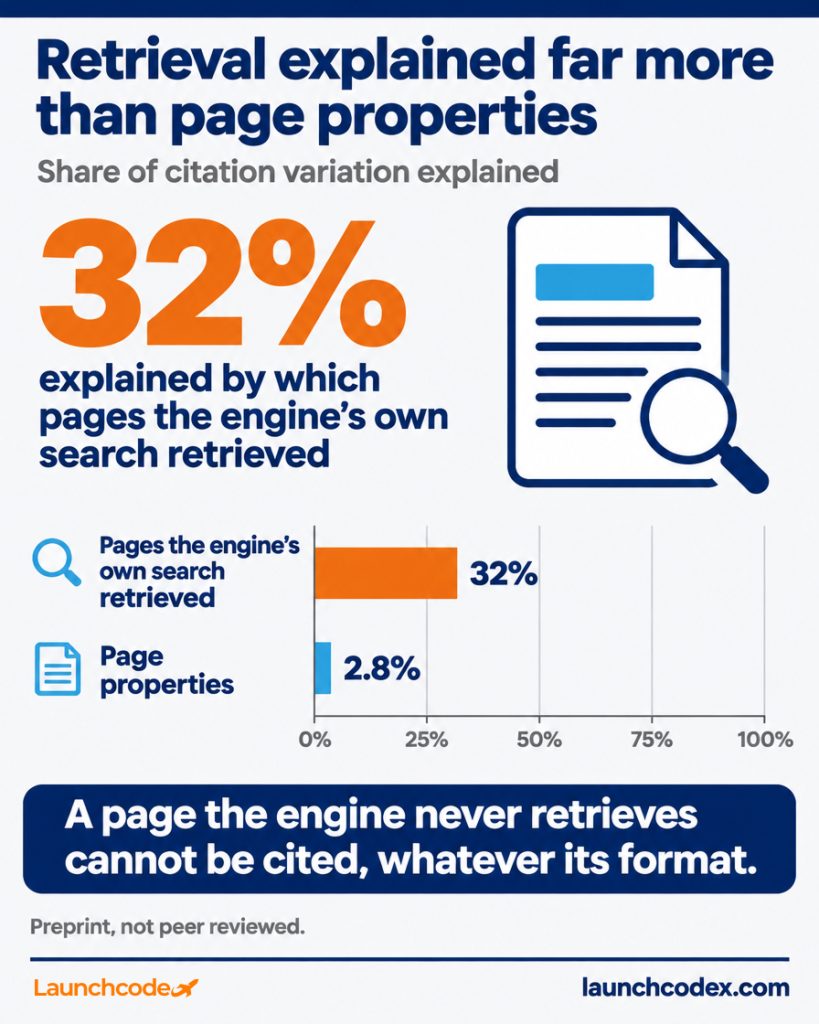
A page audit cannot prove that any trait causes a citation, and it cannot help a page that is never retrieved. Chen and Koudas found that which pages an engine’s own search retrieved explained 32% of citation variation, against 2.8% for page properties. Use the audit to remove avoidable misses. Do not use it to promise results.
Three limits shape how you should read every figure in this post:
“The audit shows these traits appear alongside citations. It does not prove they cause them. We still build pages this way, because an answer first opening and a clean structure make a page easier for people to use, whatever an AI platform decides.” Derick Do, Co-Founder & Chief Product Officer
Crawl access, authorship, and third party mentions sit outside a page audit. Check that your robots.txt file lets AI crawlers in. Show who wrote and reviewed each page. Earn mentions on trusted sites. Treat each as a separate workstream.
Start with the pages that already matter to revenue. Score each one on the three format traits, send pages with none or one trait to the rewrite queue, and fix openings and headings before schema or speed. Re-check citations by platform after each round. In the Launchcodex audit, the share of pages cited rose from 27% to 86% as pages added traits.
This week, open a Google Sheets file, list 10 to 20 priority queries, name the page for each, and score checks 1, 2, and 4. Log a baseline for check 6 in the same file. Once a page passes all six checks, its format is no longer the problem, and your tracking data shows what else is holding it back.
To see the full dataset behind this audit, download the full ebook, What gets cited in AI search: The 2026 Launchcodex AI visibility study. It includes the research method, the charts, and the limits of the data.
Lead each page with the answer, name each section by the question it answers, keep a visible and current date, treat schema as support, pass Core Web Vitals, and log citations by platform. Run them in that order. In the Launchcodex audit, the largest gaps sat in page format, and Google says it has no extra requirements for AI features.
Start with 10 to 20 priority queries and the page that should be cited for each. A short list keeps the audit inside one week. Expand once those pages hold all three format traits.
No. Fix the opening and the headings first. Schema showed the smallest gap of any trait in the Launchcodex audit, and Google says structured data is not required for generative AI search. Add or correct markup once the format passes.
No. The audit shows patterns, not cause. In the Chen and Koudas study, retrieval by an engine’s own search explained far more citation variation than page properties did. A passing page can still go uncited, so track results by platform to see what changes.
Update the content first, then add a visible last updated date. In the Launchcodex audit, 18% of the 390 pages showed no date. Without one, nobody can judge how current the page is.


Real stories from the people we’ve partnered with to modernize and grow their marketing.