
Share:

AI marketing & automation


A single check of an AI platform tells you very little. Ask ChatGPT the same question twice and the result can change, so a page that is cited today may vanish tomorrow even when nothing on your site changed. If you read one answer as a measurement, you may report movement that is only variation.
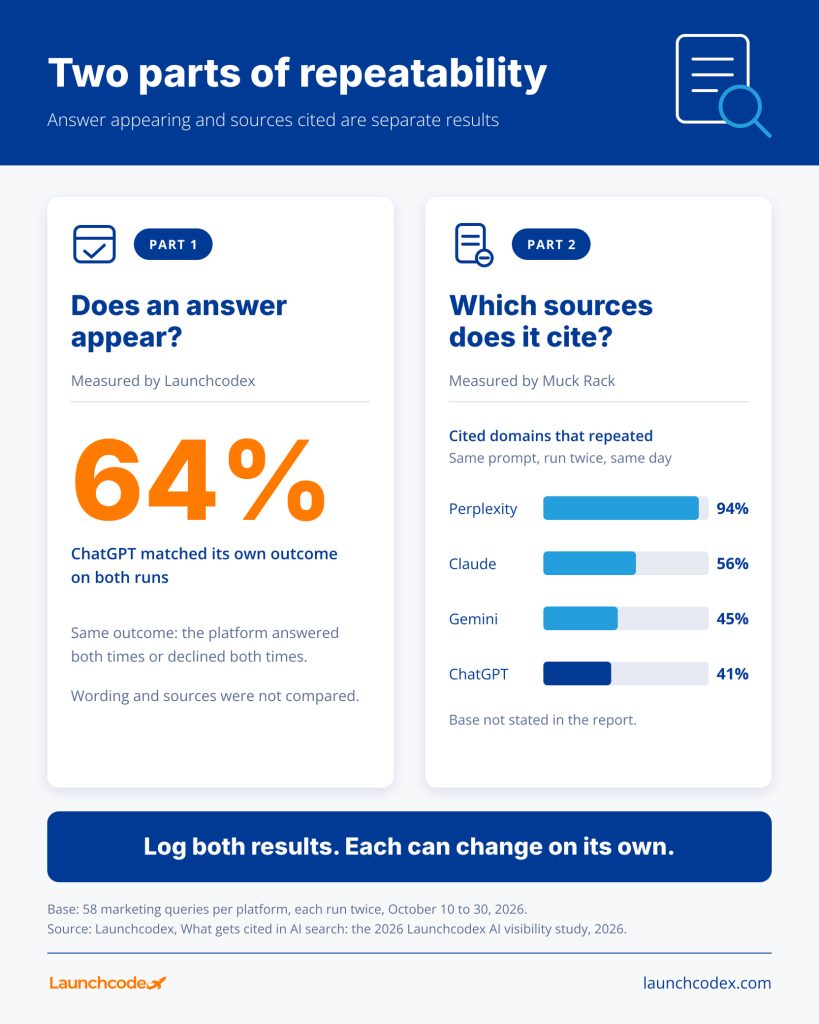
In the Launchcodex AI visibility study, we ran 58 marketing queries on four AI platforms twice, with data collected from October 10 to 30, 2026. ChatGPT gave the same outcome on both runs for 64% of queries. Google AI Overviews did so for 95%. Same outcome means the platform answered both times or declined both times. Our stance is simple. Stop treating any single AI answer as a measurement. Fix a query set, repeat every check on every platform and report the trend by platform. This guide shows you how to do that, what the free Google and Bing reports can and cannot tell you, and what a small query set can prove.
Fix a set of 10 to 20 queries, run each one at least twice on every platform, record whether an answer appeared and whether your page was cited, and compare results on a schedule. Give ChatGPT the most repeats. Judge the trend across rounds, not any single result. This turns unstable answers into evidence a team can act on.
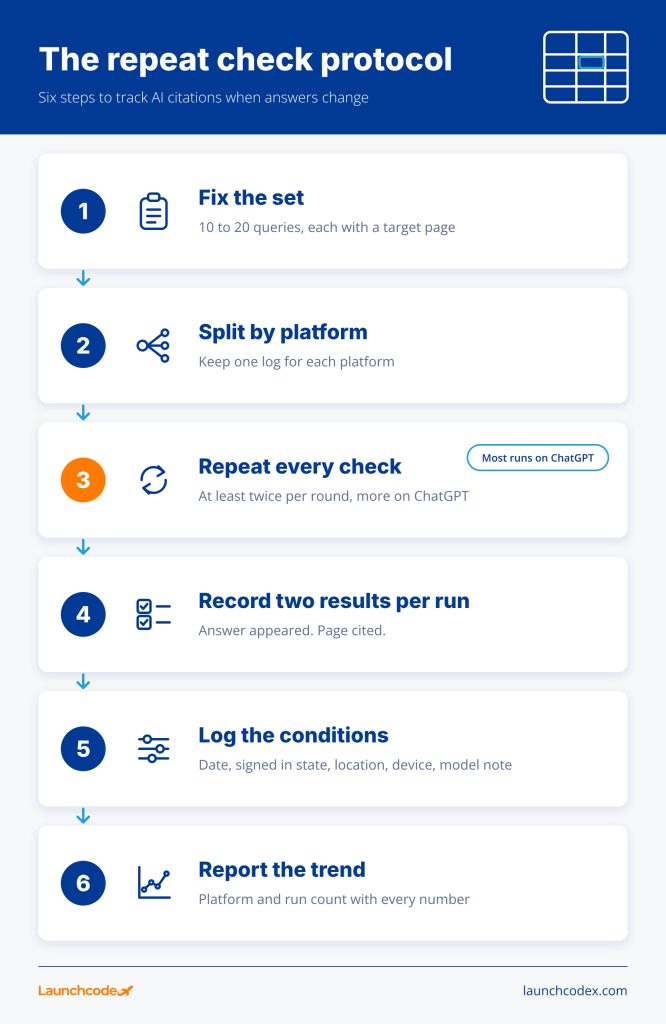
The Repeat check protocol has six steps:
The protocol extends the measurement check from the ebook behind this study and adds a logging step. The guides we reviewed give run counts without evidence or skip them. None gives repeat rates by platform from original data.
AI answers change because the same input can produce different outputs. Thinking Machines Lab ran one prompt 1,000 times at temperature 0 on an open model and got 80 unique completions. The authors trace the variation mainly to changes in batch size as server load varies. ChatGPT’s setup is not public, so this test does not explain its results.
Thinking Machines Lab published the test in September 2025. The prompt was “Tell me about Richard Feynman” and the model was Qwen3-235B-A22B-Instruct-2507. The most common completion appeared 78 times. After the team changed the math to be batch invariant, all 1,000 completions matched. For trackers, the point is simple. A setting meant to fix the output does not guarantee one answer.
SparkToro and Gumshoe.ai tested live platforms. About 600 volunteers ran 12 prompts on ChatGPT, Claude and Google’s AI features and produced 2,961 responses. The chance of getting the same list of brands twice was under 1 in 100 for ChatGPT and Google AI. Claude was slightly more likely to repeat a list. Identical ordering of a list came up about 1 time in 1,000 runs. The data came from November and December 2025, and SparkToro published the findings on January 27, 2026.
Two cautions apply. Gumshoe.ai sells AI tracking tools, and the study is not peer reviewed. It also measured brand lists, while the Launchcodex study measured whether an answer appeared. The measures differ, but both show that single checks mislead.
What to do: treat every miss as possible variation until repeats confirm it. Do not blame your own setup for a result that changes between runs.
ChatGPT repeated its own outcome on 64% of queries, the lowest rate of the four platforms. Google AI Overviews repeated on 95%, Google AI Mode on 91% and Perplexity on 88%. Same outcome means the platform answered both times or declined both times. The base is 58 marketing queries per platform, each run twice.
| Platform | Same outcome on both runs | Returned an answer on run 1 |
|---|---|---|
| Google AI Overviews | 95% | 97% |
| Google AI Mode | 91% | 90% |
| Perplexity | 88% | 93% |
| ChatGPT | 64% | 78% (45 of 58 queries) |
Base: 58 marketing queries per platform. Run 1 collection ran from October 10 to 23, 2026. Run 2 ran from October 17 to 30, 2026. The answer column covers the first run only.
“ChatGPT changed its outcome on 36% of the queries we repeated. One check is a sample of one. Track the same queries on a schedule and judge the trend, not the snapshot.”
Derick Do, Co-Founder & Chief Product Officer
ChatGPT is both the platform most likely to return no answer and the platform least likely to repeat itself. A ChatGPT check can end in a cited page, an answer without your page or no answer at all, and the next check can end differently. Plan the most repeats there. Keep at least two on the other three platforms, because no platform repeated itself on every query.
The study measured whether an answer appeared. It did not compare answer wording or cited sources between runs, so it says nothing about which sources repeated. It covers 58 marketing queries over 21 days and does not describe AI search as a whole. It also did not record signed in state, location, device or model version. Read the table as a reason to repeat your checks, not as a ranking of platform quality.
Not reliably. Repeatability has two parts, whether an answer appears and which sources it cites. The Launchcodex study measured the first part. Outside studies measured the second and found that cited sources change between runs. A page can lose its citation while the answer stays, so track both parts in every round.
Muck Rack’s October 2026 What Is AI Reading? report ran the same prompt twice on the same day. The share of cited domains that repeated was 94% for Perplexity, 56% for Claude, 45% for Gemini and 41% for ChatGPT. The report does not state its base.
Ronald Sielinski’s preprint, written by a researcher at IQRush, used 200 queries on each of three consumer product topics. Two responses to the same query cited an identical set of sources only about 0.01% to 0.10% of the time on Google Gemini and in single digits on OpenAI SearchGPT and Perplexity. The author collected samples once a day for nine days in February 2026.
| Study | What it measured | ChatGPT | Perplexity |
|---|---|---|---|
| Launchcodex study | Same outcome on both runs | 64% | 88% |
| Muck Rack report | Cited domains that repeated on a same day rerun | 41% | 94% |
Perplexity has the third highest repeat rate in the Launchcodex data and the highest in Muck Rack’s. The measures differ, so do not merge them into one ranking. ChatGPT has the lowest value in both. For tracking, log answer appearance and page citation as separate results, because each can change independently.
How each platform chooses and counts its sources is a separate question, and our guide to AI platform sources covers it in depth.
Run every round the same way. Use the same queries, the same wording, the same platform settings and the same log sheet. Then a change in the log is more likely to reflect the platform or your pages than your method. The five steps below cover setup and collection. The sixth step, reporting, has its own section.
Choose 10 to 20 queries that tie to pipeline. Name the page you want each query to cite. Write each query word for word and never edit it between rounds. Our AI citation readiness audit covers how to judge whether a page can be cited. This guide covers only how to track the queries afterward.
“Ask your sales team which questions buyers raise in the first call. Start your set there, and add queries only when a page you care about is missing from it.”
Tanner Medina, Co-Founder & Chief Growth Officer
Keep one log for each platform. Platforms cite different sources. Kevin Indig in Search Engine Journal reported Omnia data from a 20,000 prompt sample. Only 2.37% of cited URLs appeared in ChatGPT, Perplexity and Google AI Overviews for the same prompt, and 91.07% of citations appeared in only one engine. The data skews toward Spanish and other EU markets and prompts, and Omnia sells monitoring software, so treat it as directional. A combined log would hide the platform that moved.
Run each query at least twice in every round on every platform. Add runs on ChatGPT first, since it matched its own outcome on 64% of queries. Decide the run count before round one and hold it fixed. Sielinski’s preprint also advises fixing the sample size in advance. Write the run number in the log so you can compare like with like.
Log two results for every run. First, did an answer appear? Second, did that answer cite your target page? Count a citation as a linked source and a mention as your brand named without a link. Track mentions in a third column if they matter to your team.
The first result needs its own column. ChatGPT returned an answer for 78% of queries (45 of 58) on the first run. A missing answer is a real outcome, so log it as one.
Say a software company tracks 15 queries on ChatGPT. Query 4 returns an answer that cites its pricing page on run 1 and returns no answer on run 2. Log both results as they happened. Do not drop run 2 and do not call it a failed check. Query 4 now shows an unstable outcome, and that is useful to know.
Copy these columns into a spreadsheet such as Google Sheets:
| Column | What to record |
|---|---|
| Query | The exact wording, unchanged between rounds |
| Platform | ChatGPT, Perplexity, Google AI Overviews or Google AI Mode |
| Target page | The page you want the answer to cite |
| Round and run | The date of the round and the run number |
| Answer appeared | Yes or no |
| Page cited | Yes or no, or not applicable when no answer appeared |
| Conditions | Signed in state, location, device and any model note |
Record the date, signed in state, location, device and any model name the platform shows. The Launchcodex study did not record these, which limits what its data can say. Run checks logged out where the platform allows it, so personal history does not shape the answer, and keep that choice the same in every round. Also log any page updates on your side. Without that note, you cannot tie a change in citations to its cause.
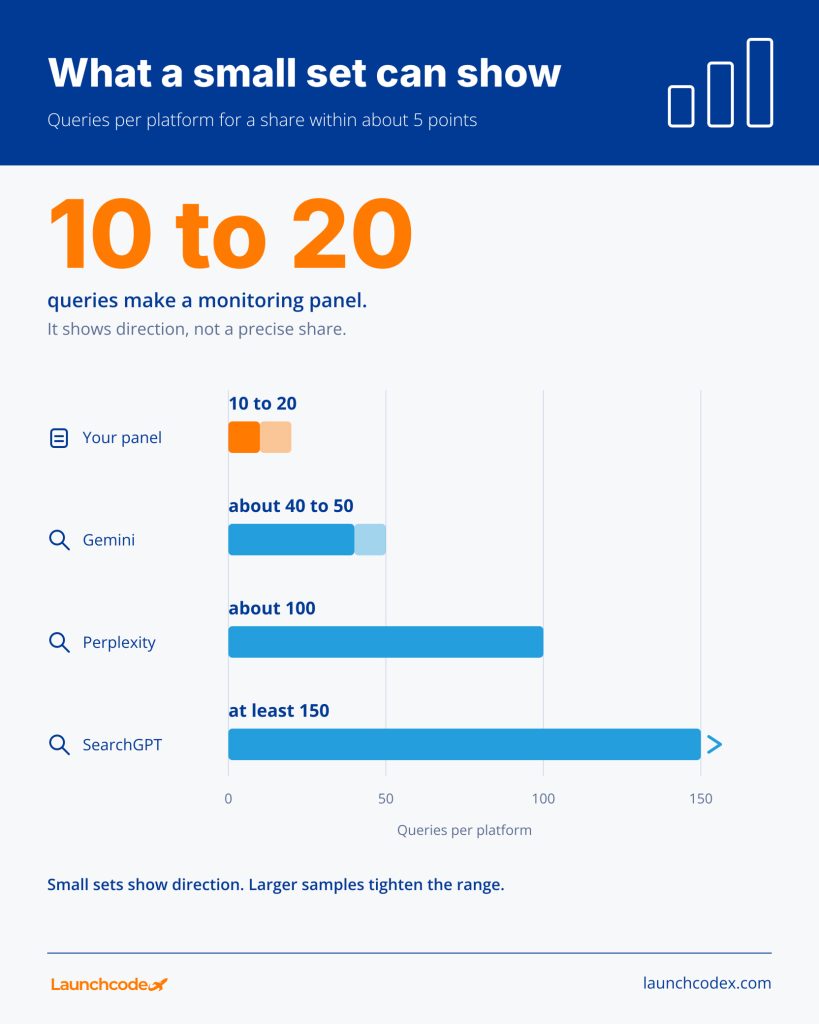
A set of 10 to 20 queries shows direction for your priority pages. It does not give a tight estimate of your visibility share. Sielinski’s preprint estimates that a share within about 5 points takes about 40 to 50 queries per platform on Gemini, about 100 on Perplexity and at least 150 on SearchGPT. Treat a small set as a monitoring panel.
SparkToro goes further on runs. It advises running each prompt at least 60 to 100 times and using dozens to hundreds of prompts, then reporting visibility as the share of responses that include the brand. The author also says the right number of runs is still an open question. The Launchcodex method asks for far fewer runs, and the trade off is plain. More runs give a tighter number. A small panel costs less and fits a manual workflow. Use the panel when you need direction on pages that matter. Move to a larger sample or a tool when you need a precise share.
Louise Linehan at Ahrefs frames the shift this way: “Think of AI tracking less like rank tracking and more like polling.” Ahrefs sells Brand Radar and argues for tracking aggregates across thousands of prompts, so check that advice against your budget.
SparkToro gives a clear example. A cancer hospital appeared in 69 of 71 ChatGPT responses to one prompt (97%) but was the first mention in only 25 of them. Presence was far steadier than position. Rand Fishkin, co-founder of SparkToro, put it bluntly: “any tool that gives a ‘ranking position in AI’ is full of baloney.” Log whether you appear, not where.
Google Search Console shows your impressions in AI Overviews and AI Mode by date, page, country and device. Bing Webmaster Tools counts citations in Microsoft Copilot and Bing AI summaries. Neither report covers ChatGPT, and neither replaces repeat checks. Use them as free starting points and keep manual checks for the platforms they miss.
| Report | Platforms covered | What it shows | What it leaves out |
|---|---|---|---|
| Search Console generative AI performance report | Google AI Overviews and AI Mode | Organic impressions by date, page, country and device | ChatGPT, Perplexity and prompt level detail |
| Bing Webmaster Tools AI Performance | Microsoft Copilot, AI summaries in Bing and select partner integrations | Total citations, average cited pages per day, page level citation counts, visibility over time and grounding queries | ChatGPT. The announcement mentions no click data or user prompts |
| Google Analytics 4 referral reports | AI domains that send visits | Visits from sources such as chatgpt.com | Citations that sent no visit |
Google’s Search Console help page says the report excludes Search Labs experiments. Google states that it rolled these insights out to all websites worldwide as of August 31, 2026. Search Engine Land reports that the report does not include click data. Microsoft’s Bing Webmaster Blog introduced the Bing report as a public preview in February 2026. Grounding queries are a sample of the phrases the AI used to retrieve content.
In October 2026, OpenAI appeared to drop the utm_source=chatgpt.com tag from ChatGPT links around the GPT-6 release, so analytics tools logged those visits as direct traffic. Search Engine Roundtable reported that Cedric Huesler of Adobe flagged the change in a personal LinkedIn post. He later said it was a bug, and the tag returned the next day. A drop in tagged visits does not prove a drop in citations. Check your privacy and consent rules before you add tracking parameters to links.
Start by hand if your set holds 10 to 20 queries. A paid tool fits when you need larger samples or more frequent rounds. Either way, ask how many runs sit behind each number. A tool that shows one run per query gives you the same sample of one in a dashboard.
Paid options named in the sources include Ahrefs Brand Radar, Semrush’s AI visibility tools, SE Ranking’s AI Search Toolkit and Omnia. These vendors sell the products, so judge their claims by the questions below.
Ask any vendor:
No formal standard exists for measuring AI answers, so these questions are your test.
Report AI citations in their own view, apart from rankings. Show the platform, the query count and the run count beside every number, and report the trend across scheduled rounds. Sielinski’s preprint states the rule: “citation visibility must be reported with uncertainty estimates.” A small panel cannot give a tight range, so say so in the report.
Rankings and AI citations are separate measures, and our post on whether Google rankings predict AI citations covers that question in depth.
Use these rules in every report:
You can start this week. Pick 10 to 20 queries and name a target page for each. Run every query at least twice on each platform, with extra runs on ChatGPT. Log whether an answer appeared, whether your page was cited and the conditions of the check. Repeat the round on a schedule and judge the trend.
The Launchcodex study shows why this matters. ChatGPT matched its own outcome on 64% of queries, so one ChatGPT check can differ from the next. Download the full ebook, What gets cited in AI search: the 2026 Launchcodex AI visibility study, to see the method, the data and the limits behind this guide. If you want a team to run citation tracking across platforms for you, Launchcodex offers that service.
Run each query at least twice per round on every platform, with more runs on ChatGPT. It matched its own outcome on 64% of queries in the Launchcodex study. SparkToro advises at least 60 to 100 runs per prompt for tighter estimates, so treat a small panel as directional.
The same input can produce different outputs. Thinking Machines Lab traced the variation in one open model mainly to batch size changes under server load. ChatGPT’s setup is not public, so the exact cause there is unknown.
It shows impressions in AI Overviews and AI Mode by date, page, country and device. It does not cover ChatGPT or Perplexity, and it does not show which prompts triggered an impression.
The platform either answered both times or declined both times. The study did not compare answer wording or cited sources between runs.
No. It shows visits from AI domains, not citations. Referral tags can also disappear, as the October 2026 ChatGPT UTM change showed.


Real stories from the people we’ve partnered with to modernize and grow their marketing.